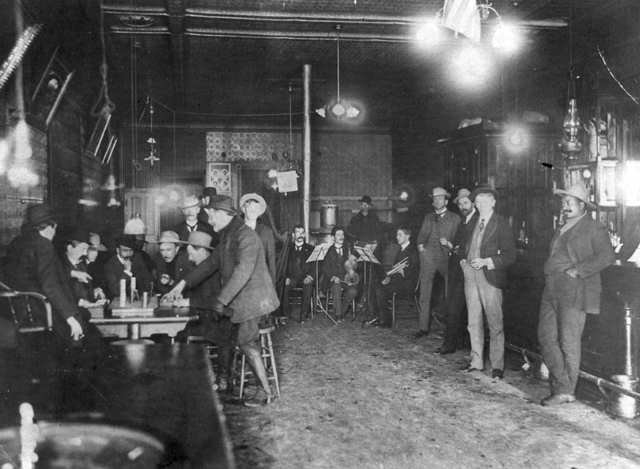
Here's a glimpse of an actual musical group in the Old West - harp, violin, and cornet. This is Telluride, CO in 1891, about a decade after the end of the great cattle drives, which were not in this area anyway. This is the commercial gold country, and the reason for this photograph (and others) is because Telluride was the location of one of the very earliest AC generation electric power systems, which was installed to power a stamp mill at the Gold King mine.
en.wikipedia.org/wiki/Ames_Hyd...ing_Plant
I got this photo from the very interesting small book "Jazz on the Barbary Coast."
Edited by - DougD on 08/23/2026 15:42:55


Great photo! I'd love to have a peek at their set list ... !
There may have been a time when a violinist and a fiddler were clearly different but in this day and age I see a Lot of classically trained violinist playing as great fiddlers........Times, they are a-changin'.......
quote:
Originally posted by TuneWeaverThere may have been a time when a violinist and a fiddler were clearly different but in this day and age I see a Lot of classically trained violinist playing as great fiddlers........Times, they are a-changin'.......
Possibly fewer players going the other way, although there are some. Times are a-changin.
I have a problem though with some of the seriously good players in bluegrass going off on indulgent seeming tangents, making albums of faux jazz and classical style music. It might be that having good chops isn't enough if you're not actually steeped in the style you're emulating, especially if it sounds a lot like like jam band music. Or maybe that's just me being overly-opinionated again.
Edited by - Brian Wood on 08/23/2026 16:52:00
Harp, violin, cornet is such an interesting combo! I also wonder what they sounded like, and what they were playing…jazz, I guess?!
quote:
Originally posted by Brian Woodquote:
Originally posted by TuneWeaverThere may have been a time when a violinist and a fiddler were clearly different but in this day and age I see a Lot of classically trained violinist playing as great fiddlers........Times, they are a-changin'.......
Possibly fewer players going the other way, although there are some. Times are a-changin.
I have a problem though with some of the seriously good players in bluegrass going off on indulgent seeming tangents, making albums of faux jazz and classical style music. It might be that having good chops isn't enough if you're not actually steeped in the style you're emulating, especially if it sounds a lot like like jam band music. Or maybe that's just me being overly-opinionated again.
I don't know.. Now and then on Youtube I see clearly classically trained violinists trying to show people how to play a fiddle.. Somehow it just never seems to work... There ARE exceptions.. Deb Shebish is a very accomplished musician who can classical violin, fiddle with the best, sit in an Irish jam and play bluegrass... all very well...
quote:
Originally posted by DougDHere's a glimpse of an actual musical group in the Old West - harp, violin, and cornet. This is Telluride, CO in 1891, about a decade after the end of the great cattle drives, which were not in this area anyway. This is the commercial gold country, and the reason for this photograph (and others) is because Telluride was the location of one of the very earliest AC generation electric power systems, which was installed to power a stamp mill at the Gold King mine.
en.wikipedia.org/wiki/Ames_Hyd...ing_Plant
I got this photo from the very interesting small book "Jazz on the Barbary Coast."
Yes, not exactly a scene from the heart of the Wild West at the height of the era, but it does show that the West wasn't as untamed at the end of the 19th century as is often supposed.
The expansion of rail travel made it relatively easy for people to move around and for things that were popular in cities to make their way out into smaller towns. Keep in mind that at this time, Dvorak was visiting America and writing his New World Symphony.
In addition to "classical" posture, the musicians are dressed up and reading music from stands.
quote:
Originally posted by The Violin Beautifulquote:
Originally posted by DougDHere's a glimpse of an actual musical group in the Old West - harp, violin, and cornet. This is Telluride, CO in 1891, about a decade after the end of the great cattle drives, which were not in this area anyway. This is the commercial gold country, and the reason for this photograph (and others) is because Telluride was the location of one of the very earliest AC generation electric power systems, which was installed to power a stamp mill at the Gold King mine.
en.wikipedia.org/wiki/Ames_Hyd...ing_Plant
I got this photo from the very interesting small book "Jazz on the Barbary Coast."Yes, not exactly a scene from the heart of the Wild West at the height of the era, but it does show that the West wasn't as untamed at the end of the 19th century as is often supposed.
The expansion of rail travel made it relatively easy for people to move around and for things that were popular in cities to make their way out into smaller towns. Keep in mind that at this time, Dvorak was visiting America and writing his New World Symphony.
In addition to "classical" posture, the musicians are dressed up and reading music from stands.
Which one is doing the transposing? The strings or the horn. Looking at the seating arrangement it wouldn't be a surprise if a fourth member to left hidden behind the crowd of Dvorak lovers existed.
"I don't know.. Now and then on Youtube I see clearly classically trained violinists trying to show people how to play a fiddle.. Somehow it just never seems to work... There ARE exceptions.."
Couldn't agree more. I get the impression that 'times are tough, so let me try and pick up a few extra sheckels teaching newbies how to play these laughably simple tunes - they'll never know the difference.' No investment in truly learning the style and feeling of the genre. Reels, jigs, hornpipes played as dry as 5 day old toast, vibrato stuck in at every opportunity. Can't say i've ever seen the reverse - a player who is clearly a fiddler trying to teach or give tips on classical playing. And Yah, a select few make the crossover successfully, Uncle Itzack and O'Connor come to mind, but few others. Hey by all means explore other genres, but to set oneself up as a teacher in those others; almost seems kinda desperate.
quote:
Originally posted by wrench13"I don't know.. Now and then on Youtube I see clearly classically trained violinists trying to show people how to play a fiddle.. Somehow it just never seems to work... There ARE exceptions.."
Couldn't agree more. I get the impression that 'times are tough, so let me try and pick up a few extra sheckels teaching newbies how to play these laughably simple tunes - they'll never know the difference.' No investment in truly learning the style and feeling of the genre. Reels, jigs, hornpipes played as dry as 5 day old toast, vibrato stuck in at every opportunity. Can't say i've ever seen the reverse - a player who is clearly a fiddler trying to teach or give tips on classical playing. And Yah, a select few make the crossover successfully, Uncle Itzack and O'Connor come to mind, but few others. Hey by all means explore other genres, but to set oneself up as a teacher in those others; almost seems kinda desperate.
quote:
Originally posted by wrench13quote:
Originally posted by wrench13"I don't know.. Now and then on Youtube I see clearly classically trained violinists trying to show people how to play a fiddle.. Somehow it just never seems to work... There ARE exceptions.."
Couldn't agree more. I get the impression that 'times are tough, so let me try and pick up a few extra sheckels teaching newbies how to play these laughably simple tunes - they'll never know the difference.' No investment in truly learning the style and feeling of the genre. Reels, jigs, hornpipes played as dry as 5 day old toast, vibrato stuck in at every opportunity. Can't say i've ever seen the reverse - a player who is clearly a fiddler trying to teach or give tips on classical playing. And Yah, a select few make the crossover successfully, Uncle Itzack and O'Connor come to mind, but few others. Hey by all means explore other genres, but to set oneself up as a teacher in those others; almost seems kinda desperate.
Maybe these people don't realize that they fall short on the necessary skills to play a proper Folk style and underestimate what's required. A lot of classically oriented musicians have a sense that their type of refined music is higher up the food chain and therefore Folk style is simple in its nature so they can play it by default. They simply don't understand that what they are doing is inadequate but unfortunately there are people from a base of no knowledge keen to learn and eager to follow their direction. I suppose it takes all sorts to keep this earth turning.
...fake!!! Not a one is chewin on straw, or bare footed. I don't see any tabakee runnin down the chin. And where is all the white powder stuff on the top of the fiddles - there all nice and shiny.
If you're gonna put on a show - try to make it real.
quote:
Originally posted by tonyelder...fake!!! Not a one is chewin on straw, or bare footed. I don't see any tabakee runnin down the chin. And where is all the white powder stuff on the top of the fiddles - there all nice and shiny.
If you're gonna put on a show - try to make it real.
Yep, Tony 100% fake - it was the best ChatGBT could be in short notice ! But illustrates the point well.
"almost seems kinda desperate" ... I wouldn't hold being "kinda desperate" against anyone these days - or any days, I suppose. I don't know about anyone else, but I've been kinda desperate in my time - yes, even such a splendid specimen of the human animal as I ... !
That is a pithy quote and I'm not sure anyone has responded to the points it makes... especially...
1. ways in which each approaches the instrument and the music—
2. ways in which each learns the instrument and repertoire—
approach/learning is a big subject.
I think fiddlers I have liked and talked to and learned from approach/ed the instrument and repertoire with a reverence, but a playful one. Sometimes systematic in learning, but again...playful...child like...sometimes supernatural. Definitely informal... I was advertising lessons several years back and a friend who is classically trained asked me about my "pedagogy"... I had to go look up the definition. haha.
I happened to be reading some of the late poet John O'Donohue's writing before seeing this post...
What you encounter, recognize or discover depends to a large degree on the quality of your approach. Many of the ancient cultures practiced careful rituals of approach… When we approach with reverence, great things decide to approach us. Our real life comes to the surface and its light awakens the concealed beauty in things. When we walk on the earth with reverence, beauty will decide to trust us. The rushed heart and arrogant mind lack the gentleness and patience to enter that embrace. –John O’Donohue
Edited by - ShawnCraver on 08/24/2026 08:53:26
Shawn, I think that is such a beautiful quote. I am saving it!
quote:
Originally posted by wrench13quote:
Originally posted by wrench13"I don't know.. Now and then on Youtube I see clearly classically trained violinists trying to show people how to play a fiddle.. Somehow it just never seems to work... There ARE exceptions.."
Couldn't agree more. I get the impression that 'times are tough, so let me try and pick up a few extra sheckels teaching newbies how to play these laughably simple tunes - they'll never know the difference.' No investment in truly learning the style and feeling of the genre. Reels, jigs, hornpipes played as dry as 5 day old toast, vibrato stuck in at every opportunity. Can't say i've ever seen the reverse - a player who is clearly a fiddler trying to teach or give tips on classical playing. And Yah, a select few make the crossover successfully, Uncle Itzack and O'Connor come to mind, but few others. Hey by all means explore other genres, but to set oneself up as a teacher in those others; almost seems kinda desperate.
I don't think there are many violinists who teach fiddle to make more money. It doesn't make financial sense and there is nowhere near as much demand.
A friend of mine (not a classically trained player) was teaching fiddle at a local music studio a few years ago. The studio began pushing him to get Suzuki certification because there wasn't enough demand for fiddling and they wanted to be able to advertise that their fiddle instructor had a Suzuki certificate to attract more players, as well as giving a reason to charge more for lessons.
The fiddler I studied with had an active studio of about 40 students when I was growing up, but he also ran a music store, sold music, did basic repairs, rented a few fiddles, taught at workshops, and played professional gigs on weekends. As good as he was and as many things as he did to bring in money, it was always a struggle.
Most of the "classically trained players" making YouTubes are doing so because they chose to devote their careers to fiddling and sharing it through teaching and they have the financial freedom to do so or they weren't trained well enough to teach classical students in a more conventional setting. No one who's really that good is devoting enough time and effort to produce excellent program material without being remunerated.
I think something that's missing from this discussion that has had a huge impact on all types of music is the way learning an instrument has changed in the last 40 years or so. The resources available in learning anything are much broader than simply learning to be a classical player or learning to be a folk fiddler. There are all sorts of teachers with varying approaches, there are internet resources such as YouTube and online transcriptions, and there are even schools for old-time and bluegrass at the post-secondary level. Also, I think all of us have grown up listening to a far broader range of music than in the past. When I was young it was basically classical, rock, pop, folk, jazz, and country. Now there's exposure to the entire world's music plus all the local cultural stuff like Tex-Mex or polkas which were unheard of in my town. Local school music teachers around here instruct in both the classical genre and introduce fiddle tunes. I think the separation between classical and folk fiddling is a dead argument. That is not to say that the argument is ever going to go fully away and all of us are probably going to keep our old viewpoints, but to the young this stuff is not even on the radar. Kids today want to play what they want to play and my observation is they can move from old-time, bluegrass, Irish, Cape Breton, Metis, etc. to classical or jazz or rock and have no problem worrying about authenticity. (whatever that is). Whether or not they sound fully in the style that you think is correct is a personal judgement you can make but I doubt if they will care much. Some of them are going to sound great to you and others not so much. Seems like that applies personally to all of us as we listen to any music genre.
quote:
Originally posted by pmiller510I think something that's missing from this discussion that has had a huge impact on all types of music is the way learning an instrument has changed in the last 40 years or so. The resources available in learning anything are much broader than simply learning to be a classical player or learning to be a folk fiddler. There are all sorts of teachers with varying approaches, there are internet resources such as YouTube and online transcriptions, and there are even schools for old-time and bluegrass at the post-secondary level. Also, I think all of us have grown up listening to a far broader range of music than in the past. When I was young it was basically classical, rock, pop, folk, jazz, and country. Now there's exposure to the entire world's music plus all the local cultural stuff like Tex-Mex or polkas which were unheard of in my town. Local school music teachers around here instruct in both the classical genre and introduce fiddle tunes. I think the separation between classical and folk fiddling is a dead argument. That is not to say that the argument is ever going to go fully away and all of us are probably going to keep our old viewpoints, but to the young this stuff is not even on the radar. Kids today want to play what they want to play and my observation is they can move from old-time, bluegrass, Irish, Cape Breton, Metis, etc. to classical or jazz or rock and have no problem worrying about authenticity. (whatever that is). Whether or not they sound fully in the style that you think is correct is a personal judgement you can make but I doubt if they will care much. Some of them are going to sound great to you and others not so much. Seems like that applies personally to all of us as we listen to any music genre.
I think you make some good points, although I disagree with a few things. I do agree that it's easier to find obscure music now than it used to be, but I think it's important to keep in mind that people, especially younger listeners, are primarily seeking out music that was being made during the time you say there wasn't as much variety (or possibly before). Local radio stations had less variety in some ways, but that was where underground radio came to life with legends like Wolfman Jack and Weasel.
I agree that kids play want they want to play, however I think the current generation are doing something that older generations didn't do so much: seeking authenticity. Middle aged adults nowadays resented the thought of being told how to play when they were young, and even a lot of professional musicians leaned into the counter-culture ethos even if their playing was not that wild. In the classical world, Nigel Kennedy was playing in concert halls in punk rock outfits and wearing earrings and Lara St. John and a few other players were doing photo shoots for their album covers that looked more like swimsuit edition pictures. In fiddle music, there was a move to add new sounds and techniques to take things to a different place. Playing electric violins started to be more popular and an aging "rocker" began aggressively marketing new electric violins copying electric guitar designs and rock concert programs to school children and orchestras. Fiddlers like Eileen Ivers openly embraced a merge with rock and more commercial uses of Celtic music. A famous fiddler began doing commercials for a violin outfit at a violin shop. Mark O'Connor came out with his Heroes album and then got classical players interested in Appalachia with his Appalachian Journey recording.
But a good deal of that enthusiasm for something new and different didn't carry over. Younger players today are more and more voracious for information and seek out the original forms or the authentic versions. If a tune is played, people who like it tend to look for its back story and the original versions so they can at least be aware of "how it should be."
I think I'd agree that the judgment of the average fiddler is completely uninteresting to many younger players, but I would counter that by saying that they care very much about what the "authentic" or authoritative sources say. In rare cases this is even taken beyond reason when the intellectually thirsty cannot find source material and instead attempt to pscyhoanalyze their heroes to unlock hidden meaning.
It's far more common to hear young people say "They just don't play that way anymore!" than "I wish they'd stop playing the old way." Touring musicians keep burning out because fans want to hear their favorite music, not their new projects. Older people who genuinely know the history of various forms of music are getting a lot of traction online by catering to the thirst for information--about the classics. The last documentary on the Beatles during their final days as a band is far more interesting to a lot of people than listening to anything the individual members have done since their split.
At music stores, the demand for antiqued guitars has taken off. Kids want a guitar that looks like one a hero played or might have played back before they were even born. Some models are even painstaking copies of specific models with the same wear and similar setup aesthetics. The demand for antiqued violins had already existed for centuries, but this demand is different. A friend of mine recently showed off an amp he bought that's a faithful clone of a legendary amp. To him, it's the best way to recapture the original if you can't buy a real one and it takes pride of place in his studio.
You're most likely correct that no one will change their mind about these topics. But comments don't have to be solely directed at interlocutors. A public forum allows many to read and consider privately. Even Socrates didn't win everyone over despite ably refuting every point of argument and exposing bad ideas.
Quote from "The Violin Beautiful."
"Younger players today are more and more voracious for information and seek out the original forms or the authentic versions. If a tune is played, people who like it tend to look for its back story and the original versions so they can at least be aware of "how it should be."
Your comments on young players are not what I have encountered in my area. Almost all new players, young and older, seem to have heard fiddle music on stage or at festivals or at a local session and decided they want to play it. They start attending a session and learn from it and that is as deep as it ever goes. They do not listen to the old guys and rarely even know the names. This is not to say that some haven't pursued it more seriously as you describe going back in time and listening to the original sources and seriously study the style they want to learn, but they are rare in my experience.
A lot of the younger players I meet astound me completely with their depth of interest and knowledge. The classical players I meet seem to know more repertoire than almost any kid I knew in my time and they know every symphonic work and can recognize it from a few seconds of listening. I’ve watched kids quiz each other for fun. I see a lot of Celtic players who are interested in tunes and tune history. They also seem to have a depth of knowledge and curiosity that’s quite impressive. They also show a desire to learn multiple genres within the Celtic umbrella and can transition between them easily at sessions.
Bluegrass musicians are a little different, because there are the players who follow in the footsteps of Mark O’Connor and embrace the modern, jazzier, more chordally complex version of the genre. Then there are the players who are more interested in the foundational form of bluegrass, with more of a focus on recapturing the spirit of the original sound. There are also players who play bluegrass licks for country bands, which are a very different genre.
Old Time is different again because the young players are so hard to find. Every so often a Suzuki student will get curious about a jam because of an invitation or having had a little experience with the O’Connor method from a teacher who uses it as a supplement. Those kids show a lot of promise but they tend to get bored or burn out very quickly. The few that I meet that are more dedicated to playing it are quite knowledgeable and have a concentrated focus. For example, I met a player at Galax who was completely obsessed with Clark Kessinger, even trying to learn about his bow to see if he should buy one of the same weight to emulate his bowing style. He was a sponge for any tidbit of information he could get from one of the players who had personally known Kessinger, and he said something along the lines of “I don’t see any point in listening to modern players. None of them can play like Clark Kessinger. I’d be much happier to be an imperfect copy of him than to be whatever it is that players are nowadays.”
As I was saying before, I think there is a focus on authenticity, authority, or both. A lot of Old Time players have learned from Bruce Molsky (much to the chagrin of members here), and I think the loyalty to him comes from his authoritativeness as a fiddler.
Rich so you're saying that autistic like delving into minutia about a fiddle tune is common? Not saying some fiddlers are not a bit on the spectrum ( i know I am), but I've rarely encountered fiddlers with that deep an interest in that, young or old.
And what's wrong with learning from Bruce Molsky??
I still remember when I started playing fiddle. Was a rock bassist, folky type 12 string guitar player. I happened to see Dave Bromberg at Central Park, in 1972, with his big band- horn section, full rock instruments and 3 (!) fiddlers; Matt Glasser, Evan Stover and Jay Unger. The skies opened up, the ground fell out from under me and I knew, in my deepest being, I wanted to make that sound some day. Still trying!
quote:
Originally posted by The Violin BeautifulA lot of Old Time players have learned from Bruce Molsky (much to the chagrin of members here)
I don't know what you mean.
wrench13 - That big band David Bromberg had was great!
I've never heard anyone here complain about people learning from Bruce Molsky either.
quote:
Originally posted by Brian Woodquote:
Originally posted by The Violin BeautifulA lot of Old Time players have learned from Bruce Molsky (much to the chagrin of members here)
I don't know what you mean.
There have been numerous complaints on this forum about Bruce Molsky's "acolytes" or about his teaching turning everyone into clones of his style, not real Old Time players. I think that's ridiculous, and I've never heard it elsewhere.
Terms of Use | Privacy Policy | Privacy Consent (EU/GDPR Only)
Copyright 2026 Fiddle Hangout. All Rights Reserved.