


There are many humorous comments on the differences between the two, but while rewatching the excellent film "New England Fiddles" at the Folkstreams website, I came across this footnote in the transcript:
"Although a violin and a fiddle are identical instruments, a violinist and a fiddler are opposites. The ways in which each approaches the instrument and the music—especially the ways in which each learns the instrument and repertoire—are so radically different that there is little common ground between them."
This seems quite true to me, although maybe less so today. What do you think?

I always approach my violin from the right. My fiddle from the left.

I guess it depends on who you ask. I think within those "traditions" - that would be a very true statement. In contemporary times - maybe less so, but still true in general.
BUT - I'm not 'the expert". 
Edited by - tonyelder on 08/22/2026 06:53:24
I think that’s nonsense. Fiddlers and classical players have played together and shared music for centuries.
Many fiddlers approach the violin by playing on their own instead of taking lessons as playing by ear instead of learning to read, but those are both roads that are supposed to lead to the same place: proficiency in playing. That the roads end up taking detours for some players is their own doing, not a feature of the genre.
There seems to be an awful lot of propaganda encouraging fiddlers to think that they’re special snowflakes and somehow have a relationship with the violin that’s unique to them and no one else.
quote:
Originally posted by The Violin BeautifulI think that’s nonsense. Fiddlers and classical players have played together and shared music for centuries.
Many fiddlers approach the violin by playing on their own instead of taking lessons as playing by ear instead of learning to read, but those are both roads that are supposed to lead to the same place: proficiency in playing. That the roads end up taking detours for some players is their own doing, not a feature of the genre.
There seems to be an awful lot of propaganda encouraging fiddlers to think that they’re special snowflakes and somehow have a relationship with the violin that’s unique to them and no one else.
...and there is "the expert". Right on cue. 
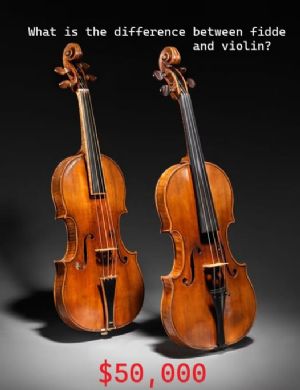
The only difference between a fiddle and a violin is: you carry a violin in a fancy case and you carry a fiddle in an old tow sack.. LOL
Edited by - wrench13 on 08/22/2026 10:31:29
quote:
Originally posted by wrench13
I'll pay the $50,000 but which one are you going to give me?
Well, it didn't take long for the corny jokes to surface. I meant this as a serious comment, but maybe I took it out of context. It was a footnote to a conversation between fiddler Jerry Robichaud and the young Maranchie sisters on the difference between fiddle and "violin" approach to playing and technique.
This conversation is part of the excellent short film "New England Fiddles"
folkstreams.net/films/new-england-fiddles
I recommend it, but if you don't have time to watch, you can read the transcript at the same site. I grew up in southern New England, and met, or at least saw, some of the players in the film 15 years earlier (the film is from 1983).
tonyelder - Excellent use of quotation marks!
Interesting little film Doug. I can relate sort of; in my family, after dinner, the boys and I would go downstairs to the studio and play all sorts of music - fiddle stuff, classic rock, some swing, a good mix. It was our way. AFA fidde vs violin approach, well you know my answer to that. Never read a note and still can't. Never stopped our enjoyment and pursuit of fiddle music.
When anyone asks me what’s the difference between fiddle and violin it irritates me for some reason. All I see is the vast grey area in between. Grey is actually a bad choice of word because there’s an enormous amount depth and color from one end to the other. It’s a bit like two bookmarks that can easily be swapped over and everything in the middle can stay the same.
While there may be no difference in the instruments used for violin playing and fiddle playing, sometimes the setup is a bit different. While my G and E strings have bridge heights that are the same as classical, I then carve a bit out so my bridge is a bit less curved. This helps me when I cross three or four strings in tunes I play.
It’s ludicrous to imagine that there’s nothing in common between two styles played by the same instrument. The arguments that suggest there is a difference conveniently omit the fact that fiddlers buy instruments that were made with classical players in mind.
Some fiddlers recut their bridges or request a flatter curve, but just as many (if not more) use bridges with standard curves. Fiddlers often use steel strings, but that’s part of the propaganda (don’t waste your money on those fancy strangs!). Before the mid-20th century, everyone—fiddlers included—was using gut. Fiddle tunes were written and originally played on gut just like baroque music. Even the bow used was one of the many baroque styles for a good while, until classical playing changed the design and fiddlers again followed suit.
Throughout time fiddlers have copied violinists in many ways. The chinrest was adopted by fiddlers even if they didn’t play with the fiddle under the chin. And in recent history, fiddlers have adopted the shoulder rest, carbon fiber bows, orchestral strings, tuners, and metronomes that came from the classical world. All the most popular “fiddle” string sets nowadays were designed for orchestra players originally and some are even still used by them.
There have always been players who played in both styles and had no issue doing so. I enjoyed reading the story of an 18th century slave player who was hired by an opera after showing promise, then taken captive and forced to play as a fiddler on a navy ship for some time before being allowed to come home and make a career as a composer, teacher, and concert player. While Patrick Henry was not as proficient in classical playing as Thomas Jefferson, the two played violin and fiddle music together frequently in their youth before they fell out.
Mark O’Connor’s recordings with classical players were made to show just how little distance there was between the genres. Bluegrass musicians play Bach all the time now because Chris Thile made it cool to play the Sonatas and Partitas on non-violin instruments. As I recounted a little while ago, I attended an Old Time dance where the fiddler played some Biber in between tunes.
A number of the members here play both fiddle and violin styles. Either they’re not valid as players of one style or they’re proof that there’s no chasm between styles.
In some respects the difference between fiddle and violin music is fiddle music makes you want to dance and move, violin music makes you want to listen. This is not to say that there are no violin pieces, like glorious waltzes, that do not inspire dancing or fiddle tunes that are lovely melodies, worth just enjoying the cascade of notes. But if a partial description is needed, this has to be considered, though I don't understand the need to slice and dice up things, packing them into neat boxes.
quote:
Originally posted by wrench13In some respects the difference between fiddle and violin music is fiddle music makes you want to dance and move, violin music makes you want to listen. This is not to say that there are no violin pieces, like glorious waltzes, that do not inspire dancing or fiddle tunes that are lovely melodies, worth just enjoying the cascade of notes. But if a partial description is needed, this has to be considered, though I don't understand the need to slice and dice up things, packing them into neat boxes.
While there is a lot of violin repertoire that's less focused on dance, I don't think that distinction really applies between the styles. So much of the violin repertoire is written in dance forms. Solo Bach, which is arguably the greatest violin literature ever written, is an assortment of dances. Modern players sometimes forget this and wander off into strange places, but as the great Ida Haendel so beautifully put it, Bach has a heartbeat running through it. You can't lose that heartbeat if you want to play it well. A heartbeat can modulate, but it remains constant nonetheless.
Old Time used to focus on dancing very heavily as it was primarily played at dances, but that's not the case anymore. Now it's more often played at jams where no dancing occurs and it loses its rhythmic pulse easily when players lose connection with the dance. But other forms of fiddling aren't necessarily dance-oriented anymore, either. I think dancing to folk music has in general lost appeal over time to younger generations.
I do think dance ought to be included in descriptions of Old Time, but I just don't agree that it is a critical distinction from classical playing.

quote:
Originally posted by wrench13
That cowboy with the fiddle looks too clean cut and disaplined. He must have been classically trained.
My opinion is known I guess. Here in Europe I explain that I play the fiddle, but call the instrument myself a violin , like when I say I have to clean my violin (well that's what it is right) I never use the word fiddle.
I don't want to be associated with elite folk violinists who first had a very classic training based on reading the notes and then dove into folk.
I'm not a folk violinist. Regardless of my level; I AM a TRUE fiddler :p They can keep their snobbery approach to themselves :p
EDIT: something gives me the impression that on the other side of the ocean, violinists have more freedom and there exists a more modern approach of reading notes and learning an instrument with less pressure and social hierarchy.
Edited by - Quincy on 08/23/2026 09:15:27
quote:
Originally posted by martyjoequote:
Originally posted by wrench13
That cowboy with the fiddle looks too clean cut and disaplined. He must have been classically trained.
Funny, there's no chinrest there either, so it's too early for the American West. The chinrest was invented in 1802 and was globally popular almost immediately.
Cowboys played some fiddle music, but it wasn't the Old Time music that was recorded in the 1920s and 1930s.
There are a lot of depictions that lead the viewer to believe that everyone was listening to Ragtime, but that music wasn't even written until the days of the West were already coming to an end. Stephen Foster was popular almost universally then.
quote:
Originally posted by QuincyMy opinion is known I guess. Here in Europe I explain that I play the fiddle, but call the instrument myself a violin , like when I say I have to clean my violin (well that's what it is right) I never use the word fiddle.
I don't want to be associated with elite folk violinists who first had a very classic training based on reading the notes and then dove into folk.
I'm not a folk violinist. Regardless of my level; I AM a TRUE fiddler :p They can keep their snobbery approach to themselves :pEDIT: something gives me the impression that on the other side of the ocean, violinists have more freedom and there exists a more modern approach of reading notes and learning an instrument with less pressure and social hierarchy.
It's easy for me because I play Cello and I play a viola but I always make the distinction that it's a Tenor Viola (GDAE), as opposed to Alto (CGDA). The funny thing is I've just strung up an identical sized (16.25") viola to regular Treble tuning (GDAE). What am I going to call that? Probably just fiddle. I could introduce myself as a cellist a violist and a fiddlist. 
Edited by - martyjoe on 08/23/2026 10:06:38
quote:
Originally posted by The Violin Beautifulquote:
Originally posted by martyjoequote:
Originally posted by wrench13
That cowboy with the fiddle looks too clean cut and disaplined. He must have been classically trained.
Funny, there's no chinrest there either, so it's too early for the American West. The chinrest was invented in 1802 and was globally popular almost immediately.
Cowboys played some fiddle music, but it wasn't the Old Time music that was recorded in the 1920s and 1930s.
There are a lot of depictions that lead the viewer to believe that everyone was listening to Ragtime, but that music wasn't even written until the days of the West were already coming to an end. Stephen Foster was popular almost universally then.
Funny thing that apparatus holding the pot over the fire looks exactly like the one I bought at Walmart 3 weeks ago. And is that a Swiss Army knife he has in his back pocket?
Edited by - martyjoe on 08/23/2026 10:58:36
Haha fiddlist , suits you well , martyjoe. I adore the sound of viola and cello! Groundhogpeggy has this very beautiful version of Drunken hiccups on viola in calico tuning on her channel. I now wonder if that's a tenor or an alto.
Do you crosstune for the viola or cello martyjoe? Is it possible for a cello as well?
I like to keep it simple: I've always just wanted to sound like those old guys I used to hear when I was young - and I've never really wanted to sound like those other guys.
My current fiddle heroine has a degree from the Yale Music Conservatory, and recently released an album with top Irish Trad guitarist John Doyle.. I guess he’s not holding the classical training against her :-)
Anyway I don’t really mentally ‘box’ people, I feel like your music is your music…no matter how you learned to play or where it came from, it’s about finding who you are as a musician. In that sense I think everybody’s journey is similar…
PS And yes people used to dance to classical music - it’s not just for listening! minuets, waltzes, gavottes, allemandes, etc were danced to…
Edited by - NCnotes on 08/23/2026 12:51:44
quote:
Originally posted by martyjoequote:
Originally posted by The Violin Beautifulquote:
Originally posted by martyjoequote:
Originally posted by wrench13
That cowboy with the fiddle looks too clean cut and disaplined. He must have been classically trained.
Funny, there's no chinrest there either, so it's too early for the American West. The chinrest was invented in 1802 and was globally popular almost immediately.
Cowboys played some fiddle music, but it wasn't the Old Time music that was recorded in the 1920s and 1930s.
There are a lot of depictions that lead the viewer to believe that everyone was listening to Ragtime, but that music wasn't even written until the days of the West were already coming to an end. Stephen Foster was popular almost universally then.
Funny thing that apparatus holding the pot over the fire looks exactly like the one I bought at Walmart 3 weeks ago. And is that a Swiss Army knife he has in his back pocket?
...and why is that guy poking coals with a bow?
Coals? Those are the remains of that feller that tried playing Orange Blossom Special ... !
Terms of Use | Privacy Policy | Privacy Consent (EU/GDPR Only)
Copyright 2026 Fiddle Hangout. All Rights Reserved.


