


I decided yesterday that I am going to have an attempt at making a fiddle quartet. 2 violins, 1 viola and a cello. In the last few of years I have been taking a keen interest in the history of the violin ( tenor violin in particular). One maker that has intrigued me is Frenchman Felix Savart. He came up with his acclaimed rational violin. Proving that there can be an alternative to the conventional form. I will also be trying something new and even more unconventional. My 4 fiddles will be ugly, ugly, ugly and uglier! but I’m hoping that they sound good. They will follow the line of the style of guitar I invented over the Christmas break! So they will have a bolted cantilever system that should replace the sound post (it allows for no bracing on the guitar). My plan A is to have them complete for Paddies Day next year. Currently I have 3 banjos, 3 guitars, 2 bouzouki and a 5 string banjo lute on the bench in my workshop so it’s going to take the whole year.

i have a Savart fiddle Its ok. My friend who made it for me put little uke tuners on a simple little head and rounded the corners for some reason. i use a viola bridge on it to lift the strings a little higher for access without hitting the body with the bow, still could do with lifting a little more. its made of Sapele i think and a spruce top. Mine has no arching on the top and with steel strings it sinks in a little in the middle. Really nice viola like bass. the neck is a bit wide and chunky for me, and the bridge and fingerboard a bit flat. Sounds ok but difficult to play. If it was my only fiddle i would get around those problems though.

Yes. I think there’s as much innovation in the Savart violin as there is in the very first violins of Brescia and Cromona. It’s a pity the top on yours was made flat, ideally it should have a very slight radius. My design is for a flat top and back so there will be a small bit of sag. I haven’t a clear idea for the bridge design yet, it is likely to bare no resemblance to a fiddle bridge.
Ok. I’m sure that you’re going to get a few surprises from this thread as it progresses. So I’ll keep them up my sleeve for the time being. I have decided to make the bodies of the 2 violins at 9 inches, the viola at 10 inches and the cello at 15 inches. My thinking is that if you were to choose an amp to boost the sound of your fiddle only (nothing else). I think a 9” speaker would be a good choice. Your viola, 10”. Your cello 15”. (Bass, 18”).so that’s a good starting point. Remember that this is going to be cantilevered so the top and back are going to be much larger than that, approximately an inch and a half. The top and back will be of plywood put under tension. Not regular plywood but a special aircraft grade birch plywood I sourced from Finland. The top and back will be attached to a bamboo frame. The ribs will be of bamboo and the neck will be of bamboo. The top and bottom will be bolted together and the neck will carry through inside the body and act as a counterweight. It will be held in place by a wedge system to the rib. It will all be revealed when I get started and by the way I have no intention of filling any patents so feel free to copy me.
martjoe - There have certainly been many efforts to build instruments of different design than the traditional one, from Chanot to Carleen Hutchins (including the "Russian" style violins - don't know how that happened). I wondered if you've ever looked at the "Cradle of Harmony" designed by William Sidney Mount in the 19th century?
There's scale drawings for the real Savart fiddle in Ed Herron Allen's book Violin Making As It Was And Is. I think it won a blind competition of some sort back in the day, against Strads etc.
Edit: the Guy who made mine used to make fiddles out of old wardrobes etc he would come down with a differen one every year or so.
Edited by - pete_fiddle on 03/18/2026 10:12:18
quote:
Originally posted by pete_fiddleThere's scale drawings for the real Savart fiddle in Ed Herron Allen's book Violin Making As It Was And Is. I think it won a blind competition of some sort back in the day, against Strads etc.
Edit: the Guy who made mine used to make fiddles out of old wardrobes etc he would come down with a differen one every year or so.
Savart impressed Herron-Allen and gave him some bad ideas on violinmaking, but his attempts with violins did not fare well at the time or since. Most trapezoidal violins are decor now for shops.
I really enjoyed the book and its influence at its time as an introduction to violinmaking is undeniable, however it should not be taken as a great source of information. It's more of an entertaining read. It is commonly jokingly referred to as "Violin Making as it WASN'T and ISN'T" because of its inaccuracies.
If that shape is intriguing to you, by all means carry out your experiments. I would just warn that the previous attempts have not been very successful, so you're fighting a steep uphill battle to make the design work. I'd be interested to see pictures if you do go ahead with it.
quote:
Originally posted by pete_fiddleThere's scale drawings for the real Savart fiddle in Ed Herron Allen's book Violin Making As It Was And Is. I think it won a blind competition of some sort back in the day, against Strads etc.
Edit: the Guy who made mine used to make fiddles out of old wardrobes etc he would come down with a differen one every year or so.
If that story is true, doesn't it really put the validity of blind tests into question?
There has yet to be a blind violin test that was actually carried out scientifically or proved anything meaningful for the world. If anything, those tests have helped to encourage people to pay more for old violins.
quote:
Originally posted by The Violin Beautifulquote:
Originally posted by pete_fiddleThere's scale drawings for the real Savart fiddle in Ed Herron Allen's book Violin Making As It Was And Is. I think it won a blind competition of some sort back in the day, against Strads etc.
Edit: the Guy who made mine used to make fiddles out of old wardrobes etc he would come down with a differen one every year or so.
If that story is true, doesn't it really put the validity of blind tests into question?
There has yet to be a blind violin test that was actually carried out scientifically or proved anything meaningful for the world. If anything, those tests have helped to encourage people to pay more for old violins.
i don't care, i'm just saying what's in the book.
The Savart fiddle showed me just how well designed the normal shaped violin really is.
i think the normal shaped violin is a balancing act of perfection.... Like how much pressure and tension on 2mm thick pieces of spruce and sycamore, and it still lasts 200 years or more ?
Edited by - pete_fiddle on 03/18/2026 16:43:26
quote:
Originally posted by The Violin Beautifulquote:
Originally posted by pete_fiddleThere's scale drawings for the real Savart fiddle in Ed Herron Allen's book Violin Making As It Was And Is. I think it won a blind competition of some sort back in the day, against Strads etc.
Edit: the Guy who made mine used to make fiddles out of old wardrobes etc he would come down with a differen one every year or so.
If that story is true, doesn't it really put the validity of blind tests into question?
There has yet to be a blind violin test that was actually carried out scientifically or proved anything meaningful for the world. If anything, those tests have helped to encourage people to pay more for old violins.
I agree that blind tests are totally flawed but what it tells me in this instance is that the Savart violin sound is on a par with that of a conventional violin. If it sounded like a Stentor it would be the apparent one in any blind test. So it makes think of the old expression "There's more than one way to skin a cat". Rich you are probably right about Most Savart copies are hanging on walls. And that's probably because most of them were built with the sound post in the wrong place. Something tells me that someone copying a Del Gesu is going to be lot more particular than someone copying a Savart. Plus most luthiers with that level of skill are not likely to bother copying a Savart. I'm sure if you put your mind to it you could easily make an outstanding violin After Felix Savart. Any how my version of the violin family bares zero resemblance to Savart, in fact quite the opposite. I plan to start making forms on Saturday to get the ball rolling. The forms I made for the guitar is of no use as it has a 12" body which would be more tenor viola size.
Well this sounds fun and interesting! I hope we’ll get to hear what the prototypes sound like.
Also, there’s no law saying they have to sound like a Strad…their tone could have a beauty all its own.
Anything that creates music is a musical instrument…
Here's an interesting article about the model of Mount's "Cradle of Harmony" violin that was exhibited in 1853 at New York's Crystal Palace (didn't know we had one of those). Interestingly it says it didn't win a prize because all the violins were "unfit for competition."
bgc.bard.edu/about/news/618/01...-a-cradle
And here's an album of some of the tunes from Mount's manuscript book, played on a laterversion of the "Cradle of Harmony).
folkways.si.edu/gilbert-ross/t...ithsonian
The recordings of the cradle violin are impressive to me but I couldn’t hear much on the low G string. If mine sound that good I’ll be delighted. Having a concave back is an interesting concept. I can’t wait to get started!
Here’s a pegbox on a tenor I made a couple of years ago.
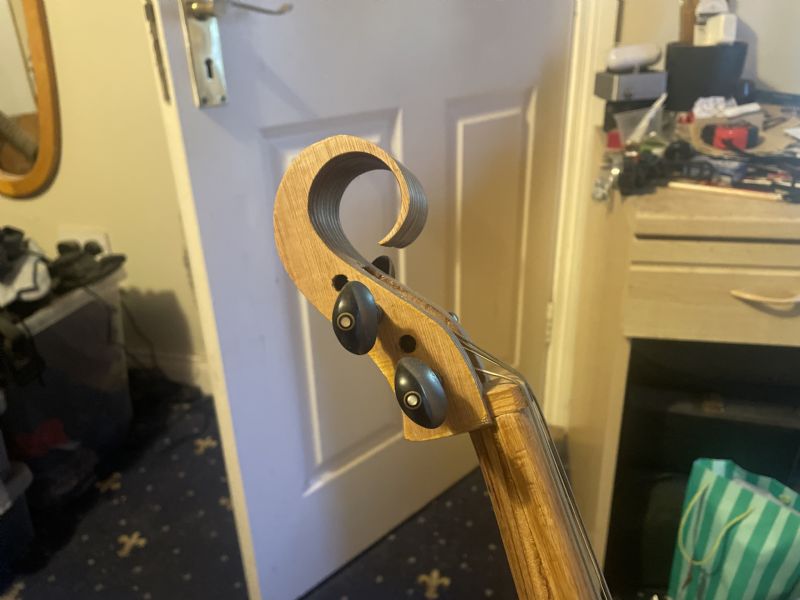
“Col.Thornton’s Strathspey” does go low…
that is an interesting looking and nice-sounding violin/fiddle he made!
Cool modern end on the scroll there, Marty Joe.
Also...
MartyJoe, do you guys all play a slipjig called "The Humors of Westmeath"? It's a favorite of mine! Is it really from Westmeath? :-)
It's not a popular one here, but I've been playing it more at sesh in hopes it will get picked up.
Not familiar to me. I’ll ask at tonight’s session. As you probably know there’s a good tune called Mullingar races. The horses racing track closed many years ago and gave way to a large industrial estate. The railway platform for the racetrack is still there a mile out along the disused railway that has a cycle track along side. Mullingar still has a greyhound racing track but that’s not connected to the tune.
Interesting little babel fact Mullingar is the 2nd highest county town in Ireland 520’ above sea level. Cavan is 40’ higher. Our drinking water comes from a lake on top of a hill fed by an underground spring.
NCnotes - W S Mount designed the "Cradle of Harmony," but he didn't build them. The one in the article was built by a local carpenter, whose name is on it.
His paintings are really beautiful and culturally significant.
Having the skills of a carpenter a help. A lot of people have asked me if I’m a carpenter from the shaping of necks and heels on my instruments. I have to say no I developed those skills from shaping and working with concrete over the years.
Yep they know the humours of Westmeath and the bucks of Westmeath and the rakes of Westmeath. I didn’t get to hear any them though.
Cool, So not only do they know the "Humors of Westmeath", they have upped me with a couple of tunes I've never heard of!
Hope you had a fun session! :-)
"Yep they know the humours of Westmeath and the bucks of Westmeath and the rakes of Westmeath. I didn’t get to hear any them though."
So many tunes named after a town or place-- I just learned the other day that Mooncoin is a locale in Kilkenny (Móin Choinn or Coyne's Bog, according to Wikipedia). I've always liked that name for a tune.
Someone has surely followed up on the idea to travel to every town in Ireland with a tune(s) named after it, just to play the namesake tune in a local establishment.... Fergal Scahill, are you listening? :-)
quote:
Originally posted by JonD"Yep they know the humours of Westmeath and the bucks of Westmeath and the rakes of Westmeath. I didn’t get to hear any them though."
So many tunes named after a town or place-- I just learned the other day that Mooncoin is a locale in Kilkenny (Móin Choinn or Coyne's Bog, according to Wikipedia). I've always liked that name for a tune.
Someone has surely followed up on the idea to travel to every town in Ireland with a tune(s) named after it, just to play the namesake tune in a local establishment.... Fergal Scahill, are you listening? :-)
I don't know if if anyone has made a trip to all the places after which tunes are named, but a friend took a trip to Ireland not long ago and made a point of stopping at the Cliffs of Moher to play the tune (and some others). Apparently it's become quite popular to do that.
One of my favorite reels is “Within a Mile of Dublin” so I’ll have to make a note to stop and play the tune when I get close enough!
Would you pick a spot within a mile of the city centre, or a spot within a mile from the county Dublin border?
Terms of Use | Privacy Policy | Privacy Consent (EU/GDPR Only)
Copyright 2026 Fiddle Hangout. All Rights Reserved.

