DVD-quality lessons (including tabs/sheet music) available for immediate viewing on any device.
Take your playing to the next level with the help of a local or online fiddle teacher.
Monthly newsletter includes free lessons, favorite member content, fiddle news and more.
Premier Sponsors


|
Please note this is an archived topic, so it is locked and unable to be replied to. You may, however, start a new topic and refer to this topic with a link: http://www.fiddlehangout.com/archive/24606
Page: 1 2
Joyful - Posted - 11/02/2011: 09:52:10
Okay, I've been taking lessons for about 2-1/2 years and in the beginning put the 4 little pieces of tape to help with finger placement. Then I purchased the "Fiddle Fretter" and loved it because it helped with 2nd and 3rd positions. BUT I felt I was really starting to depend on those little fret marks too much so last Sunday I took it off. Now I can play the songs I know just fine, but trying a new song is a whole different story especially with double stops. So I put the tape back on. My question is this, should I keep the tape on and if so, how long or, take it off and struggle a little. I know I'll get lots of help and opinions on this one!!!
Thanks, Sharon
Sue B. - Posted - 11/02/2011: 09:57:56
There will be folks here who say never put 'em on, and others who may say never take 'em off. Imo, they are only in-tune for some keys, so getting away from them at your advancement could be a good idea. You could leave just one, either 1st finger or 3rd finger. You could spend practice time playing tunes you know well, listening very carefully & adjusting. Also consider scales in the more common keys, including scales in 3rds & 4ths. Sue
Mojohand40 - Posted - 11/02/2011: 10:14:38
I'm a newbie, so take what I say with a touch of salt,...
..when I first started learning fiddle, I was VERY tempted to put tape on. At the time, I already knew how to read notation, and since I played mandolin (tuned the same), I already knew where the scales, double stops, arpeggios etc are. My trouble was (besides bowing!) I had/have lousy intonation.
I thought: "Hmmm...put tape markers on and just think mandolin, save a headache..."...
But, I then thought "Nah...just struggle and take the time to learn to intonate"..And I'm glad I did. I'm still ALWAYS working on getting good pitch, etc. (and it's frustrating at times), but I honestly believe that had I used tape or a some other "fret" marker, my fiddle playing would have actually progressed slower. JMO.
As I said, I'm a beginner, who's still struggling, but I believe using tape is just postponing things, and not using is the way to learn for the long term.
Swing - Posted - 11/02/2011: 10:21:48
I say do not tape... you will be better to forge ahead and learn to hear the notes. Learn to play the scales and arpeggio's etc then when all hell breaks loose and it is a dry day and a peg slips a little you will automatically adjust to playing in tune...
The biggest problem with tape or the fretter is that you have to re-learn to play without. It will be well worth the effort.
Play Happy
crumpet - Posted - 11/02/2011: 10:29:14
I learned with tapes--as a third grader, in a public school Suzuki class--and I'm glad I did. I think in that instance--young children, having no musical training whatsoever--tapes are good because they remove the frustration of the very beginning of making music, showing you where to put your fingers which helps the notes sound sort of in tune. The sounds that come out in the very beginning sound more like real music, and less like noise, to the untrained ear. Even with tapes, you still have to learn to make adjustments for different tunes and keys, by ear. Tapes aren't so much an actual learning aid, just a way to make beginning less frustrating.
However, as an adult when I re-learned, I considered putting tapes on. I'm glad I didn't. I think they're a bad idea in all other circumstances. An adult beginner, having a better developed ear AND the foresight to understand that while it sounds bad now, will improve with practice, doesn't need the help of tapes. Our attention span is longer than a 7 year old's, so we don't need tricks to keep us interested.
Edited by - crumpet on 11/02/2011 10:30:58
mudbug - Posted - 11/02/2011: 10:33:38
Sharon, You've trained your fingers enough so you now have muscle memory. Now it's time to work on your ears. Identifying micro-tones and adjusting on the fly. You gotta do it eventually. Why not start now? ................Actually, now I seem to recall that some use the "fretter" that have arthritis, and they say it helps them, so if you don't take it off, eventually you'll get to the age where you have to have it on for physical reasons, but 2 1/2 years seems like a long time, to me, for a training aid, but we're all at different points on the path. Here's anouther thought. With having that for a crutch for your left hand, your right hand might have progressed beyond your left and now you don't want to sound bad while you work on the left hand. Hey, none of us want to sound bad, but that's how you get better, working slowly at the most obvious thing that needs work. That's why they call it practice instead of playing. 
LUV2FIDDLE - Posted - 11/02/2011: 10:40:15
My teacher put tape on my fiddle when I first started. (I was 12 so I wasn't a LITTLE kid!  ) He took the 2nd finger tape off after maybe three weeks then took the 3rd finger tape off a few weeks after that and let me wear the first finger tape off. (I kinda "helped" it come off because I wanted to try it without!
  ) But when I got to starting to learn double stops and upper positions he wouldn't put tape on it because he said I should be good enough to be able to hear and adjust since I'd been playing for several months. Now every LONG once in awhile (extremely rare though) if I'm learning a tune that has upper positions and I miss the right note almost every time I play it because I get lost while trying to find it, he'll put a tiny piece of tape on for a week or two. (quite embarrassing though when everybody thinks you're SO GOOD!
 ) If you're a little kid you probably need more tape. If you're an adult or teenager you probably don't need as much. But I would start out with tape at least on the first position first finger notes (A,E,B,F) and MAYBE the third finger notes (C,G,D,A) With that much you should be able to do very well with your 2nd and 4th fingers. That's my opinion on beginners and for upper position tape I guess it just depends on what you're most comfortable with. Don't depend entirely on tape though and don't leave it on forever! Just remember that in-tune fiddle players are much more enjoyable to listen to than out-of-tune fiddler players so if the tape helps you, go for it!
Edited by - LUV2FIDDLE on 11/02/2011 10:42:45
richdissmore - Posted - 11/02/2011: 12:03:23
i have never used tape to help with fingering notes if you can do with out your better off just remember were you put your fingers if you can use your hearing to tell you witch note your on then addjust
Peghead - Posted - 11/02/2011: 12:31:08
Leave it on until it wears off, by then you shouldn't need to replace it.
Edited by - Peghead on 11/02/2011 12:34:41
piccard - Posted - 11/02/2011: 12:35:09
The tape is just a habit that gets in the way of progress. Take them off and jump in to the deep end of the pool. Depend on your ear and it won't let you down it just takes a little cultivating.
Dorcasmolorcas - Posted - 11/02/2011: 12:43:07
It sounds like you are pretty dependent on the tapes. When I had students that were using tapes, I always had to wean them off of them. I would suggest that you try removing one tape at a time once a month (or whatever works best with your practice schedule). That way you can develop your ear and muscle memory without feeling too much withdrawal.
:-)
mswlogo - Posted - 11/02/2011: 12:58:36
I say put them on. If I could go through learning twice I'd try both ways and tell which was best for sure.
I needed/wanted my ears to learn what the right pitch was to start and my fingers to start in the right positions on day one.
I think it really depends on the person. You may have some music background so your ear might be better trained to start with.
I only ever put a couple on. B and D on A string. You really don't ever need more because in 1st position every else is just a finger width away which you can start memorizing immediately.
You should know C# is about a finger width below D, and C is about a finger width above B.
I also like them when it's really noisy. And I also like them for learning 2nd and 3rd position (which I don't do much off).
I just put two dots (like a Guitar or Banjo). No need to go all the way across with tape which can act as a fret.
I sold a fiddle with them on to friend (with lots of musical experience that was learning fiddle). She kept them on for month or so.
Like a year later she had to borrow one of my fiddles that had them. After a week she said, I don't think I should have ever taken them off.
And she has perfect pitch to boot. Plays classical piano for 25 years. I know, makes no sense but it really happened that way.
Joyful - Posted - 11/02/2011: 13:00:27
Thanks everyone for your advice...I knew I could count on some good responses. I think the tape is coming off!! Hey, it's only cheap tape, if I get really frustrated I can always put one back on for starting finger position.
You guys are great
Sharon
S_Heriger - Posted - 11/02/2011: 13:50:18
I used the tape for about four months when I was first learning, then took it off. It forced me to correct by ear as I played, which really helped me progress much faster. I found that I was relying on the tape and ignoring my ear, so I forced myself to do it, and found myself quickly correcting for notes played out of tune. For what it's worth, I think 'training wheels' of any sort should come off as soon as possible. You might not like the way you sound at first, but you'll work hard to fix the problem, and then you're free of them.
Learner - Posted - 11/02/2011: 14:26:11
Hello Joyful:
To help wean you off of the tapes, try playing a song, that you know well. with your eyes closed.
I sometimes play with my eyes closed. It seems to help keep me from being distracted.
I think that you will be surprised at how well you will play without using your eyes, just relying on your ears and muscle memory. Maybe not immediately, but after a few minutes you'll get the hang of it. Then you'll have little problem losing the tapes.
Best wishes,
Frank
FireandAir - Posted - 11/02/2011: 14:42:40
I don't bother using tapes; I figure it's not going to explode if I hit something sharp or flat, so I might as well learn where to put my fingers and it'll improve with time. Oddly, my intonation improves when I shut my eyes and go slow, though. (Easier to hear without the visual distracting me.)
However, that said, I'm not sure I think that tapes are the worst thing ever. There are a lot of fretless bass players out there who have basses with inlays, and as long as they don't act like, "But my finger's on the A so it's GOT the be right even if it sounds flat!" they seem to do okay. I wouldn't be morally opposed to inlaid frets on a stringed instrument, as long as they are used as guidelines. Like most things though, most people would misuse them or insist that they are on the center of the note when they are off, because their finger is right on the fret that's supposed to be an A. They're more of a psychological impediment than anything, I think -- with the right attitude, I don't think they'd be a problem.
fiddle and banjo player - Posted - 11/02/2011: 15:37:31
quote:
Originally posted by mudbug
You've trained your fingers enough so you now have muscle memory. Now it's time to work on your ears.
I agree with mudbug. If you can play the tunes you know well without tapes, that's a great start. Maybe take one off at a time, as you feel ready. Try playing without looking at your fingers too, that really helped me. It's like when you learn to type, don't look at the keyboard and you'll learn much faster.
Personally, I started playing at age 5, and wore tapes until about 12. At that point, I had been taking one off at a time, really as they were falling off, because I didn't use them anymore.
LUV2FIDDLE - Posted - 11/02/2011: 16:05:13
You should get to the point where you can play in the dark! :-) People are impressed when I can do it in pitch-black darkness but it's nothing impressive, it's muscle memory that I've practiced and learned. All's it takes is practicing! :-)
Fiddle Chick - Posted - 11/02/2011: 17:35:14
I taped when I was first learning but then the tape started to come off so I left it off and am glad I did. First off I'm an adult and was embarrassed to be seen with tape on my fiddle.
I do have a couple tick marks for the third finger on G stirng and one beween A & E for the pinky and by tick marks I mean I took a white out pen and make the slightest touch on the finger board. I can see the marks but they don't wave a flag like tape will.
I would do what ever is most comfortable for you but it will become a habit and I think it will be harder to play without them. Learn to sight read the finger board.
Happy fiddlin
Kathy
BlueRidge - Posted - 11/02/2011: 17:40:53
I played around with both, early on, and found they did help with intonation (as long as they were on) but had me distracted from the hundred other things that needed attention.
What helped me much more than tapes, was doing a simple intonation exercise at the start of every practice--that helped both getting my muscle memory down and being able to hear whether I was in tune while playing.
To start, get your left hand in a comfortable, relaxed, correct position (first position). Play all the notes that make sympathetic strings "ring". Its unmistakable. Your fiddle will sound like a bell if you hit them right. The A on the G. The E on the D. The G on the D. The D on the A. The E on the A. The G on the E. The A on the E. Do this several times before practicing. This gets your mind and muscles oriented to where the notes are and gets your ears tuned to hear when you are off, and you will find you can quickly correct yourself for the rest of your practice.
Then do your scales (if you practice them). Then launch in to your tunes. This worked (and still works) really well for me...
toddwright - Posted - 11/02/2011: 17:54:34
Tape is a good tool for a beginning fiddler to get started. After a few weeks you should not only be able the hear the note but also have developed a muscle memory.
boxbow - Posted - 11/02/2011: 18:32:28
Way back in the misty ages, long ago, as a kid I played a cello, and had tape at first. The thing about cello is that you really have to crank your neck around to see the tape. It wasn't long before I ignored the tape, and I never once considered using it on my fiddle. Never even crossed my mind. High on my current list of things to do better/differently is not using sheet music. That's going really well, but I've found that I stare at my fingers while playing, and I've long been convinced that watching my fingers slows me down. The new item on the list is to be able to play with my eyes closed or while watching the rhythm guitar or the bass, should I be so lucky as to have one at a jam. I'm doing pretty well, sometimes extremely well, and I don't wish to go back. I'm picking up tunes quicker by ear as well as from sheet music. My improvised ornamentation is still kind of one-dimensional to my ear, but it's getting better. No tape, no dots, no sore neck, no rushing/dragging of the tempo. Am I missing anything?
I guess my overly illustrated point is that it's better, in my opinion, to learn to play the music in your head. Eliminate the layers of contrivances between the music in your head and the music coming from your fiddle. I'm not afraid to play a little bit off pitch now and then, and I seldom do. When I do, it's usually because I hit an honest-to-God klinker. Had there been tape on the finger board, I'd have been fingering the wrong piece of it. Playing without external cues, other than your ears, is the best way. Mudbug mentioned muscle memory. I really don't know what-all goes into muscle memory, but I do know that it's real. It's a product of practice, habit, and good form. External cues delay it's development. My intonation can be off when I first pick up my fiddle. Usually I can isolate whatever bad form is causing it in pretty short order. It's almost always bad form. Where's my wrist? Where's my elbow? Where's my thumb? Are my fingers arched properly? Certain keys make it worse, but that's my own fault for not working more on them.
lose the tape
For me, the most relaxed position for playing my fiddle leaves me looking the wrong way to see my fingers, and it points my ear right at the f-holes. Fiddles are not the most ergonomic contraptions out there, but they got that bit right.
Edited by - boxbow on 11/02/2011 18:41:31
BlueRidge - Posted - 11/02/2011: 21:47:46
One other thought on this topic...
It might depend on the style of music you want to play too. I play some styles that require your intonation to be spot on. Any style where you are playing a lot of unisons (like E on the D string and an open E or A on the D string and an open A) is gonna sound really bad if your intonation is a little off--other double stops will too, but it won't be so obvious.
You can fudge it sometimes by sliding up till it sounds right, but you should use slides musically and not to fudge it. I would practice some exercise to get good intonation. Doesn't have to be what I outlined above, but something.
Tapes won't help with that... They'll get you close enough for some work, but not close enough to train your ear well
nallycat - Posted - 11/03/2011: 04:34:50
My Violin teacher used tape when I was young, and after only a few weeks it was removed I did not have to relearn anything, I then knew that the note should sound like and could hear when it was wrong, the tape gave the position so I could hear the correct pitch from the second I put finger to board,. you can go on about play by ear but I have heard tunes played by fiddlers completely off key, and I bet you have to. In my view the physical position of the fingers must come before learning the pitch there is only one position on a finger board to arrive at a correct note, but you can learn a note wrong by ear.
wooliver - Posted - 11/03/2011: 05:23:08
This where i say, "get a mandolin."
Not a good habit to look at your fingers. If you want a good/easy intonation model, get a mandolin. Cheap $50 Rogue mandolins. I got three of them for loaning out.
nickc - Posted - 11/03/2011: 09:38:08
I say take it off. And i'll join you!
I'm a beginner and i put tape on right from the start. I've found it useful while training my fingers to land in the right places but i can see my teacher looking at it with utter distain. It's going to come off for the next lesson. Everything but the first finger!
FireandAir - Posted - 11/03/2011: 10:54:55
Even the first finger, you don't really need. I've seen some of the best people in the business poke a little before starting a piece or a song to orient themselves on the fingerboard before they start playing.
bj - Posted - 11/03/2011: 13:56:29
The reason we play potatoes to kick off a tune is to find our finger spots.
Take 'em off. They've become a crutch for you. Ears are the most important tool a fiddler has. Learn to use them instead.
Tommys dad - Posted - 11/03/2011: 15:09:48
Tape is for violinists, fiddlers play by ear. I used them for a month or so you should take them off!
LUV2FIDDLE - Posted - 11/03/2011: 15:13:45
If you've had it on for more than a few weeks, I vote take it off too ... but if you've JUST STARTED I suggest you leave it on for a few weeks.
cardinalwookie - Posted - 11/03/2011: 15:40:38
I've only been playing for 2 months, but I made the decision not to use tape or dots as I felt it would lead me down the wrong path. I wanted to be able to find the notes rather than look for them. I have played several fretted instruments before so I have a picture already in my mind of where the frets should be. If you have never played stringed instruments before then I can see the point, but still I would say lose them asap. I can't say that my playing is anywhere near perfect pitch, but If I had tape I would be looking at my fingerboard rather than blind adjusting (what I do automatically now). As previous posters have stated playing blind (using the force) is a great practice technique I find that it builds confidence and gives a feel of being attuned to your instrument rather that trying to control it.
So if you need the training wheels as you have no context of where your fingers should be then use them until you develop the muscle memory. If you can manage without, don't even start.
Shawn Craver - Posted - 11/03/2011: 18:21:17
Playing the fiddle is a relationship between you and the instrument. The fingerboard is the most intimate part of the fiddle. It is time to remove the tape and go at it.
fiddlepogo - Posted - 11/03/2011: 21:03:22
An alternative to tape- worked for me, your mileage may vary:
1. Keep your fiddle in tune- tune every time you play it.... this way, the right note will ALWAYS be in the same place, and that place will be easier to memorize.
2. Start on one key that has drones easily available... G or D are good places to start.
3. Use the drones while playing simple pentatonic tunes to get your index and ring finger notes in tune
4. Then get the middle and pinky notes in tune.
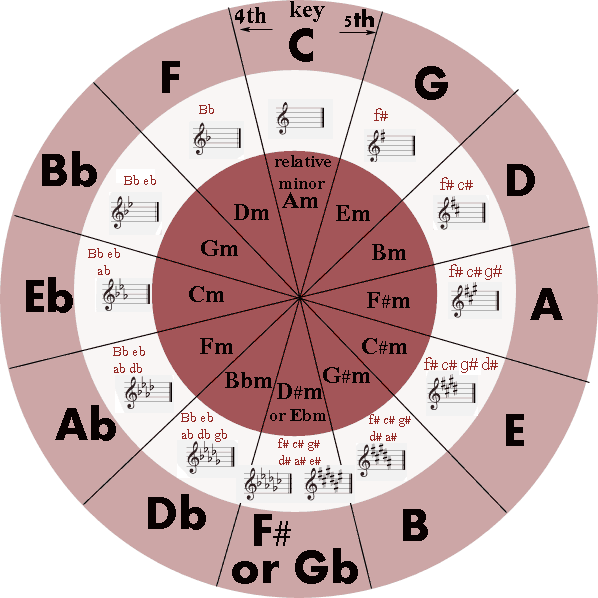
5. Once your tunes in that key are in tune, find a picture of the "Circle of Fifths"
folkblues.com/images/circle_5th.gif
and practice tunes in the next key on the circle from what you started on- you can move in either direction. At some point in either direction, you will lose most of your drones, but by then you will have a good foundation and a better ear for hearing out of tune notes.
6. In the new key, the fingering will be the same on three strings, but moved up or down one string, depending on which way around the circle of fifths you chose. Each time you change keys, one string with familiar fingerings disappears on one side of the fingerboard, and is replaced by a new one on the opposite side with new fingerings... but ones that are only a LITTLE different from the string that it is next to. Work on that key, focusing on that string, until it all sounds in tune.
7. Continue the process key by key. By going around the circle of fifths, the new fingerings are gradual, and become familiar friends, since they move across the fingerboard 3 times in the next three keys before "dropping off the edge" and disappearing.
8. When practicing, continue to segregate your tunes by key- that makes cleaning up the intonation in that key that much easier, and reinforces the right fingering.
9. Retrace these steps to some degree when warming up... for instance, I usually start out with tunes in G that are pentatonic and use mostly the index and third finger, at least in the first part.
This method based on the circle of fifths works because the fiddle is tuned in fifths in standard tuning. It will also work on any other instrument tunes in fifths or fourths- cello, viola, and bass.
It also works because it is gradual... usually only two notes are going to be a problem in the new key, and it's easier to focus on and correct the intonation on two notes than it is a half dozen or more. And the sound of only two notes being out of tune is going to be a LOT easier on anybody who has to listen to you practice!
Downside: Using this method, you are likely to become REALLY proficient at some keys, but not so good at others, depending on how industrious you are. Depending on your genre, that may or may not be acceptable. It will work for Old Time- you'll fairly quickly cover the main keys, and the keys beyond those are gravy.
Possible fix:
Once you get a certain number of keys under control, you could pick two keys two work on from either side of the ones you have under control, and work in opposite directions. That would speed up your progress.
Another link from the folkblues page:
folkblues.com/theory/circle_5ths.htm
Another view of the circle of fifths:
piano-play-it.com/images/circl...ifths.png
And the page it's on:
piano-play-it.com/circle-of-fifths.html
Edited by - fiddlepogo on 11/03/2011 21:19:04
fiddlepogo - Posted - 11/03/2011: 21:33:45
quote:
Originally posted by bj
The reason we play potatoes to kick off a tune is to find our finger spots.
Take 'em off. They've become a crutch for you. Ears are the most important tool a fiddler has. Learn to use them instead.
Quibble:
A very good reason, but not the only reason... it's also the way to cue the other jammers/band members and any dancers as to what the tempo will be, so they can come in neatly together at the beginning of the part.
But if you're playing alone, yeah, it's really the ONLY reason.... well, no... it's also good to practice doing potatoes so your "potatoes" will be crisply in-tune and neatly on-tempo when you need to do them at a jam, gig, or dance.
Diane G - Posted - 11/03/2011: 21:44:48
I'm a violin/fiddle teacher for children here in San Diego....I BELIEVE IN TAPES ACROSS THE FINGERBOARD FOR CHILDREN AND SOME ADULTS TOO!
I tell the children and parents that these are training tools to help them with a difficult instrument to learn. Not all children and their parents have great pitch and can tell if the note is sharp or flat when they are first learning...lets give them a head start by helping them to learn great pitch and have them progress faster. I use the tapes (4 of them for 1st, 2nd (high 2nd finger on the D and A string for the sharps..3rd and 4th fingers) for anywhere from 4 months to 6 months...depending on the student...even adults. I take off a tape...2nd or third finger to start one at a time and we work on scales, finger exercises and tunes so they can start to get the hang of intonation without the tapes. I always tell the parents or student that the tapes are a guide and not an absolute pitch. So we work around this with the lessons so that a student and the parent if the child is young to trust their ear to the correct pitch.
If all the tapes come off and a student is still struggling then I put small dots on the 1st and 4th finger positions as guide to help them continue to have good intonation and tell them they need to work on it every practice
One more thing. how the tapes are put on is very important...especially how one measures for putting the tape in the correct position. Go to violinlab.com and watch the video on the Correct way to measure and put on tapes on a violin. This video is free and very good...it is explained very well and through.
Stay tuned. Diane in SoCal
DougD - Posted - 11/04/2011: 06:37:16
Sharon, if I read your original post correctly you've been taking lessons for 2 1/2 years. To me that seems a long time still to be using tapes or the fiddle fretter, but I really don't have any experience with either. I'd say its high time to start using your ears - play scales, double stops with open strings - simple new tunes. It will come.
Shawn Craver - Posted - 11/04/2011: 07:57:09
A singer doesn't learn to sing by putting tape on his or her mouth.-- or a noose around the neck. So why then should a fiddler learn to fiddle by putting tape around the fiddle's neck? This sounds like torture to me. Is that the way it works for violinists? Torture the instrument and the player? Then the player must struggle to torture fiddle sounds out of the constrains that they have been subjected to? Is this the underlying reason that violinists struggle to fiddle? A foundation of torture that has been ingrained into the student "necessary?" It is a time of liberation! Release your inner fiddler! Out demon of torture! OUT! OUT! OUT THOU DARK AND FOUL CREATURE!
LUV2FIDDLE - Posted - 11/04/2011: 10:26:40
quote:
Originally posted by DougD
Sharon, if I read your original post correctly you've been taking lessons for 2 1/2 years. To me that seems a long time still to be using tapes or the fiddle fretter, but I really don't have any experience with either. I'd say its high time to start using your ears - play scales, double stops with open strings - simple new tunes. It will come.
Wow, 2 1/2 years? I didn't realize that! In my humble opinion, it may be time to think about removing the tape! However my position on tape for beginners is different...
I know a lot of you don't agree with tape for beginners but I hope we can get along and I won't end up looking like this:  (Sorry ... I saw the face and REALLY needed to find a good excuse to use it! )
LUV2FIDDLE - Posted - 11/04/2011: 11:43:13
quote:
Originally posted by Shawn Craver
Here is my favorite face.
That must mean you're the person who punched me in the eye ...
Shawn Craver - Posted - 11/04/2011: 12:29:14
lol. no i am harmless. I just like to look at things from different angles. I really have nothing against tape. Where I grew up (as far as I know) no one put tape on their fiddle, but I imagine that if they ever did, it was probably duct tape.
LUV2FIDDLE - Posted - 11/04/2011: 12:43:43
quote:
Originally posted by Shawn Craver
lol. no i am harmless. I just like to look at things from different angles. I really have nothing against tape. Where I grew up (as far as I know) no one put tape on their fiddle, but I imagine that if they ever did, it was probably duct tape.
Lol Hmm, duct tape on a fiddle. Now THAT would really stick! They probably would never get it off again. So if anyone out there is trying to decide between no tape or duct tape, I'd definitely recommend no tape!
fiddlepogo - Posted - 11/04/2011: 13:35:11
One way of looking at this is that like with riding a bicycle, beginners need some "training wheels"... an aid to get them started.
But at some point you have to remove the training wheels.
In my method, the drone strings are the "training wheels"
And the tapes definitely fill the role of "training wheels"
I think the use of drones is a little better, because at least it's training the ear to hear what's off and what's in tune.
The tapes however are a visual aid, so you go from something visual to using your ears, which seems like a much bigger jump.
However, in either case, at some point, you have to "take the training wheels off" and use the proper method for "getting down the road".
At 2 and 1/2 years, it's probably time to "take the training wheels off, and see how you do.
We can argue here about which "training wheels" are better, but the proof is in the pudding, and for the OP, the pudding will get tasted when the training wheels come off.
IF at that point the intonation isn't good, there is an additional form of intonation aid/training wheels that some people use:
Recordings of drones. The advantage of this is that you aren't limited to the open note drones on your fiddle, and so you can theoretically have drones in any key.
I think bj posted info a while back on where to get a CD of drones, I think it was intended for cello, but no reason it wouldn't work for violin.
You could also tape down a key on an organ or keyboard (as long as it was a sustaining sound without vibrato), but you could only tape down a white key...
and use masking tape, NOT duct tape!!! If your keyboard has a pitch shift feature, you could use that to get a flatted drone (one of the "black keys").
Edited by - fiddlepogo on 11/04/2011 13:39:06
alaskafiddler - Posted - 11/05/2011: 01:47:47
quote:
Originally posted by Diane G
I'm a violin/fiddle teacher for children here in San Diego....I BELIEVE IN TAPES ACROSS THE FINGERBOARD FOR CHILDREN AND SOME ADULTS TOO!
I tell the children and parents that these are training tools to help them with a difficult instrument to learn. Not all children and their parents have great pitch and can tell if the note is sharp or flat when they are first learning...lets give them a head start by helping them to learn great pitch and have them progress faster.
Tape will never teach great pitch, intonation. At best it will just show one approximately where to put the finger, and give a sense of general pitch region (showing the general difference between a C and C#) That isn't that hard to accomplish without the tape. To actually get that C or C# in tune is something tape does not accomplish.
Not sure how much of an actual head start or faster progress would occur (how do you even measure?) - At some point you have to actually tackle developing the ears, I think it's best right from the start. And it ain't that hard. I generally start with the idea that pitch and intonation resides in your head not you fingers. I think tape just encourages the students to focus on the tactile or visual sense of where the pitch is, not the auditory.
After many many years, my own observation is that, overall, folks that use tape, fretters, tuners and various other things to try make the process quicker end up (after a while) overall progressing slower than those that just do do it the old fashioned way, with the ear.
SBritton - Posted - 11/05/2011: 12:32:57
I bought a high grade fret when I first started playing. [It was that one that was just a long solid press on.] It said 'no residue - easy to remove' so when I decided to buy a new set of strings I went to remove that bastard.
It left a THICK layer of residue on the board and I found out the hard way, on that cheap violin, what the difference between a true ebony board and a sprayed one was. I was so mad I went and bought the violin I had now. I almost needed to re-learn how to play. Rather, I never properly learned. When my listening skills improved I noticed that tape only gets you in the ball park. A small shift in your finger position changes the note.
That tape probably put me back a year in practice because I never honed very important listening skills needed to play the fiddle.
Diane G - Posted - 11/05/2011: 13:23:59
Nallycat. YOU HIT THE RIGHT NOTE THERE!!!! I COMPLETELY AGREE WITH YOU ON LEARNING THE POSITION OF THE FINGER...MUSCLE MEMORY...then the pitch will be more defined and you can correct the pitch. The pitch, intonation, is something that we all work on and is a constant issue.
Thanks for posting the wisdom. Stay tuned.
Diane in SoCal
LUV2FIDDLE - Posted - 11/05/2011: 23:03:05
quote:
Originally posted by Diane G
Nallycat. YOU HIT THE RIGHT NOTE THERE!!!! I COMPLETELY AGREE WITH YOU ON LEARNING THE POSITION OF THE FINGER...MUSCLE MEMORY...then the pitch will be more defined and you can correct the pitch. The pitch, intonation, is something that we all work on and is a constant issue.
Yes, I totally agree with you, as long as you don't leave it on TOO LONG!
alaskafiddler - Posted - 11/06/2011: 01:59:59
quote:
Originally posted by Diane G
Nallycat. YOU HIT THE RIGHT NOTE THERE!!!! I COMPLETELY AGREE WITH YOU ON LEARNING THE POSITION OF THE FINGER...MUSCLE MEMORY...then the pitch will be more defined and you can correct the pitch. The pitch, intonation, is something that we all work on and is a constant issue.
Thanks for posting the wisdom. Stay tuned.
Diane in SoCal
So in learning and relying on the position of the finger... muscle memory, pitch and intonation remains a constant issue that you have to work on?
I haven't noticed those fiddlers who have learned and are relying on ear, that pitch and intonation is not a constant issue, nor require particular work on. Even not an issue for them to play different fiddles with slightly different scale lengths. Once your ear knows what it's listening for, it's like the metaphoric riding a bike.
OldNSlow - Posted - 11/06/2011: 16:35:20
Yah, but unless you are using a really odd fiddle hold, your ears hardly ever touch the strings, LOL.
Edited by - OldNSlow on 11/06/2011 16:35:45
Page: 1 2
Terms of Use | Privacy Policy | Privacy Consent (EU/GDPR Only)
Copyright 2026 Fiddle Hangout. All Rights Reserved.