quote:
Originally posted by Brian WoodI don't find myself in disagreement of those favoring a holistic description of music. What I was trying to convey was the difference between a painting or photograph or sculpture, which actually exist "all at once", and dynamic forms of art like music, which exist in time.
Parallels could be drawn between the process of creating a painting one brush stroke at a time and rendering a tune one note or phrase at a time, then viewing the result as a whole. Or maybe the better analogy would be a book.


quote:
Originally posted by bacfirequote:
Originally posted by Brian WoodI don't find myself in disagreement of those favoring a holistic description of music. What I was trying to convey was the difference between a painting or photograph or sculpture, which actually exist "all at once", and dynamic forms of art like music, which exist in time.
Parallels could be drawn between the process of creating a painting one brush stroke at a time and rendering a tune one note or phrase at a time, then viewing the result as a whole. Or maybe the better analogy would be a book.
Paintings are created in time but generally viewed as a whole. Books are experienced in time like you suggest. I'm not trying to make a point so much as express wonderment for art that is a time dependent experience. Maybe not so interesting to some.
yes very good point that the element of TIME is a really big deal in music!
Keeping time, keeping time with others, speeding or slowing or pausing …that element doesn’t exist at all in visual arts. But it does exist in dance too …
(“HOlistic” learning, for me, meant that I don’t learn well when it’s “let’s play these six notes…then these eight notes…then play these eight notes…now let’s play back those sets of notes in order…” ack! I don’t know why I stink so much at it! But at sessions I pick up tunes on the fly - first softly chiming in on some of the “big notes” and filling in more notes each time through. People have commented on my “picking up tunes quickly” but honestly I can only do it in THAT way… In “tune learning class”, I am the worst! Who knows why … but I stopped going to the tune learning class … if I’m learning a tune at home, I just loop the recording and play along, until most of the tune falls into place. )
"but more in terms of what kind of 'storm' ... a fiddler could summon up."
Exactly how i like to attack fiddle tunes! Nice quote!
Haha...those D28s gonna keep things down to earth...solid foundation for sure.
Definitely Brian Wood... Agreed. I really like that idea of unfolding, revealing... like opening up a letter or a gift... or reading a book...tunes can unfold...even though they are not material.
These discussions are getting my mind right for some upcoming performances. Now If I could only get my band together to rehearse... damn kids these days...they have jobs and stuff
Edited by - ShawnCraver on 09/10/2026 22:40:41
quote:
Originally posted by Brian WoodParallels could be drawn between the process of creating a painting one brush stroke at a time and rendering a tune one note or phrase at a time, then viewing the result as a whole. Or maybe the better analogy would be a book.Paintings are created in time but generally viewed as a whole. Books are experienced in time like you suggest. I'm not trying to make a point so much as express wonderment for art that is a time dependent experience. Maybe not so interesting to some.
Perspectives on this are interesting. I'm mostly just engaging in some devil's advocacy here, but couldn't it be said that a tune is not a tune until it's complete, and therefore, a whole? Notes and phrases are just brush strokes...or words and sentences...that don't convey a perception of the whole tune/painting/story until at least a certain portion of the completed work has been created. How many notes and phrases must be played before the listener perceives the tune as the player intended? Depending on the tune/song and the intent of the composer/performer, it could be every last note.
ive just got to internalize a tune in whatever way is easiest, (lilting is usually good enough for most tunes), before i even pick up the fiddle. Then it's a matter of getting it out of the fiddle in whatever way i can. This usually takes a week or two for me. And then if it sticks, the Analyzing, polishing and personalizing starts. Then revisiting it later and applying any recently discovered techniques etc...A bit like tending to a house plant...lol. Not that i know much about that either.
quote:
Originally posted by pete_fiddleive just got to internalize a tune in whatever way is easiest, (lilting is usually good enough for most tunes)
I'm not familiar with the term "lilting" like you're using it. Is that like humming it?
heres a pretty good explanation
https://www.youtube.com/watch?v=GI9tIOWMK5c
but this guy seems to be talking about jigs, it can apply to reels also or any other time signatures.
Edited by - pete_fiddle on 09/11/2026 13:08:04
"Lilting" means to sing a tune using nonsense syllables instead of words. Here's a good example:
youtu.be/nbM3KtWQwsI?si=RMCSLN8WYqW_k7R4
yes that's one of the sources i learned my version of "Kitty lie over" and almost exactly how my friend, (a pipe player) taught it to me also.
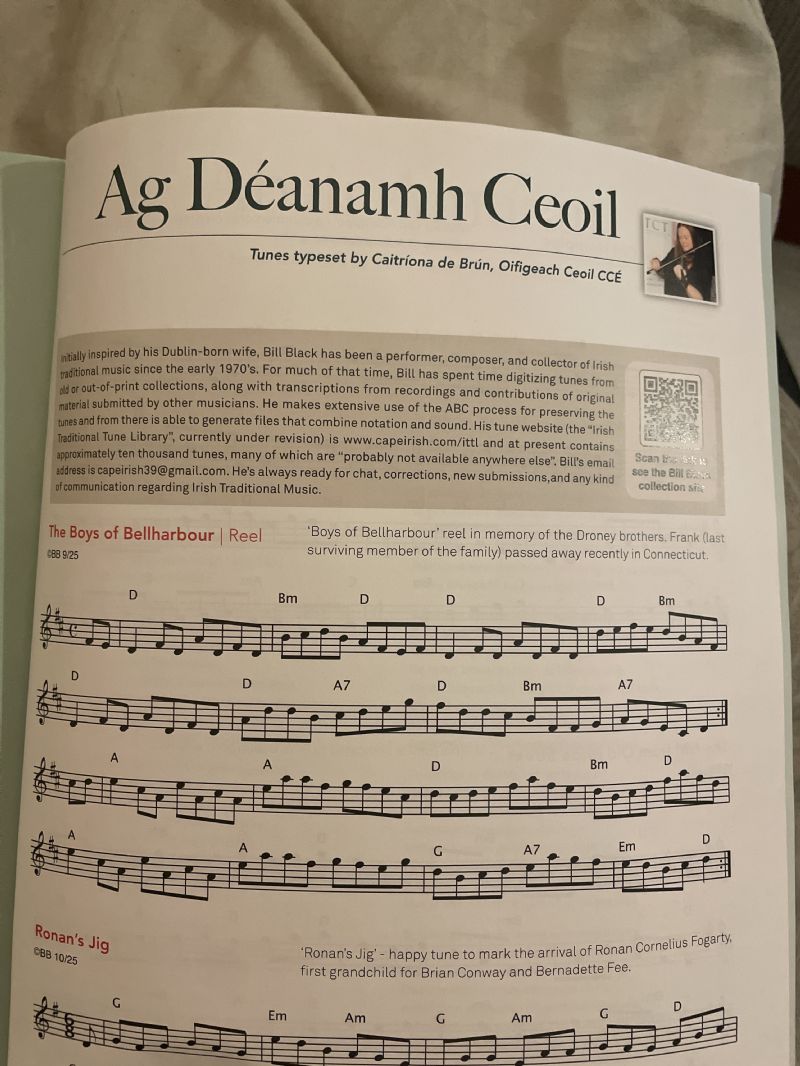
I started back at fiddle lessons at my Comholtas branch on Monday. I took a few lessons about 4yrs ago and it was a great benefit. A different teacher this time round and she’s on the ball. My first task is learning to read notation on the fiddle so we started off with the Blarney Pilgrim. It seemed handy enough to follow, mainly because I already know it. I still had to concentrate because there are a couple of variations from the way I’d play it. So today I took out a copy of Treoir magazine (Comhaltas’s monthly newsletter) because at the back there are always a few tunes written out. The first one is a 2 part reel in D. Well I’m pretty sure I’ve got the notes right but I haven’t a clue what the tune sounds like, so it definitely doesn’t seem like holistic learning!! I’ll have a crack at it again tomorrow for another 15 minutes and gradually I’ll begin to hear the tune. Then I can ditch the music and play it from memory. Interesting way to learn a tune.
I thought of this thread when I was playing "Shuckin' the Brush" today. I listened to and tried to emulate Earl White, then, Koken, then Kirk, then something else I heard on Youtube... I picked something out of each version and made it my own.. several times.....Over time, as I play the tune more, I'll put more of my own bowing into it. It will be an ever-evolving tune..
Last night my daughter hosted a jam and we played Shuckin' the Brush...The group loved it and we sounded amazing if I must say so myself.....
Marty Joe, due to my misspent youth … I can look at that page and hear the music playing in my head! Look out for the C#, that will be a high third finger on the G string in that first A7 measure….
I learned Blarney Pilgrim at session and have never seen it on paper…it always feels weird to be ‘reading’ the music for a tune you know! (Or, think you know) I often find that I’m missing notes here and there when I see the notation. I’m learning a reel from sheet music too…”Gooseberry Bush”. It would take me soooo long to pick that one up by ear, it’s so odd and twisty! But it’s such a cool one. :-)
I'm envious of your misspent youth NCNotes! :-D
I'm curious, when you learn a tune from sheet music do the notes and staff appear in your head as you play it back?
I don't consider my youth "misspent" (not entirely anyway), but I learned to read music at about the same time I learned to read words. Like NCnotes, I can look at simple notation and "hear" the music playing in my head without actually having to play it. I think NC notes is talking about this sort of "sight reading," not actually learning the tune from notation. My problem with that method is that I may be able to play it, but I don't remember it very well. As someone said on here, it goes "in one eye and out the other."
The problem with "reading" the music for a tune you already know is that there is not one "only and correct" version of traditional music, so the notation may well be not exactly what you know.
I've had a further odd experience with looking at notation supposedly derived from my own playing. When I first got the "Fiddler's Fakebook" I looked at a couple tunes where the source was recordings by our band. I never could have learned those tunes from that notation, even though I apparently did know them.
Edited by - DougD on 09/15/2026 01:51:12
Misspent youth = many hours with butt in orchestra chair :-D
HEaring notes when looking at sheet music: hmm, it’s not a ‘perfect pitch’ kind of scenario…it’s kind of like knowing in your head what the intervals (whole step, half step, third, fifth, octave) sound like … so when you see the note intervals on the staff you hear the matching intervals playing in your head: “a third up, then one step down, then back to the same note”… kind of like mental sight-reading. ( with folk tunes I can do this … but not some concerto in A-flat minor!! )
That must be weird and interesting to see transcriptions of your own band’s playing, Doug! DId you feel like they got it right…? And you yourself may not play it that way anymore?
NCnotes - When I "headread" music this way, I think I'm usually picturing fingering it on a keyboard, my first instrument, rather than thinking of intervals, although I know what they sound like (from singing training). Definitely not a "perfect pitch" scenario, and I don't know the violin as well, but I can shift to picturing the fingerboard if I want to (another advantage of playing in standard tuning).
As far as the transcription of our recordings in the Fakebook, that was a long time ago, but I think it was mostly the style of notation, plus the futility of transcribing two fiddles plus a whole band into one line. Another odd one was that Mel Bay published a collection of books called something like "Old Time Classics" based on our recordings. The books were for fiddle, banjo, mandolin (which we never used, although I think the author played mando) and guitar. Weirdly, the guitar book was written for a guitar flatpicking the melody, which I never did, except for a couple breaks on Carter Family songs. I don't think those books exactly set the world on fire, and I'm glad I didn't have to learn our tunes that way!
Perfect pitch is dreamland for me. I haven’t any idea how close I come to it. I do have reasonably good relative pitch. It kinda puzzles me how some very good musicians I know have poor relative pitch. One woman at our sessions always has trouble finding the key to start singing songs she performs (sings) every week, yet she is a serious concertina player. And of course a good singer when she gets going.
quote:
Originally posted by martyjoePerfect pitch is dreamland for me. I haven’t any idea how close I come to it. I do have reasonably good relative pitch. It kinda puzzles me how some very good musicians I know have poor relative pitch. One woman at our sessions always has trouble finding the key to start singing songs she performs (sings) every week, yet she is a serious concertina player. And of course a good singer when she gets going.
A good fiddle playing friend was in a jam once and tuning his fiddle.. I asked him what he used as a reference since he didn't have a tuning device.. He said he could hear the D string on a guitar across the room..... That''ll never be me doing that..!
Finally, my personal scheme on how I do many things.
Edited by - farmerjones on 09/15/2026 15:44:40
At jams and gigs I always waited for the guitarist to tune up so I could tune my fiddle to his pitches, even when he's strumming a chord I can tune to that. One time I re-strung my friends guitar, on the way to a gig he was performing at, I had no reference for the pitches. I heard later that the guitar was perfectly in tune, he didn't need to make any adjustments. No, I ain't got perfect pitch, at the time I was playing a lot of classical guitar with which I took particular care with tuning, using a tuning fork. I must have had the pitch of the fork in my head. I've transcribed many tunes, some lengthy Hungarian Gypsy pieces. I have a stack of fiddle tune books, I've played so often from those books that I can now just read the dots and instantly hear the tune in my head, that is how I select tunes to learn. When I get a suggestion for a tune I go straight to session.com, or any of the many other sites, and my selection is based on hearing the dots I read. I have, in the distant past learnt tunes by ear, and I really do not see any difference to learning from the dots. Either way the tune must be in your head and must be practiced repeatedly for them to stick. I am still not convinced that one way is better than the other, even with the state of the art player devices that can do all sorts of things to a play back. But, since I acquired a tablet I'm learning a ton of new tunes, admittedly it's taking a bit longer than I thought, maybe that's because I've got so many tunes at my finger tips. Learning a dozen at a time might be a bit much, but it's all good for developing a good memory, there are no dead lines so I have all the time I need. And, there's much other stuff to practice besides fiddle tunes, and I'm not going to stop meandering through chord progressions any time.
Between my early dyslexia and so-so vision, it's no wonder my ear developed better. I've decoded hornpipes from notation. Changing the notes into letters, then into fingers. Hornpipes are such, there doesn't seem to be any fudging. One bad note and yer toast. Unlike Blues where it was improvised to begin with.
quote:
Originally posted by pete_fiddleive just got to internalize a tune in whatever way is easiest, (lilting is usually good enough for most tunes), before i even pick up the fiddle. Then it's a matter of getting it out of the fiddle in whatever way i can. This usually takes a week or two for me. And then if it sticks, the Analyzing, polishing and personalizing starts. Then revisiting it later and applying any recently discovered techniques etc...A bit like tending to a house plant...lol. Not that i know much about that either.
My natural goto is similar; to also use idea of internalizing, audiation of the tune first. Singing, even nonsense syllables (lilting, diddling, scat...) as useful part of that by ear process, as a more active engagement; seems to make easier, quicker and reinforce stronger audiation. (To then using that audiation process as a guide/focus in working it out on an instrument.) For many folks, find it helps with memorization, as neurologically it's different type memory, more experiential.
That video is interesting, in that he thought it's so odd, seemed oblivious, as foreign concept (perhaps due to more formal culture to learn music?) To me, I always thought that was common in some form (was just part of culture I grew up in).
but this guy seems to be talking about jigs, it can apply to reels also or any other time signatures.
It's not just for jigs, (video states "3 syllables, because that's what Irish music sounds like"  ). Nor just Irish music. For example, back 50+ years ago, most of my friends applied that to rock guitar riffs and leads. And seems pretty common in traditional music and fiddler world.
It does shows up as part of some education/teaching methods (and research); and/or just workshops, where they start by having the attendees sing/diddle the tune... but have noticed how some were uncomfortable with or struggled with that (again perhaps as odd foreign concept?).
It cost nothing to try, and can do it without an instrument; in car, at work, on a walk, or quietly singing along at a session.
Edited by - alaskafiddler on 09/15/2026 20:37:40
Terms of Use | Privacy Policy | Privacy Consent (EU/GDPR Only)
Copyright 2026 Fiddle Hangout. All Rights Reserved.