


quote:
Originally posted by JonDI had a couple online lessons with James Kelly and he used an analogy that has stuck with me, in which a tune is like a landscape painting in which there is a foreground and a background. Your eye is drawn to the foreground by the design of the painting which mainly tells the story the artist is trying to tell-- and it pays less attention to the background images (which can still be important to the story, just more subtlely). Similarly the bowing approach ideally gives emphasis to some parts (the 'core' of the tune) but less to others, such as passing notes. I try to think of a tune in these terms -- which parts really 'make' the tune, and use the bow to make that happen.
I am trying to be sympathetic to this view of a painted landscape. I see it in the sense of knowing a tune in it's entirety. It is somewhat mysterious how one can know a tune as a whole but it's true for all kinds of music. You know 8 Days A Week, Stairway To Heaven, Mary Had A Little Lamb, and Paddy On The Turnpike as whole things, units. Yet, when it comes to playing them and knowing them as they are, you start at the beginning and follow the trail. I don't think it's useful to think of learning or playing tunes in a wholistic sense. When you actually engage with them they are linear. You can't actually play a tune holistically.


I am in that 'chord structure' camp. Maybe not initially, but any tune I intend to play out, I know its structure.
quote:
Originally posted by Old ScratchSome of the older fiddlers, in particular, would occasionally play harmonies or variations inconsistent with the chord structure, presumably because they were not thinking in those terms. Just an observation.
"Pentatonic Extensions".
Although they may, or may not have not known it as such. Its just a way of describing it to folk who think in triads, and/or 7th chords.
The more notes you put into an accompanying chord, the more it restricts what a player can do with the melody. In ITM a Drone or a 1-5 Diad usually suffice. leaving a player to play outside the box.
quote:
Originally posted by pete_fiddleThe more notes you put into an accompanying chord, the more it restricts what a player can do with the melody. In ITM a Drone or a 1-5 Diad usually suffice. leaving a player to play outside the box.
Yes. That is evident in the "power chords" or "5 chords" as you indicate. Melodies can be free to lean major or minor without constraint. Best for old time is simple chords and unrestricted melodies.
Personally i distinguish between chords and diads.
i think of the simplest Chord spelling as having 3 notes, 1,3 & 5, in which ever inversion.
in which case a "chord" is either Major Minor Diminished or Augmented
Whereas a diad (or interval), can be any of the above...Edit: And more eg M6 min 6, M9,min9 sus4..etc
Edited by - pete_fiddle on 09/01/2026 11:44:01
"You can't actually play a tune holistically."
Ommmmmm.....I agree, that would violate the space-time continuum.
I probably didn't explain the analogy very well. There are notes and phrases that are more important. Find them and make them the foreground. That's all.
quote:
Originally posted by JonDI had a couple online lessons with James Kelly and he used an analogy that has stuck with me, in which a tune is like a landscape painting in which there is a foreground and a background. Your eye is drawn to the foreground by the design of the painting which mainly tells the story the artist is trying to tell-- and it pays less attention to the background images (which can still be important to the story, just more subtlely). Similarly the bowing approach ideally gives emphasis to some parts (the 'core' of the tune) but less to others, such as passing notes. I try to think of a tune in these terms -- which parts really 'make' the tune, and use the bow to make that happen.
YUp he said the same thing to me! :-)
Edited by - NCnotes on 09/01/2026 19:26:42
I set out to learn Midnight on the Water this week... had only played along with in jams...jumping in on the catchy parts...but never really sat down and played it for my self.
I gave Benny Thomasson a listen and thought I'd try to break it down in phrases to get all those trilly things...but that was a huge mistake... a fail...and a headache for an hour or so...
So I just turned it up and played along with it as a whole... took it in 'holistically'... and within minutes I was matching his phrasing... getting the tripletly things...and after about five minutes I felt like I understood what he was doing and had the tune.
Now polishing it up and playing it for my own enjoyment.
Shawn, THAT is how tunes should be learned IMO.... It has to come from your own experiences/skills...
Years (and years) ago, i said the melody is within the scale. Not ness. the chord(s). Not ness. the pentatonic scale, but the 8 or 16 note scale. Then it's like carving out a canoe. Chop down a tree and remove anything that isn't a canoe. Other than that, I have no idea how it happens. I remember early on I was a real proponent of scale work. But, eventually, I knew enough tunes, that the next tune was a brother, sister, uncle, cousin of the last tune. Then I thru out tune collecting.
I've always known about the pentatonic strip down, and since it has been brought up again it was in the back of my mind last night. I was messing with Billy in the Lowground and I found myself playing only the pentatonic notes in a steady stream of 8th notes and still landing on the target notes in the appropriate places. The version I play has the F chord in the second part, so there needs to be a short visit to the F pentatonic.
Under the definition of holistic, I reckon playing from the notation is 'holistic'. The tune is taken as a whole entity from beginning to end. One is not just looking at the note being played, one's brain is continuously scanning ahead, subconsciously aware of the overarching structure, chord changes, phrases, and the eventual resolution at the very end. Through a Gestalt perspective, the notes merge into a singular, continuous wave of movement and expression. And when the music is memorize very quickly, the visual scaffold drops away almost immediately, allowing one's internal ear and muscle memory to take over. One is not just recalling static notes; one is riding an unbroken current of dynamic expression.
I did take a look at some of the notations ("sheet music") of the tune before I listened to Benny Thomasson playing it. They were all very stripped down... and I just knew they weren't even close to what "Midnight on the Water" is as a piece of music... So I ignored them.
Trying to block it out in phrases was a fail because Thomasson's phrasing is complex...to my ears... very different than the simple stately Appalachian tunes I usually play...Listening to it as a whole helped me make sense of his phrasing... he was/is a MONSTER fiddler
What was interesting is that I was able to grab some of Thomasson's phrasing because I've dabbled a bit in Norwegian fiddle music... with its long bows and trilly things... I got into that stuff a little when I played guitar with fiddler Bill Peterson's Scandinavian ensemble... (Bill is also known for his association with Dwight Lamb and the Sioux River Folk Fest) up in South Dakota... Bill called it his "Scandi Band"... Yes they made me wear suspenders lol
So TuneWeaver, I suppose it is accurate to say that my "past experience" influenced my ability to learn the tune holistically. Saying "yes" to musical experiences has never let me down... musically speaking... haha
Also... Texas fiddling isn't something I know a lot about... but I think it is fascinating with its various influences... German, Appalachian,Jazz, ... Scandinavian?
Edited by - ShawnCraver on 09/04/2026 01:25:23
quote:
Originally posted by buckhenryI've always known about the pentatonic strip down, and since it has been brought up again it was in the back of my mind last night. I was messing with Billy in the Lowground and I found myself playing only the pentatonic notes in a steady stream of 8th notes and still landing on the target notes in the appropriate places. The version I play has the F chord in the second part, so there needs to be a short visit to the F pentatonic.
Under the definition of holistic, I reckon playing from the notation is 'holistic'. The tune is taken as a whole entity from beginning to end. One is not just looking at the note being played, one's brain is continuously scanning ahead, subconsciously aware of the overarching structure, chord changes, phrases, and the eventual resolution at the very end. Through a Gestalt perspective, the notes merge into a singular, continuous wave of movement and expression. And when the music is memorize very quickly, the visual scaffold drops away almost immediately, allowing one's internal ear and muscle memory to take over. One is not just recalling static notes; one is riding an unbroken current of dynamic expression.
That is a good expression of what it must be like to be a good sight reader.
quote:
Originally posted by ShawnCraver
What was interesting is that I was able to grab some of Thomasson's phrasing because I've dabbled a bit in Norwegian fiddle music... with its long bows and trilly things... I got into that stuff a little when I played guitar with fiddler Bill Peterson's Scandinavian ensemble... (Bill is also known for his association with Dwight Lamb and the Sioux River Folk Fest) up in South Dakota... Bill called it his "Scandi Band"... Yes they made me wear suspenders lol
So TuneWeaver, I suppose it is accurate to say that my "past experience" influenced my ability to learn the tune holistically. Saying "yes" to musical experiences has never let me down... musically speaking... hahaAlso... Texas fiddling isn't something I know a lot about... but I think it is fascinating with its various influences... German, Appalachian,Jazz, ... Scandinavian?
Wow Shawn! That cool you know these folks. My friend Red Lamb was a national treasure. Bill Peterson took Red to the Olde Country. They restored their heritage by reintroducing tunes Red knew and played. I asked Red if I could put his Cyril Stinnett videos on YouTube. Bill took it one step further by compiling a disc or two of Cyril Stinnett performances.
I've never made it to Newton Hills. It never works out. Maybe one day. Thanks again!
Edited by - farmerjones on 09/04/2026 06:34:01
I lived in Sioux Falls for about 5 years or so and had a bluegrassy/folky trio called Sweet Briar. We played that festival in 1998. 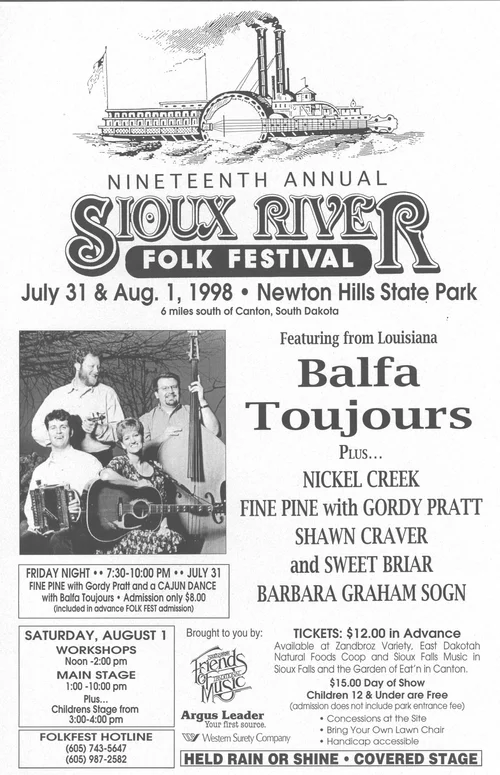
quote:
Originally posted by ShawnCraverI lived in Sioux Falls for about 5 years or so and had a bluegrassy/folky trio called Sweet Briar. We played that festival in 1998.
Nice detail using a plectrum banjo for the paddle wheel!
quote:
Originally posted by Brian Woodquote:
Originally posted by JonDI had a couple online lessons with James Kelly and he used an analogy that has stuck with me, in which a tune is like a landscape painting in which there is a foreground and a background. Your eye is drawn to the foreground by the design of the painting which mainly tells the story the artist is trying to tell-- and it pays less attention to the background images (which can still be important to the story, just more subtlely). Similarly the bowing approach ideally gives emphasis to some parts (the 'core' of the tune) but less to others, such as passing notes. I try to think of a tune in these terms -- which parts really 'make' the tune, and use the bow to make that happen.
I am trying to be sympathetic to this view of a painted landscape. I see it in the sense of knowing a tune in it's entirety. It is somewhat mysterious how one can know a tune as a whole but it's true for all kinds of music. You know 8 Days A Week, Stairway To Heaven, Mary Had A Little Lamb, and Paddy On The Turnpike as whole things, units. Yet, when it comes to playing them and knowing them as they are, you start at the beginning and follow the trail. I don't think it's useful to think of learning or playing tunes in a wholistic sense. When you actually engage with them they are linear. You can't actually play a tune holistically.
While one concept of "whole" simply as complete, as linear start to end sum. But focus is just as of physical individual components, or steps then strung together; on linear clock time unit grid (for example 125ms) path, completion is just getting to the end of instructions.
However, the "wholeness" in Holistic; is generally described as focus about perceived essence, sense of the system itself; the properties, qualities and essence that come from taken as the overall; larger scales of interconnected system. The properties and qualities which come from contextual, relationships, movement, flow, pattern; shape, form, structure, layers; a mental cognition that create or help define the "essence" of the thing. Some folks also use "holistic" to include the spirit/emotion qualities (expression, feel, energy, heart and soul...) as part of the essence; as well as how the context of environment/surroundings might play role.
The larger scale, overall context can affect/alter the properties and qualities of the of individual component; in how they relate to the whole, in terms of role, function, meaning, significance, perception and understanding.
With that, many people can and do relate to, perceive and experience music in holistic way. Listening, engagement, learning and to know a piece of music as more holistic experience, and it's essence. (more than just linear sum of individual note events).
I don't think it's useful to think of learning or playing tunes in a wholistic sense.
Many people (myself included) can and do apply that holistic experience and concepts toward learning, knowing and playing; find that a focus thinking in terms holistic aspects useful in many ways, if not integral toward their personal goals of what means to learn, know and play the music.
Edited by - alaskafiddler on 09/08/2026 20:36:33
yes this is a weird thing to say maybe-
but during the “absorption” of a tune, sometimes the notes feel flexible and optional and less Important…like you could sub an A for a C, leave out some notes and just play a long tone…skip the note and have a little rhythmic space there…you have the overall key and shape and spirit of the tune, and the actual note tones feel like small flexible details. I think this might be the spirit of ‘variation’ that I am starting to stumble on…but it’s been creeping into my playing.
quote:
Originally posted by NCnotesyes this is a weird thing to say maybe-
but during the “absorption” of a tune, sometimes the notes feel flexible and optional and less Important…like you could sub an A for a C, leave out some notes and just play a long tone…skip the note and have a little rhythmic space there…you have the overall key and shape and spirit of the tune, and the actual note tones feel like small flexible details. I think this might be the spirit of ‘variation’ that I am starting to stumble on…but it’s been creeping into my playing.
NFN, it's been said, when one learns a tune from memory is similar to coming up the tune yourself (originally). It's said to come from the same place. Where that is, we don't really know. I used to be really attached to a few challenging tunes. But my memory has always been mooshy. I can never remember keys. If I hear a tune, by the time it gets under my fingers, it's typically in D. Then I move it to satisfy the others.
Hmmm. I think a person can think of a fiddle tune as being a little journey from the start to the finish... but in my experience... fiddle tunes are more vehicles for creating an atmosphere...summoning up a storm as the old saying goes etc.
Many of the old fiddlers I spoke to about fiddle music never described the music in a linear or technical manner, but more in terms of what kind of 'storm' or mood a fiddler could summon up.
I recall one conversation with a man named Bus Harvey... in Southern Garrett County Maryland (just over backbone Mountain from West Virginia).
When I asked him about the famous Harvey family of if fiddlers there, he described one at a dance (all the Harveys fiddled) as 'elevating'... He'd start the tune bobbing up and down then jumping, then said it was almost as if he was elevated in a cloud and the dancers couldn't help but dance as they became so 'light' on foot... That sort of thing... It was never about executing a tune from start to finish.
People get uncomfortable with 'superstition' like this... but that's my experience in talking to old fiddlers on how they viewed the music.
PS Shawn - looking over your flyer, just wanted to add - fan of Nickel Creek here! :-) had some of their stuff on repeat for years.
To flesh out my post a little bit...
I think how one views the music is going to determine how one learns it... and ultimately performs it.
And none of this negates the technical or systematic aspects of learning a tune.
Shawn - Interesting story. Back in my active playing days, some audience members claimed they saw our band "elevate" while playing. As a band member, I'm a little skeptical about this, but maybe a D-28 guitar was too heavy to "lift off" much.
But as Tommy Jarrell sang "Get to feelin' much better, gonna sprout wings and fly."
Edited by - DougD on 09/10/2026 10:15:48
quote:
Originally posted by ShawnCraverTo flesh out my post a little bit...
I think how one views the music is going to determine how one learns it... and ultimately performs it.
And none of this negates the technical or systematic aspects of learning a tune.
Absolutely true! Visualization is so so powerful. That's such a big part of how isolated communities had their own style decades ago, and how today the bar is being continuously raised. We have so much more access to a broader range of music than our ancestors did so we visualize greater possibilities.
I don't find myself in disagreement of those favoring a holistic description of music. What I was trying to convey was the difference between a painting or photograph or sculpture, which actually exist "all at once", and dynamic forms of art like music, which exist in time. One feels music in many ways but it is actually linear. That's all. To me it is a mysterious thing that the sense of something whole can be made by unfolding in time. The mysterious element of time is an intrinsic part of music and not to be dismissed as unimportant. How it unfolds is where a sense of its whole emerges.
Terms of Use | Privacy Policy | Privacy Consent (EU/GDPR Only)
Copyright 2026 Fiddle Hangout. All Rights Reserved.

