DVD-quality lessons (including tabs/sheet music) available for immediate viewing on any device.
Take your playing to the next level with the help of a local or online fiddle teacher.
Monthly newsletter includes free lessons, favorite member content, fiddle news and more.
Premier Sponsors


|
Please note this is an archived topic, so it is locked and unable to be replied to. You may, however, start a new topic and refer to this topic with a link: http://www.fiddlehangout.com/archive/60157
Page: 1 2
NCnotes - Posted - 06/25/2025: 09:54:34
I play mostly Irish Trad tunes, some Scottish…but they are not really double-stop-heavy genres.
However I heard that a flatter bridge can give you a warmer sound, and make for easier (lower-effort) string crossings? That all sounds like something I’d like…!
1. Is the above ‘word of mouth’ true?
2. Is it expensive?
Once I have a flatter bridge, am I gonna keep hitting 2 strings at once when I don’t want to?
Wondering!
Thanks! :-)
Edited by - NCnotes on 06/25/2025 09:55:11
The Violin Beautiful - Posted - 06/25/2025: 11:01:03
quote:
Originally posted by NCnotesI play mostly Irish Trad tunes, some Scottish…but they are not really double-stop-heavy genres.
However I heard that a flatter bridge can give you a warmer sound, and make for easier (lower-effort) string crossings? That all sounds like something I’d like…!
1. Is the above ‘word of mouth’ true?
2. Is it expensive?
Once I have a flatter bridge, am I gonna keep hitting 2 strings at once when I don’t want to?
Wondering!
Thanks! :-)
1. Nonsense
2. No
Bridge curvature has nothing to do with warmth. It is sometimes suggested that a lower neck height and the resulting lower bridge make a fiddle warmer, but I don't find that to be necessarily true. It tends to make the sound more two-dimensional and/or muffled. Adjusting bridge curvature, though, is a matter of function for the bow. By flattening the curve, it lessens the amount that the bow moves in string crossings. With the strings closer to being in line with each other it can be minimally easier to play chords. Going too flat causes issues, though, as the bow starts catching other strings too much when it's not wanted and passages become very muddy.
Consider the fingerboard as well. It is shaped to a specific radius and carefully planed to a specific scoop to facilitate playing. The standard bridge template is designed to give proper clearance for all four strings. If you flatten the curve, you're essentially lowering the middle strings while maintaining the outer string heights. That can sometimes be an issue. The nut helps to alleviate some of it by being shaped to accommodate the fingerboard and strings. I cut "fiddle" bridges for some of my customers who prefer that shape, but I always make sure I've explained what's being compromised before doing it.
Another thing to consider is bowing technique. Players can easily forget just how close the strings are and how little motion is needed for string crossings. Solo Bach can be a great remedy for this if studied conscientiously. A lot of players have a bad habit of lifting the arm far too much in string crossings and exaggerating the distance. Drive the string from below the elbow and keep the upper arm in support. It's a myth that classical music makes little use of chords and double stops. Here's a good example of a piece that is played with a standard violin setup and involves chordal playing throughout:
youtu.be/Jbxh8d1Sv8w?si=EZdm9pOVhXg6PfV5
Although I don't believe in deceiving my customers and would never do it, I've heard from colleagues that they have fooled fiddlers into thinking they made flatter bridges by simply changing the look of the edges of the bridge and leaving the curve alone.
If you really feel the need to change the curve, it can be done easily enough in minutes and costs very little. However, I would just point out that the violin was designed to do many different things, and changing the setup for only one sort of playing limits its capabilities in terms of functionality.
pete_fiddle - Posted - 06/25/2025: 11:29:20
Keep your Bridge NC It sounds good to me. (from what iv'e heard). Better the Devil you know...
Edit: Double stops thing is just practice.
Edit 2.0: Maybe give a wire mute a try if yo want warmer? they are ultimately adjustable. Loads of players use them.
Edited by - pete_fiddle on 06/25/2025 11:35:48
DougD - Posted - 06/25/2025: 11:46:37
Well, you can get out the file and sandpaper or pocket knife and flatten your bridge in a matter of minutes - or ruin it. I'd suggest that if you really want to experiment with the shape you have a luthier cut a new bridge for you from scratch, and keep your perfectly good one. I suspect that having played on a "standard" shaped bridge as long as you have, you will likely have trouble adapting to a flatter one, but who knows?
Don't you have some work to do to keep you out of mischief?
NCnotes - Posted - 06/25/2025: 12:36:44
Thanks all!
Haha Doug, workwise I am in a holding pattern...sent a bunch of stuff to the client yesterday and there is that unnerving dead silence...if I hadn't been doing this for 30 years, I'd be nervous!! :-O
But instead, I'm fiddling around...hahahaha.
Hmm thanks Rich, so tone change by lowering the bridge is a myth, huh!
(People are truly propagating and saying this...)
That was probably my main curiosity.
Even after changing my bowing technique a lot**, I would still like to go darker/mellower on sound. I'm not to the point of instrument 'shopping' - but I may took a look into a wire mute (that, at least, does not sound expensive! :-)
String crossings are currently no prob - so yea, Pete is right, why mess with it -
I think I'll just leave my bridge!
Is the flatter bridge more popular amongst players who play tons of doublestops?
Or who need to play 3-string doublestops? (OT / bluegrass?)
**Thanks to James Kelly - who taught me to use 90% less bow, stop using bow pressure, downplay changes of the bow ... my whole bow arm works different now.
NCnotes - Posted - 06/25/2025: 12:46:17
re a couple other comments of Rich:
"Solo Bach can be a great remedy for this if studied conscientiously. " LOVE Bach...
"I've heard from colleagues that they have fooled fiddlers into thinking they made flatter bridges by simply changing the look of the edges of the bridge and leaving the curve alone."
Whoa - so I wonder if there is a Placebo effect and the fiddlers are like, Hey now I can play better!
farmerjones - Posted - 06/25/2025: 12:54:50
It's too bad you don't have two bridges. One for tweaking, and one just in case.
Rich mentioned lowering the two middle strings. Well, it seems simple, but you start by lowering the string by half the thickness of the string, or less. Thousandths of an inch.
I'd start by getting a $20 blank bridge. Getting a qualified person to fit the new bridge. Tell said person you want it identical. I was lucky. I got to watch over my luthier's shoulder.
Is you luthier close by? Is he/she going to soak you for a new bridge? These are things to consider. I suppose youtube has videos now. Nothing’s a mystery. Even open heart surgery.
pete_fiddle - Posted - 06/25/2025: 13:09:47
I wouldn't mess with my fiddle, it takes on a different character with a change of strings, let alone a change of bridge. The wire mute will mess with aluminium.... ( or Gold...lol),.. wound strings. But they are ok with steel strings, as long as you don't pull it back over the fancy windings.
Flatter Bridge will mean you don't have to lift or lower your right elbow as much, so you may find that you are making double stops or playing open strings when you maybe don't want to. IMO better to mean it, (the double stop/Diad/Chord/Interval, or whatever), than hit it unknowingly.
Edited by - pete_fiddle on 06/25/2025 13:22:25
Lonesome Fiddler - Posted - 06/25/2025: 13:49:36
All my three fiddles have bridges with slightly different heights & curvatures. In any case, I can quickly adjust to the different shapes on the fly. Anyway, yeah, I do think it's fun that my cheapest fiddle, bought at an L.A. folk/bluegrass store, 'way back when, does have a fairly flat bridge that invites (and perhaps even demands) two-string bowing.
pete_fiddle - Posted - 06/25/2025: 13:59:19
To my thinking , OT Players are more "wrist" less bow, open tuning players, and Classical are more "arm" more bow, standard tuning players. of course there are anomalies, but that is my personal opinion.
In which case a flatter bridge would tend to suit an O/T player, and a standard bridge would tend to suit a Classical player. Both have there merits and limitations.
ShawnCraver - Posted - 06/25/2025: 14:34:59
Not to be contrary, but here's Irish fiddler Frankie Gavin hitting a bunch of strings all at once... youtu.be/RBNlvkZS2mU?list=RDRBNlvkZS2mU
From what I have seen, he uses a standard cut bridge (and handles single string passages and double stops/multiple strings quite nicely) youtu.be/RBNlvkZS2mU?list=RDRBNlvkZS2mU
A flatter bridge could mean a lower bridge which could mean not as much tension on the top... which 'could' result in a different none, but warmer? I agree with the other comments... I've never heard of it as a way to get warmer tone...
Old Scratch - Posted - 06/25/2025: 16:58:34
Is that some manner of wire mute on Gavin's fiddle? Sure looks like it ... !
Edited by - Old Scratch on 06/25/2025 17:02:58
DougD - Posted - 06/25/2025: 17:17:51
He's got some nimble fingers, doesn't he? That's an old video and it looks like a wire mute. Funny about those things - at one time lots of people used them, but now they're shunned as though they'll do horrible damage to your strings. Hard to keep up.
NCnotes - Posted - 06/25/2025: 20:40:10
Here is my story about Mr. Gavin…
he developed cancer and needed surgery but they wanted to go “private”. So a fundraiser was organized and I (along with many other visitors to the session.org and other fans) donated a bit. I was happy to hear that he was back to playing.
But Then…he came to my town to give a concert!!!
I showed up after work expecting a mad crowd of people…it was really crowded and seats filling up fast...wandered in, and spied my flute friend sitting front row center! I said, “Are you saving this…?” She said, “Nope. have a seat.” I sat down and said, “Wow…When did you get here?!” She said, “One hour before they opened the doors.” So I had a front row seat right in front of Frankie!
He told lots of very Irish jokes and played like a dream…he is not young, but he has still got such fast fingers! (he’s actually in the Guinness Book of World Records for playing a reel at 140bpm or something?) He also played some gorgeous airs on the flute.
Edited by - NCnotes on 06/25/2025 20:42:54
NCnotes - Posted - 06/25/2025: 20:51:29
PS
Yes I think his fiddle is wearing a wire mute? interesting! So I’m not the only one that seeks a mellower sound… :-)
PPS
Second tune is Tommy Coen’s ‘Christmas Eve’ reel. He’s actually playing at a pretty leisurely pace (for him :-D
buckhenry - Posted - 06/25/2025: 20:53:12
I messed with my bridge. I asked the luthier to cut a bridge just a little higher than standard. Then I went to town gradually filing it down, as Steve said: half the width of the string at a time, that saves the location of the string grooves. Then I re-tensioned the strings to pitch and tested the string height by playing for a bit. I must of done that about three or four times until I found my desired height.

wrench13 - Posted - 06/26/2025: 02:19:01
I used to play with a flattened bridge a long time ago, also chasing any way to improve my sound (without putting in the work). It was hard to adapt; it makes striking an adjacent string accidentally much more likely. It made doing shuffles easier. But I eventually went back to a standard bridge curvature. The fiddle I had then, my Tyrolean 1879, lost sonority on the D and A strings, and more importantly, when I played other fiddles with std curves, it took awhile to reorient my bowing. These days I'm a fanatic about all my fiddles having the exact same set up. I was finding small differences between them affecting my playing and fiddling is too damn hard to begin with to add anything that impedes it.
The Violin Beautiful - Posted - 06/26/2025: 06:32:12
quote:
Originally posted by NCnotes
"I've heard from colleagues that they have fooled fiddlers into thinking they made flatter bridges by simply changing the look of the edges of the bridge and leaving the curve alone."
Whoa - so I wonder if there is a Placebo effect and the fiddlers are like, Hey now I can play better!
Yes, it's exactly that. The customers would report that it was so much easier to play now that the bridge was flatter and the luthiers would try their best to keep a straight face, knowing that they hadn't touched the curve. It's a bit like the stories about fussy players who ask for a soundpost adjustment, and the luthiers just take the instrument into the back of the shop and let it sit for a few minutes before bringing it back out; then the players try it and gush about the huge change in sound. There are always people who get some wild ideas about violins and lose all grip on reality, some in the fiddle world, some in the classical world. They are typically handled in one of three ways:
1. The moment they start to act crazy, send them to someone else or just refuse service
2. Ignore what they say and just do what will actually work. In this option one either tells the player that the violin is the customer, not the player, so all adjustments are for the sake of that instrument instead of a player's whims, or simply pretends to have done what was asked in order to placate the unreasonable demands.
3. Work with the customer to try to get to the bottom of the matter, going into lengthy discussions about causes and setup theory and making countless adjustments and devoting a huge amount of time and attention at the expense of the business.
The third one is what I do because I am always trying my best to do right by both player and instrument, but it comes at a very high cost to time and income.
Back to the question of the bridge, lowering it DOES impact tone, but it doesn't have to be lowered overall to flatten the curve. One only needs to remove wood from the middle strings. If G and E heights are right already, recutting the entire curve will make them too low. As the bridge gets lower the violin loses carrying power and resonance. Even a change of half a millimeter makes a significant difference. But what's key is projection, because issues with a bridge that's been cut too low can be resolved with a new bridge, but a low projection requires an adjustment to the neck angle.
The Violin Beautiful - Posted - 06/26/2025: 06:36:03
quote:
Originally posted by buckhenryI messed with my bridge. I asked the luthier to cut a bridge just a little higher than standard. Then I went to town gradually filing it down, as Steve said: half the width of the string at a time, that saves the location of the string grooves. Then I re-tensioned the strings to pitch and tested the string height by playing for a bit. I must of done that about three or four times until I found my desired height.
Is this what the original bridge curve looked like?
NCnotes - Posted - 06/26/2025: 08:30:12
Funny about the placebo effect for players - I actually think I would be very prone to that!
Thanks for being the #3 type Rich…what a person dreams of in their luthier…
At the risk of wandering off the rails (sorry sorry)…
So I found a treasure of old threads on FHO about the wire mutes.
And, along with that - talk of dollar bill mutes!
This morning I tried a dollar bill mute and it’s perfect…takes a little of the edge off, just enough, but still sounds like my violin. The rubber tourte mute I had, makes it sound like a shoebox - but this dollar bill worked wonders. I can even angle it to put a tad more damping towards E. I may test out a Sibhon wire mute as well…it costs like $6-$7, so not a huge financial risk. :-)
( Hmmm…with the addition of my dollar bill mute, have I officially become a “fiddler” and not a “violinist”! )
The Violin Beautiful - Posted - 06/26/2025: 09:43:06
I’ve had a few adjustment appointments where I started out by adjusting to where I thought it sounded good and then spent an hour or two tinkering at the customers’ request, only to end up moving everything to the place I had it the first time. That’s just how it goes sometimes, especially if the players are curious to see just what will happen by pushing the violin in different directions with adjustment. It can feel a bit counterproductive to spend a lot of time just to return to the same spot, but my goal is for every player to walk out the door with us in agreement that it’s sounding and feeling better, so if it takes a while to get there, it’s a sacrifice that’s worth it to me personally.
The money mute is an old orchestra trick too, so not really fiddling-specific. There are always jokes that the closer to the first desk you sit, the higher the denomination of the bill needs to be.
wrench13 - Posted - 06/26/2025: 10:58:54
BEST ANSWER, EVER!!
1. The moment they start to act crazy, send them to someone else or just refuse service
NCnotes - Posted - 06/26/2025: 11:04:49
quote:
Originally posted by ChickenManDollar dollar bill y'all
I was debating between my 20 and my 1 (my 20 is crisper and newer) ...
but then I was like Naw, and I used the $1. 
Nice pic! You use yours closer to the bridge than mine!
ChickenMan - Posted - 06/26/2025: 14:26:48
I use it in all the ways. Up close will quiet it down a decent amount but it still sounds like a fiddle rather than all tinny like a rubber mute. Your observation about angling it is spot on. Such a versatile tool.
pete_fiddle - Posted - 06/26/2025: 14:51:17
Thing is that IMO changing any string tensions by adjusting string heights or bridge curves etc will not be immediately noticeable, as the wood and glue has to acclimatize to its new position.
Then you have to adjust your playing to the new setup and try to make the best of it with the same bow rosin, and fingers that you had with the previous setup it's a logistical nightmare. it is much simpler to adjust your tone by other means. Eg: more/ less bow weight, sounding point etc especially if you have a decent tone in the first place.
Brian Wood - Posted - 06/26/2025: 15:20:26
quote:
Originally posted by pete_fiddleThing is that IMO changing any string tensions by adjusting string heights or bridge curves etc will not be immediately noticeable, as the wood and glue has to acclimatize to its new position.
Then you have to adjust your playing to the new setup and try to make the best of it with the same bow rosin, and fingers that you had with the previous setup it's a logistical nightmare. it is much simpler to adjust your tone by other means. Eg: more/ less bow weight, sounding point etc especially if you have a decent tone in the first place.
I'm not sure why you think changes in the bridge take time to be noticeable. Any change is immediately noticeable. I fit bridges fairly often. I prefer an arch just slightly less that a typical bridge, but flat is not a description I would give it. Once I have made the initial curve I bring the strings down a little at a time until it's right using a bridge jack. It's simple to keep the string positions by drawing a vertical pencil line for each string (not perpendicular to their point on the bridge as that will make the strings closer with each lowering). Opting to not optimize your bridge and instead trying to compensate in the ways you describe makes no sense to me. It is separate issue from playing technique. Every player should have a decent setup.
buckhenry - Posted - 06/26/2025: 16:32:26
quote:
Originally posted by The Violin Beautifulquote:
Originally posted by buckhenryI messed with my bridge. I asked the luthier to cut a bridge just a little higher than standard. Then I went to town gradually filing it down, as Steve said: half the width of the string at a time, that saves the location of the string grooves. Then I re-tensioned the strings to pitch and tested the string height by playing for a bit. I must of done that about three or four times until I found my desired height.
Is this what the original bridge curve looked like?
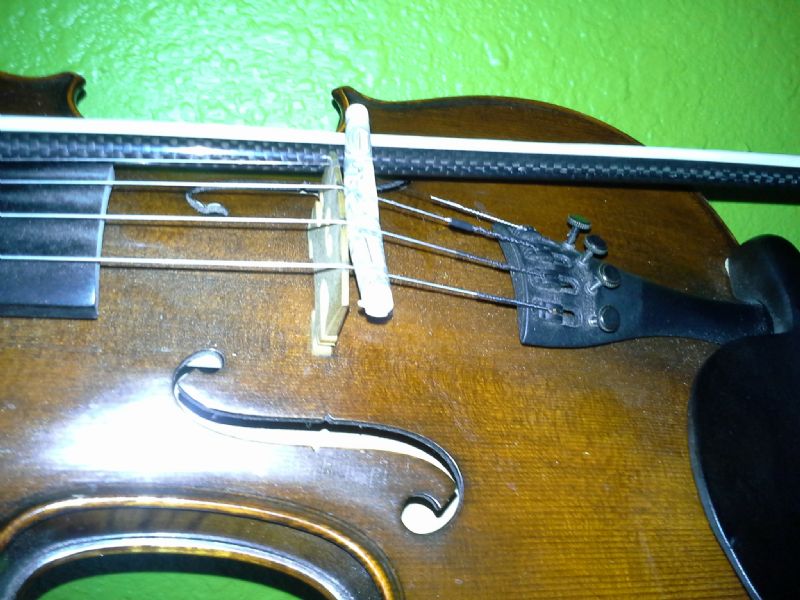
I asked the Luthier to cut the bridge as it is in the picture, he said it was harder to do that but he was very obliging. He played a little prank with me by filing both sides as required and left the middle with point, HaHa, but it didn't take him much time to file it down.
I saw a picture of ancient bridges and one had the curve as in the pic. This seemed logical to me, the outer strings dont look like they're going to role off the CD curve bottle neck shoulders. The Luthier didn't say that this bridge curve could have detrimental effects to the sound production, but I'm predicting you may have something to say about that.
Brian Wood - Posted - 06/26/2025: 19:30:23
Of course the curve is just an artifact. It is the points of the string notches, the angle at which any pair is related to the other pairs, that counts. Any 2 strings are in a line regardless of the bridge shape. The curve, or arc, determines the angle at which you're able to reach every other string or every adjacent pair of strings. In practical matters you need enough curve to be able to play any string without accidentally playing an adjacent string.
farmerjones - Posted - 06/26/2025: 19:46:12
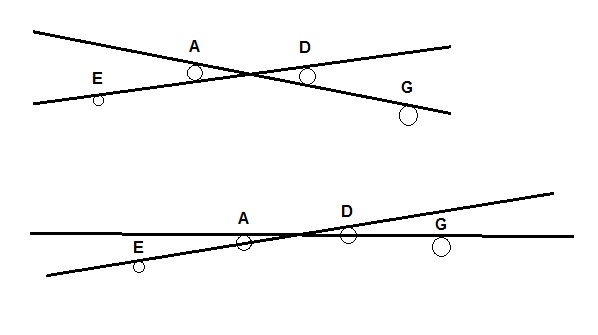
In my world the straight-edge is a business card of indeterminate thickness. But the point of the illustration is to show where I insert the straight-edge to check the (let's call it) 'flatness.'
This could be the reason I like a very stiff bow. You can't monkey around with some sloppy/floppy/flexy bow.
Edited by - farmerjones on 06/26/2025 19:49:33
pete_fiddle - Posted - 06/26/2025: 23:25:28
Wood and glue both move, especially under tension, and take time to settle to there final place. So although immediately noticeable, you don't really know what you have done until you have played your newly set up fiddle for a while.
wrench13 - Posted - 06/27/2025: 05:20:26
quote:
Originally posted by pete_fiddleWood and glue both move, especially under tension, and take time to settle to there final place. So although immediately noticeable, you don't really know what you have done until you have played your newly set up fiddle for a while.
I agree w/Pete here. A change in bridge height WILL show some immediate effect on playability, as discussed, but said change will take time to manifest changes in sound. It may be too subtle for some ears to hear, but c'mon - these thin walled, incredibly stressed wooden boxes that are expected to actually sound GOOD, react to minor stuff like changes in humidity and other forces and conditions. How could a change like bridge height not affect it? THink of wood as a very crowded elevator, packed wall to wall, going from 1st floor to the 110th. A shift by one person in the corner makes everyone reposition themselves a tiny bit. And it takes time for everyone to do that.
Like I said, it is subtle, and some ears will not hear much, if any, difference. Hell, I hear the difference if I use one to many swipes with the rosin cake.
pete_fiddle - Posted - 06/27/2025: 15:45:40
A fiddle imo, is designed to hold it's self together within limits. I think a luthier could make a fiddle that would sound amazing for a week or two, but never stand up to 200 years of playing before it imploded, (or at least sounded less than amazing). ... How many pounds/kilo's of pressure are on that bridge? And yet a half a gram of weight near to the bridge can alter the tone dramatically. let alone ergonomic parameters, atmospheric conditions and players idiosyncrasies etc.
That, and the fact that is in constant flux with changes in humidity and sweating on it etc, and getting it to vibrate under tens of pounds of pressure exerted by the strings and bow pressure for two hundred years or more, without cracks developing in the 2mm thick softwood sound board is the luthiers job.
Edited by - pete_fiddle on 06/27/2025 15:56:02
The Violin Beautiful - Posted - 06/29/2025: 07:03:53
Wood does go through structural changes over time, but with proper care and maintenance, once it’s gone through a period of settling in its infancy, it will remain fairly stable over time. Eventually the top will become shorter as the wood dries out more and the arching rises, but it takes hundreds of years for that to occur, and it can be easily corrected.
Hide glue, however, is prized for its stability. It does not creep, an issue that one finds with many other adhesives over time. Hide glue gels as it dries but then becomes hard like glass and remains that way unless it’s softened by high heat or moisture.
After raising projection, the difference is immediate and obvious. It will continue to change a little after this work is done, but only in the positive direction. The beauty of raising projection vs. a full neck reset is that there is less of the top being opened and the chances of the projection dropping lower are almost nil if the work is done properly and the violin is cared for properly.
pete_fiddle - Posted - 06/29/2025: 11:51:05
quote:
Originally posted by The Violin BeautifulWood does go through structural changes over time, but with proper care and maintenance, once it’s gone through a period of settling in its infancy, it will remain fairly stable over time. Eventually the top will become shorter as the wood dries out more and the arching rises, but it takes hundreds of years for that to occur, and it can be easily corrected.
Hide glue, however, is prized for its stability. It does not creep, an issue that one finds with many other adhesives over time. Hide glue gels as it dries but then becomes hard like glass and remains that way unless it’s softened by high heat or moisture.
After raising projection, the difference is immediate and obvious. It will continue to change a little after this work is done, but only in the positive direction. The beauty of raising projection vs. a full neck reset is that there is less of the top being opened and the chances of the projection dropping lower are almost nil if the work is done properly and the violin is cared for properly.
i am afraid i am going to have to respectfully disagree...."the top will become shorter as the wood dries out"
wood does not, (or it is negligible) become shorter in length (in the direction of the grain), over time. the greatest changes in shrinkage and expansion occur radially and tangentially, that as i am sure you are aware is the reason why cracks develop along the gran rather than across it.
Then there is "Hide glue, however, is prized for its stability. It does not creep,"
The thing with hide glue is that it can and does "creep" giving the wood a little freedom to move in differing atmospheric conditions and resets in its minusculely different position rather than holding on until the wood cracks. depending upon the mixture of the hide glue.. And also allowing a luthier to disassemble an instrument without tearing the wood. The well cared for and maintained instrument, like an old pair of boots, over time, becomes comfortable in its environment within practical limits....Or splits down the grain or falls apart..etc
The Violin Beautiful - Posted - 06/29/2025: 12:58:08
quote:
Originally posted by pete_fiddlequote:
Originally posted by The Violin BeautifulWood does go through structural changes over time, but with proper care and maintenance, once it’s gone through a period of settling in its infancy, it will remain fairly stable over time. Eventually the top will become shorter as the wood dries out more and the arching rises, but it takes hundreds of years for that to occur, and it can be easily corrected.
Hide glue, however, is prized for its stability. It does not creep, an issue that one finds with many other adhesives over time. Hide glue gels as it dries but then becomes hard like glass and remains that way unless it’s softened by high heat or moisture.
After raising projection, the difference is immediate and obvious. It will continue to change a little after this work is done, but only in the positive direction. The beauty of raising projection vs. a full neck reset is that there is less of the top being opened and the chances of the projection dropping lower are almost nil if the work is done properly and the violin is cared for properly.i am afraid i am going to have to respectfully disagree...."the top will become shorter as the wood dries out"
wood does not, (or it is negligible) become shorter in length (in the direction of the grain), over time. the greatest changes in shrinkage and expansion occur radially and tangentially, that as i am sure you are aware is the reason why cracks develop along the gran rather than across it.
Then there is "Hide glue, however, is prized for its stability. It does not creep,"
The thing with hide glue is that it can and does "creep" giving the wood a little freedom to move in differing atmospheric conditions and resets in its minusculely different position rather than holding on until the wood cracks. depending upon the mixture of the hide glue.. And also allowing a luthier to disassemble an instrument without tearing the wood. The well cared for and maintained instrument, like an old pair of boots, over time, becomes comfortable in its environment within practical limits....Or splits down the grain or falls apart..etc
I'm afraid this is all wrong. As spruce dries out it does in fact become shorter. When the wood is freshly cut it goes through a lot of shrinkage rapidly. This is why factory instruments made with improperly dried wood are so problematic and prone to warpage and shrinkage cracks. Some companies send their violins out with the seams unglued so that they won't arrive cracked when the containers are opened from shipping them overseas and the humidity goes down significantly after the wood has retained a high moisture content on the voyage. After the initial drying period, the wood becomes much more dimensionally stable, but over hundreds of years, it continues to release moisture and shrink. This is why old violins need their ribs shortened eventually. You won't find an old Cremonese violin with its bottom rib uncut for this very reason. Endgrain shrinks more and cross grain, so the plate gets shorter, not narrower.
And hide glue is prized for its lack of creep over time, unlike PVA or other glues, which are well known for suffering from issues like this. Although hide is used because it can be undone with heat and moisture, a strong glue joint can last centuries or more. There are baroque instruments with their original necks still intact 400 years later. One of the most common bad repairs that a luthier comes across is repair with wood glue as an "improvement." Unlike hide glue, it creeps over time and the repairs fail, especially when under string tension like the neck. Strings add between 50 to 75 pounds of pressure on the top. That constant pressure can deform an arch over time if not carefully maintained, and many old violins eventually have their arching corrected or they deform so much that their arching no longer resembles the original.
Cracks develop typically along grain lines because spruce is structurally strongest along its grain. Shearing cracks do happen, though as odd as it may seem. Saddle cracks usually occur because of spruce shrinking around the saddle and tightening the fit to the point that the saddle splits the top apart. Other cracks can happen because of shrinkage or impact or concentrated pressure in too small an area (like a poorly fitted soundpost).
Brian Wood - Posted - 06/29/2025: 13:15:01
quote:
Originally posted by The Violin BeautifulCracks develop typically along grain lines because spruce is structurally strongest along its grain. Shearing cracks do happen, though as odd as it may seem. Saddle cracks usually occur because of spruce shrinking around the saddle and tightening the fit to the point that the saddle splits the top apart. Other cracks can happen because of shrinkage or impact or concentrated pressure in too small an area (like a poorly fitted soundpost).
Most of what you say makes sense. I am unused to the claim that seasoned spruce shrinks in length over time, however. I would say that shrinkage in length is negligible. Across the grain yes, with the problems you describe. Maybe you can explain more what you mean about longitudinal shrinkage. Is that what you mean by "shearing cracks"?
pete_fiddle - Posted - 06/29/2025: 14:08:10
oh just ask Ai, (i haven't done yet, i am that confident).
Wood doesn't shrink or expand hardly at all longitudinally, but it does radially and tangentially. and hide glue is used so that you can take it apart with water/moisture. pva will hold on unti the wood cracks. and you wont get it apart without splintering the wood
i made some gates from tongue and groove pine and they grew about 4-6inches in width but not at all in height. and they split the morticed upright post along the grain.
ps: i live wood.
Edited by - pete_fiddle on 06/29/2025 14:20:19
pete_fiddle - Posted - 06/29/2025: 14:59:03
Also it doesn't just keep "releasing" moisture, it also gains it from the humidity of the surrounding atmosphere so it will also expand if the humidity is more than the wood. It is in constant flux. The only way i can think that wood would loose length is if it was rotten and the cellular structure was collapsing like a concertina, or the cell walls where flaking away.
The Violin Beautiful - Posted - 06/29/2025: 16:58:15
quote:
Originally posted by pete_fiddleAlso it doesn't just keep "releasing" moisture, it also gains it from the humidity of the surrounding atmosphere so it will also expand if the humidity is more than the wood. It is in constant flux. The only way i can think that wood would loose length is if it was rotten and the cellular structure was collapsing like a concertina, or the cell walls where flaking away.
Pete,
You really need to do some reading up on what happens to wood over time. It goes through cycling with moisture seasonally, but over time it continues to release its moisture, which is why old wood gets brittle and lower in density. Even if a plate is submerged in water it will release moisture and return to its previous humidity level. I am personally familiar with a fine violin that was involved in a car accident years ago and ended up submerged in a creek for at least a full day. The violin came apart as the water released the glue, but it was placed in a special box with a fan attached and slowly dried over a period of weeks so that it wouldn't crack from drying too quickly. Once it had gradually returned to the proper moisture level it was reassembled and it went back to regular use in the major orchestra where it had been played. It is still doing well today. I've also heard about a major restorer disassembling a Strad by placing it in a tank full of water so that it would come apart smoothly without any risk of wood chipping out with an opening knife.
Spruce boards are especially prone to tangential and radial shrinking, but they do also shrink a bit longitudinally (less than 1%). However, a couple things are important to note: the measurements taken of wood shrinkage are usually done over a comparatively short period of time, not the centuries that a violin is considered. Boards aren't being measured by the half millimeter like violins, so a little shrinkage isn't so noticeable. Also of importance is that the thinner a piece of spruce is, the higher its chance to shrink longitudinally. The spruce in a top is 2.5mm or less in spots, typically no more than 3.5 or 4 at its thickest, so that's pretty thin. It's no surprise that there's more observable shrinkage there.
Fine old violins are carefully examined and measured over time, and the shrinkage of the top is something that restorers come up against routinely. What happens is that the top shrinks longitudinally and pulls the ribs out of their plane. The ribs buckle and bulge, and because the back doesn't shrink at the same rate, the ribs begin to protrude from the back. Eventually this becomes enough of a problem that the ribs have to be shortened, because the back in turn shrinks faster than the ribs, which are glued at their end grain. Tops and backs have a lot of exposed endgrain, so they are more prone to movement.
Saddle cracks happen with seasonal shifts because they cause a spike in dryness that shrinks the wood laterally enough and suddenly enough to split it. But longitudinal shrinkage is how plates get shorter over centuries (independent of arching deformation).
Brian Wood - Posted - 06/29/2025: 18:36:35
"Also of importance is that the thinner a piece of spruce is, the higher its chance to shrink longitudinally".
Another pretty questionable assertion. Exactly why would that be? I am not familiar with this problem of longitudinal shrinkage in properly built violins. It seems you are exaggerating or overstating something that practical facts don't support. You have a lot of experience in the field, however, so please elaborate.
The Violin Beautiful - Posted - 06/29/2025: 18:40:03
quote:
Originally posted by Brian Woodquote:Most of what you say makes sense. I am unused to the claim that seasoned spruce shrinks in length over time, however. I would say that shrinkage in length is negligible. Across the grain yes, with the problems you describe. Maybe you can explain more what you mean about longitudinal shrinkage. Is that what you mean by "shearing cracks"?
Longitudinal shrinking is seen a lot on very old violins. This is why when a violin is being measured along its length, the number of choice is Length of Back (LOB), never the top. As I've mentioned previously, the thinness of the wood has an impact on its rate of shrinkage and its dimensional stability.
Shearing cracks are cracks that occur across the grain. They occur less frequently and are usually the result of impact. Sometimes soundpost cracks can take this shape.
As the weather becomes more humid, soundposts fit more tightly. In dry climates they fit more loosely. Some of the change in fit is caused by the long arch moving as it softens with added moisture and compresses, some is caused by the soundpost itself absorbing moisture. You can make a loose post tighter in the moment by putting water at its ends, but the water will dry and the post will go back to being loose within a day or less. This is a trick used so that a post that's a little loose can be reset without falling if a customer refuses to have a new one cut. String tension will keep the post upright, although if the post is too loose it will make the top sink over time. A post getting too tight will often cause a bump to show up in the top, which is a warning sign to the player that a shorter one is needed.
NCnotes - Posted - 06/29/2025: 23:00:09
Interesting stuff!
So, I visited luthier on Friday and he did something to my soundpost and made the sound more like what I was craving. I asked what he did, and he said he “lowered the tension”. He said that he himself prefers an open, loud, bright sound that cuts through the group and I said, you are the opposite of me! I like a dark husky romantic sound…matching the breathy woody sound of my flute friend…
He also took a look at the bridge-less “attic violin” my friend gave me. I could tell he was ITCHING to fix it up, so I said “Yea, let’s make it playable again.” It has a small crack over the soundpost area…he said that would be ok and would not affect sound, and muttered something about how people thin the plate too much. I could tell that he just loves these type of “resurrection” projects…going to get it back next week…I’ll record something on it if I can!
All this luthier / build stuff has been quite interesting to read.
NCnotes - Posted - 06/29/2025: 23:03:29
PS
He mentioned that he would add a bridge, and redo the nut…but from the way he was examining it, I suspect he’s going to spend many hours on it and not necessarily tell me…due to his compulsion to resurrect the instrument…. ( Yea I do the same thing for my clients sometimes…:-D
pete_fiddle - Posted - 06/30/2025: 00:37:11
quote:
Originally posted by NCnotesPS
He mentioned that he would add a bridge, and redo the nut…but from the way he was examining it, I suspect he’s going to spend many hours on it and not necessarily tell me…due to his compulsion to resurrect the instrument…. ( Yea I do the same thing for my clients sometimes…:-D
i'm doing it now with my friend's chainsaw
pete_fiddle - Posted - 06/30/2025: 05:06:12
"Pete,
You really need to do some reading up on what happens to wood over time" Eh?...lol
RE: longitudinal shrinkage
From green fresh cut, to 0% moisture about 0.1% longitudinal shrinkage occurs on average. What is that on a 1ft long board which is already seasoned to suit it's required use, and undergoes limited humidity changes ?
your sound post trick mentioned earlier, works because the cells in the wood of the top and back expand with the water you just put on put on it. Not the sound post growing longer.
DougD - Posted - 06/30/2025: 07:01:39
pete fiddle - Do you mean you're resurrecting your friend's chainsaw, or are you using it to repair your fiddle?
For those who enjoy factual information, here's an article about shrinkage in wood:
wood-database.com/wood-article...hrinkage/
And some specific data about Norway (aka "German") spruce:
wood-database.com/norway-spruce/
The difference between the total volumetric shrinkage and the sum of the radial and tangential shrinkage should be the longitudinal shrinkage. Its a little higher in Norway spruce than other spruce species, but still very small.
pete_fiddle - Posted - 06/30/2025: 07:26:55
Point is that for all practical purposes the longitudinal shrinkage can be ignored, unless you ar making a 30ft long fiddle and don't want it to shrink in length more than a couple of millimeters or so... is this "wind the Brit up", or something...
Edit: And i need to fix his saw so that he will give me a hand with my fence.
Edited by - pete_fiddle on 06/30/2025 07:30:02
wrench13 - Posted - 06/30/2025: 15:11:44
I'm getting older, I don't like all this talk of wood shrinking! Got enough problems already.
Page: 1 2
Terms of Use | Privacy Policy | Privacy Consent (EU/GDPR Only)
Copyright 2026 Fiddle Hangout. All Rights Reserved.