DVD-quality lessons (including tabs/sheet music) available for immediate viewing on any device.
Take your playing to the next level with the help of a local or online fiddle teacher.
Monthly newsletter includes free lessons, favorite member content, fiddle news and more.
Premier Sponsors


|
Please note this is an archived topic, so it is locked and unable to be replied to. You may, however, start a new topic and refer to this topic with a link: http://www.fiddlehangout.com/archive/59595
BarFiddler - Posted - 12/27/2024: 18:46:54
I have been playing classical violin, with a smattering of folk music and rock crossover, for a few years now. It would be kind to call me a novice, as opposed to a well-intentioned violin torturer. But I managed to find a bar band that wanted a strings player, and we goof around with improv and have fun. I was content with that. So imagine my surprise when I went down to the bar this afternoon, and the bar owner pulled out a used 5-string electric violin that he found somewhere, and encouraged me to "try it out". He had no info on manufacturer, model, or age.
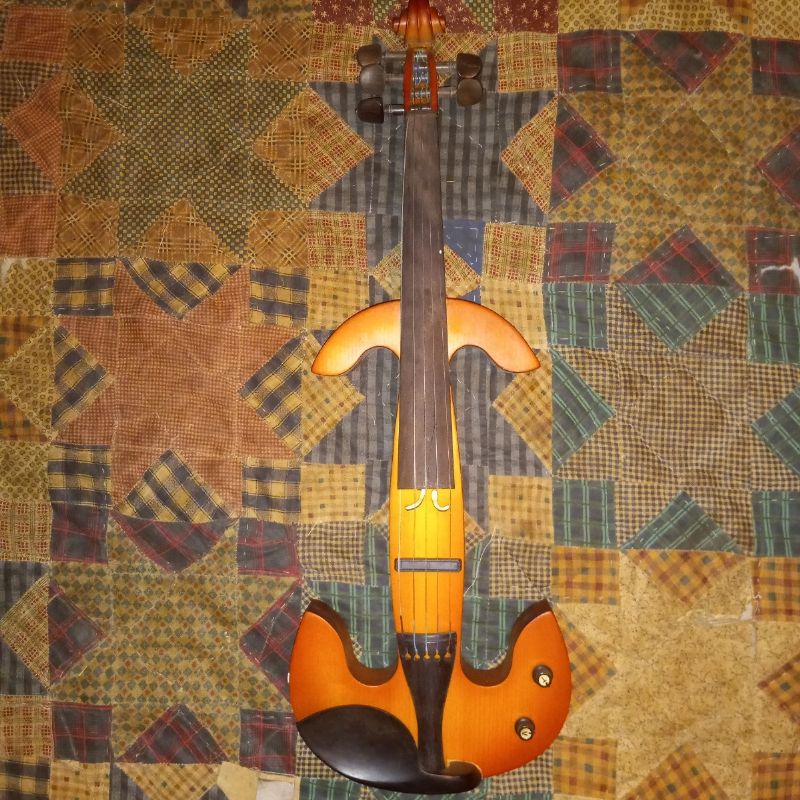
First problem, it's missing a bridge, which I'll have to look into getting fixed. It has a molded plastic pad where the bridge should be, and it looks like the bridge is supposed to sit within that pad on an inner spring-loaded platform. Everything else looks intact.
I went online to try to find some information about it, and was only able to find a single picture online of something that looked similar. That ad listed the violin as a Lido Hammerhead 5-string.
I have no idea what I'm doing with a 5-string fiddle, let alone whether a luthier can carve a bridge for me. I also don't know anything about playing an electric fiddle. I'm torn between saying "thanks but no thanks", and actually trying to get this thing repaired and back to playing music. If I decide to proceed, how exactly does someone go about learning 5-string electric versus 4-string acoustic violin playing? And would a typical luthier be able to make a new bridge for me? Any suggestions or words of wisdom would be helpful. Info about the Lido Hammerhead would be even more appreciated. Thanks!
Edited by - BarFiddler on 12/28/2024 12:04:36
wrench13 - Posted - 12/27/2024: 20:32:41
When someone offers you a free violin, you say "Yes, thank you!". Me I consider 5 stringers novelties, but its basically a 4 string with the C string of a viola. Most fiddlers I know using 5 stringers rarely use the 5th string anyway. Me - if 5 string violins were optimal, Ol' Strad would have been making them.
The Violin Beautiful - Posted - 12/28/2024: 07:00:13
quote:
Originally posted by BarFiddlerI have been playing classical violin, with a smattering of folk music and rock crossover, for a few years now. It would be kind to call me a novice, as opposed to a well-intentioned violin torturer. But I managed to find a bar band that wanted a strings player, and we goof around with improv and have fun. I was content with that. So imagine my surprise when I went down to the bar this afternoon, and the bar owner pulled out a used 5-string electric violin that he found somewhere, and encouraged me to "try it out". He had no info on manufacturer, model, or age.
First problem, it's missing a bridge, which I'll have to look into getting fixed. It has a molded plastic pad where the bridge should be, and it looks like the bridge is supposed to sit within that pad on an inner spring-loaded platform. Everything else looks intact.
I went online to try to find some information about it, and was only able to find a single picture online of something that looked similar. That ad listed the violin as a Lido Hammerhead 5-string.
I have no idea what I'm doing with a 5-string fiddle, let alone whether a luthier can carve a bridge for me. I also don't know anything about playing an electric fiddle. I'm torn between saying "thanks but no thanks", and actually trying to get this thing repaired and back to playing music. If I decide to proceed, how exactly does someone go about learning 5-string electric versus 4-string acoustic violin playing? And would a typical luthier be able to make a new bridge for me? Any suggestions or words of wisdom would be helpful. Info about the Lido Hammerhead would be even more appreciated. Thanks!
Five-string violins are not difficult to play if you've been playing the violin already, but they are cans of worms for luthiers. since there is no real standard for it, they tend to be all over the place and have to be considered case-by-case when setting up. Something you'll notice right away is that, assuming the bridge used is a typical 4/4 bridge, the strings have to be spaced to accommodate five string grooves instead of four. As a result, the strings have to be closer together. If the normal string spacing is used, the outer strings end up too close to the outer edges of the fingerboard and it will feel like your fingers are falling off the sides. You'll also find that there is less clearance between strings when doing string crossings, so you have to adjust your bowing a bit. Some makers use a wider neck to accommodate the extra string, although doing so tends to make the neck club-like and uncomfortable, not to mention considerably heavier. Five-string violins are typically 4/4 or slightly larger violins that have simply been made to accommodate an extra string so that the range can be extended. On acoustic violins, it rarely works very well, as the C string lacks the sonority of a true viola. Expect the C to feel fairly flabby and to require a different attack with the bow. With electric violins the lack of sonority can be overcome by the mixing board, amp, or preamp.
If your violin is indeed the Lindo Hammerhead, it looks from pictures that they use a normal bridge, in which case a luthier should be able to cut a new bridge for you. Some electric violins have leads that go into the bridge directly, but many of the entry level electric instruments have a platform for the bridge to sit on that captures the vibrations that are sent from the strings through the bridge.
With dedicated (non-acoustic) electric violins, the sound you get out is almost all determined by the mixing. However, playability is just as important as it is for an acoustic violin, so getting the bridge, nut, and fingerboard in good shape will make a huge difference. Unfortunately many electric violins have fingerboards that are not made to be adjusted, so you have to deal with them as they are. In the absence of a soundpost, the bridge becomes the most important part for sound, so give that the priority. String choice can also have some impact, not so much because of the tonal nuances of the strings themselves, most of which are lost without an acoustic body, but because of their response under the bow and fingers.
I haven't come across Lindo violins before, so I can't provide any specific information for your model. You can always post pictures of the violin for reference.
BarFiddler - Posted - 12/28/2024: 12:22:33
Thank you both for those responses! Yes, I felt compelled to smile and say "wow, thank you, that's such a neat-looking instrument! I'll do what I can with it!" While inside I was thinking "OMG what am I getting myself into?"
I've posted a picture of the violin. It's actually in decent shape. I looked closer at that platform that the bridge is supposed to rest on; it's definitely pressure-sensitive. And the body of the violin, such as it is, is hollow. So there's a wee bit of potential for resonance, but nothing like a classical violin. The body itself looks to be in good condition; no cracks or obvious abrasions. Someone took some time and care to assemble it carefully, and provided a creative cutout for a modified F-hole there in the middle. I do have a place to plug the amp cable into the body along the side, so apparently I don't need to plug into the bridge itself. That should make replacing the bridge easier. That C string defintely tries to slide off the fingerboard; you can see that tendency in the picture.
I've got a call into my local music store's luthier to see whether he can work with this or not. In addition to a new bridge I'll replace the strings, and have the luthier install those little thumb-adjuster widgets on each string so I can fine-tune the strings like on my acoustic violin. I guess now I need to start shopping for an amp. Suggestions on good amps for violins would be welcome. Let's focus on the lower end of the price range, and not too many knobs to fuss with. I just want to get this neglected creature back into service in some dignified form.
I was intrigued in my reading that the 5-string covers the range of the violin + viola, and is one octave higher than a cello. Wasn't planning to expand to those other instruments, but I always like to at least answer the door when Opportunity knocks. A big new horizon to explore now with my musical interests. I'll have to go back and visit some Youtube videos showing folks who really jam with their electric fiddles. I'm open to suggestions for which artists to go check out, either for rock, country, folk or Celtic. Those are my four main interests. I'll let my acoustic violin remain firmly established with classical.
ChickenMan - Posted - 12/28/2024: 12:39:48
Here's your photo posted
After you upload it, you have to tap it to attach it.
RinconMtnErnie - Posted - 12/28/2024: 15:54:37
Regarding amps, some acoustic amps to try would be a Fender Acoustasonic or a Fishman Loudbox.
Pretty much any guitar amplifier with good "cleans" will work. If you don't want a clean sound, then stay away from the Loudbox, as it doesn't work well with overdrive distortion. I own a Loudbox. I've never owned Acoustasonic, but I've played on one in a store and I liked it. I don't play the Loudbox much as I have other combo amps and amp heads that meet my needs better.
Just go to a music store or two that sells guitar amplifiers and try some. I've had good luck with Fender, Fishman, Orange, Vox and Yamaha amps. Regarding Vox, I like their NuTube designs (I own an MV50 Clean head).
I don't own anything with a speaker larger than 8".
How much power you want depends on if this is just a practice amp for you to experiment with at home, or if you plan to play out with it.
RinconMtnErnie - Posted - 12/28/2024: 16:00:00
My first amp was a Yamaha THR5a, which I still have. It's affordable, small, and great as a practice amp. You could never play out with it. They have a THR30IIA that is for performance. It's quite a bit larger and more expensive.
The Violin Beautiful - Posted - 12/28/2024: 16:11:03
Several of my customers who play electric violins have said good things about the Fishman Loudbox amp. You can connect directly or go through a preamp to refine or adjust further. There are at least a couple size options.
The setup can definitely be improved. It can be fun to experiment with an extra string. Most of the time the C string is just there for the occasional drop down or as a drone, similar to the sparing use of the G string in early violin music. If you want richness and color, making the switch to a viola will give you more to work with.
Edited by - The Violin Beautiful on 12/28/2024 16:16:21
farmerjones - Posted - 12/28/2024: 18:03:55
I'm using my DGCF (fine to course) fiddle more lately. I'd be more than tempted to tune a 5 string, ADGCF.
BarFiddler - Posted - 01/19/2025: 18:46:26
Just an update on this. The bridge has been replaced, with the D string top and center, the G and A strings spaced off to the side, and the C and E strings about half the normal width away from each edge of the bridge. Visually it looks like those outer strings are about to fall off, but the small string notches in the bridge hold them in place surprisingly well. I bought a Yamaha THR5 to get started with for a small practice amp. I also bought an LR Baggs pre-amp that I have verified I can plug directly into the PA system at my current gig location.
The bad news is when I went to power up the electric violin to start playing, those electronics were dead as a doornail. Two batteries later and more than a little testing with the multimeter found that two of the internal wires had simply separated from one of their boards. Luckily, I was able to find an identical replacement, which should be here by the end of January.
The surprising good news is .......... that violin body is resonant! I couldn't believe it. I played it in comparison to my normal acoustic violin, and it was only slightly quieter than the acoustic. So I've been practicing with it ever since. It has roughly the same tonal quality as the acoustic, and the strings were in surprisingly good shape. It's entirely possible that whoever the previous owner was, had recently replaced the strings but then quit when the internal electronics gave out, and/or when the old bridge was lost for whatever reason. Once I got the new bridge installed and the strings tuned, I had a slightly quieter acoustic, with a nicely resonant C string at the bottom. Totally unexpected.
The other pleasant surprise was that the left hand fingering has been easier than expected; occasionally I get "lost" in the strings but usually I hit the note I intend to hit. The bowing has been a bit more challenging, again getting lost in the strings once in awhile but that's getting better. The C string is conveniently low enough that I don't generally hit it by accident, but easy to find when intended. I'm working with some new folk songs with my gig band, and I think that C string will come in really handy during improv.
All in all, this has been a delightful journey getting to know a new, surprisingly responsive instrument. Horribly anthropomorphic but I think this creature is glad to be in the hands of someone who actually cares enouth to get it set up correctly. I've already been rewarded with an instrument eager to sing. I need more practice before getting up on stage with it, but it'll add a nice new dimension to our band.
Terms of Use | Privacy Policy | Privacy Consent (EU/GDPR Only)
Copyright 2026 Fiddle Hangout. All Rights Reserved.