
DVD-quality lessons (including tabs/sheet music) available for immediate viewing on any device.
Take your playing to the next level with the help of a local or online fiddle teacher.
Monthly newsletter includes free lessons, favorite member content, fiddle news and more.
Premier Sponsors


|
Please note this is an archived topic, so it is locked and unable to be replied to. You may, however, start a new topic and refer to this topic with a link: http://www.fiddlehangout.com/archive/38637
DeamhanFola - Posted - 08/17/2014: 00:13:05
Can anyone tell me why there might be 3 holes on this violin's back above the neck block and above the tail block? I've of course seen filled holes like this from where a top/back was held in place for carving, but I confess I've never seen 3 in each spot.
Is this possibly indicative of a repair? A poorly-fitting neck/tail block? Dodgy construction techniques used from the start for cheap fiddles rather than repairs?
The fiddle in question appears to have a fair bit of age. Haven't seen it in person, just in a photo.
What say the luthiers?

Dick Hauser - Posted - 08/17/2014: 07:41:48
I don't know what the holes were for, but the back of that fiddle and the neck have some good looking wood. If you are buying the fiddle, they will definitely bring the price down. I will be keeping my eye out for the answer. I have never seen holes like this on any fiddle.
DeamhanFola - Posted - 08/17/2014: 08:58:14
One friend has suggested that they might be dowels put in for additional stabilization after a neck graft. That's certainly possible, but from what I can see in the picture the button doesn't appear to be broken, and as I understand it that would be the prime candidate for additional reinforcement. (I'm not a luthier, so others will be informed about this and can correct my impression if needed.)
royce - Posted - 08/18/2014: 10:30:34
They appear to be ebony pins installed to help stabilize the end and neck block. It's possible that the button has been broken at some point or there may have been some ambitious reinforcing going on at some point.
It doesn't hurt anything as long as everything is stable. Many old European violin makers used pins in the back to help with stabilization of the back but this was done later in the violin's life.
Like Dick said, this violin has beautiful wood. I wouldn't worry about the pins. It looks like an old Markneukirchen violin. Do you know who made it?
DougD - Posted - 08/18/2014: 11:40:59
As Royce said, many old fiddles have an ebony pin in each block to help stabilize things. I wonder if this violin started with the center one at each end, which are different from the others, and someone added the two on each side later - they don't quite line up or match in size.
As has been said - lovely wood.
banjopicks - Posted - 08/18/2014: 12:09:36
Could those be locating pins. Maybe the guy was afraid he couldn't line it up correctly after removing the back with out them. I don't see how they're stabilizing anything. They wouldn't go into the neck that far back.
fiddlerjoebob - Posted - 08/18/2014: 12:34:56
..and a One piece back too...a very nice chunk of maple.
Pantagruel7 - Posted - 08/18/2014: 18:45:41
It must be a better-behaved crowd here on FH. Over on MN they started posting facial piercing photos when confronted with a photo of this violin. I, too, would like to see more photos of the violin.
Chet Bishop - Posted - 08/18/2014: 21:42:14
"It must be a better-behaved crowd here on FH. ..."
Absolutely.That is why I left there.
carlb - Posted - 08/19/2014: 06:50:26
quote:
Originally posted by banjopicks
Could those be locating pins. Maybe the guy was afraid he couldn't line it up correctly after removing the back with out them. I don't see how they're stabilizing anything. They wouldn't go into the neck that far back.
The pins would go right into the neck if the construction were a Spanish neck (and could have been used in a neck reset). If the top is completely intact, then it will be a Spanish neck which is attached from inserting in the end of the instrument. If not, the top will have a trapezoidal cut for insertion of the neck from the top (the pins would then have something to do with stabilization of the block, maybe).
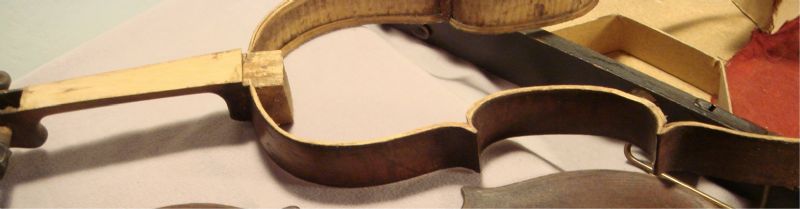 Spanish neck construction | 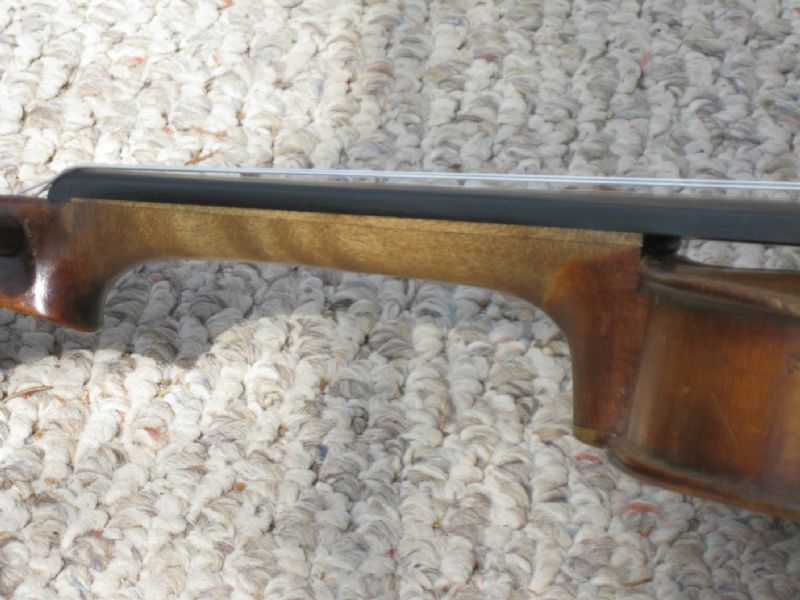 Fiddle without Neck Block | 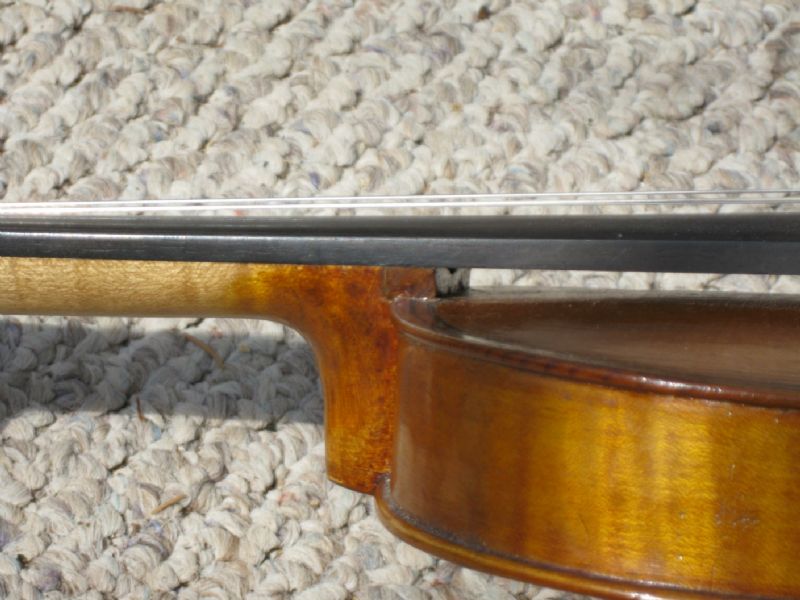 Fiddle with Neck Block |
DougD - Posted - 08/19/2014: 07:46:53
Here's a photo of a fiddle I used to have that had pins in the back. I think they're in about the same place as the center ones in the fiddle DeamhanFola posted, and I think they go in the blocks, not the neck.
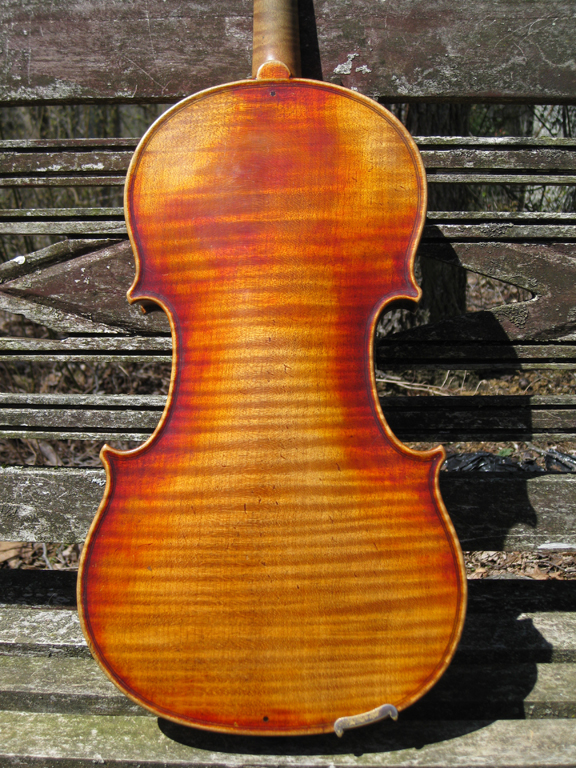 Strad back pins |
royce - Posted - 08/19/2014: 07:56:26
quote:
Originally posted by DougD
Here's a photo of a fiddle I used to have that had pins in the back. I think they're in about the same place as the center ones in the fiddle DeamhanFola posted, and I think they go in the blocks, not the neck.
Doug, that's a pretty instrument too...Yep the pins were installed at the time the violin was made most likely and they are fairly common. I agree with you on the idea that the additional ebony pins were installed later on the first violin. It was probably originally made just like yours with only two pins.
banjopicks - Posted - 08/19/2014: 08:04:08
How about this. The center pins are the first set of locating pins and the outer ones are the new locating pins which had to be offset and doubled to be symmetrical. I just can't get into the stabilization thing.
I have never built a violin, only mandos so I'm talking out of my hat but I can't see how that little ebony pin would stabilize anything. Also, if I were to take the back off of a violin, I'm pretty sure I would get everything stabilized before putting the back on. Putting those pins into a loose neck joint without fixing the problem seems pretty umm, hopeful to me.
royce - Posted - 08/19/2014: 10:07:29
quote:
Originally posted by banjopicks
How about this. The center pins are the first set of locating pins and the outer ones are the new locating pins which had to be offset and doubled to be symmetrical. I just can't get into the stabilization thing.
I have never built a violin, only mandos so I'm talking out of my hat but I can't see how that little ebony pin would stabilize anything. Also, if I were to take the back off of a violin, I'm pretty sure I would get everything stabilized before putting the back on. Putting those pins into a loose neck joint without fixing the problem seems pretty umm, hopeful to me.
I pretty much agree with you. I really think the first two original holes were locating pins but the four addtional ones were meant as reinforcement in the eyes of the fellow that put them in. I've seen some violins that had small wood screws installed and I've had to take them out and put a pin in their place fill the hole. Who knows. This is still a nice old violin and those extra pins wouldn't bother me much.
DeamhanFola - Posted - 08/19/2014: 12:43:49
quote:
Originally posted by royce
quote:
Originally posted by banjopicks
How about this. The center pins are the first set of locating pins and the outer ones are the new locating pins which had to be offset and doubled to be symmetrical. I just can't get into the stabilization thing.
I have never built a violin, only mandos so I'm talking out of my hat but I can't see how that little ebony pin would stabilize anything. Also, if I were to take the back off of a violin, I'm pretty sure I would get everything stabilized before putting the back on. Putting those pins into a loose neck joint without fixing the problem seems pretty umm, hopeful to me.
I pretty much agree with you. I really think the first two original holes were locating pins but the four addtional ones were meant as reinforcement in the eyes of the fellow that put them in. I've seen some violins that had small wood screws installed and I've had to take them out and put a pin in their place fill the hole. Who knows. This is still a nice old violin and those extra pins wouldn't bother me much.
Sorry that I can't provide more pics--it was forwarded to me by a friend. I'll see if I can get him to send more.
He did say that they appear to be ebony (or some other wood discoloured by age) dowels rather than nails.
A suggestion that was made on Maestronet was that these pins might be evidence of a fiddle that was headed towards somewhere hot & very humid. Apparently factories like JTL actually offered specific lines of trade fiddles (called 'tropical models') for use in the colonies. According to one poster, there's actually a term for it: 'lutherie coloniale'.
Another poster said that s/he heard of the Hills doing this for people headed off to India.
It makes sense in some respects: I'm sure the dowels would help the back stay on when the hide glue fails in Mumbai heat. However, I reckon it doesn't do anything about a rattling open seam.
I'm still leaning towards an (overzealous or inelegant) neck graft / button repair.
Terms of Use | Privacy Policy | Privacy Consent (EU/GDPR Only)
Copyright 2026 Fiddle Hangout. All Rights Reserved.


