
DVD-quality lessons (including tabs/sheet music) available for immediate viewing on any device.
Take your playing to the next level with the help of a local or online fiddle teacher.
Monthly newsletter includes free lessons, favorite member content, fiddle news and more.
Premier Sponsors


|
Please note this is an archived topic, so it is locked and unable to be replied to. You may, however, start a new topic and refer to this topic with a link: http://www.fiddlehangout.com/archive/60052
msfiddlestix - Posted - 05/26/2025: 14:51:02
right now I need to know the B chord shapes while in AEAE (Key of A Major)?
attempting to learn chord shapes is one of my current challenges while playing OTM.
In cross tuning the standard chords are generally not difficult to figure out but now I'm stumped on the 2 chord shapes within the middle and low registers.
farmerjones - Posted - 05/26/2025: 16:08:18
I've found good content over at Mandolin Cafe, and sister site, Jazzmando.com
Of course one must extrapolate or infer frets, and in your case, tuning, but half of your fingerboard needs less extrapolation. Also bare in mind, you're playing two strings while a mandolin may strum all four/eight strings.
buckhenry - Posted - 05/26/2025: 16:28:36
There is the first finger double stop on each pair of strings for B and F#.
Then there is 1st(E) + 3rd(A) double stop on across both A and E.
Next is 3rd(A)+4th(E) on both A and E.
If you wanted a B major the 3rd finger will need to extend to D#.
But B minor is low 3rd finger.
msfiddlestix - Posted - 05/26/2025: 18:42:02
wow. No wonder I was unable to solve this challenge. looks like there's no easier way to get around barred configurations or spider stretches. LOL.
Thanks for your time and info.
DougD - Posted - 05/29/2025: 06:05:46
Not onsite, but here's a site with fairly extensive charts of doublestops, which can be downloaded: violinspiration.com/violin-dou...ps-chart/
Trouble is, its for standard tuning, so you'll have to make your own modifications for cross tuning. My impression has always been that cross tuning is more for melody playing against drones than for chordal playing, but I don't know that much about it.
msfiddlestix - Posted - 05/29/2025: 13:42:25
quote: thanks for this. so yeah you're correct about the purpose of cross tuning, but an occasion double stop chording can be easily woven into the dronea as the melody is being played. o I"m Only an "intermediate" player at this point and just learning the musical value of incorporating just about anything in a lick if I can manage to execute without going off the rails of the gtoove and stay in tiune. challenging for me. there's this tune in cross A with a tricky syncopation which involves the 2 chord, I figure if I can maybe play the chord in that lick, maybe that might work, but I didn't know the structure of the B chord. I came here and right away got a lesson which notes comprise the B chord. thanks to a member who posted up thread. And another posted chord charts for mando. These are what I need thank you and everyone else here.
Originally posted by DougDddNot onsite, but here's a site with fairly extensive charts of doublestops, which can be downloaded: violinspiration.com/violin-dou...ps-chart/
Trouble is, its for standard tuning, so you'll have to make your own modifications for cross tuning. My impression has always been that cross tuning is more for melody playing against drones than for chordal playing, but I don't know that much about it.
buckhenry - Posted - 05/29/2025: 19:13:06
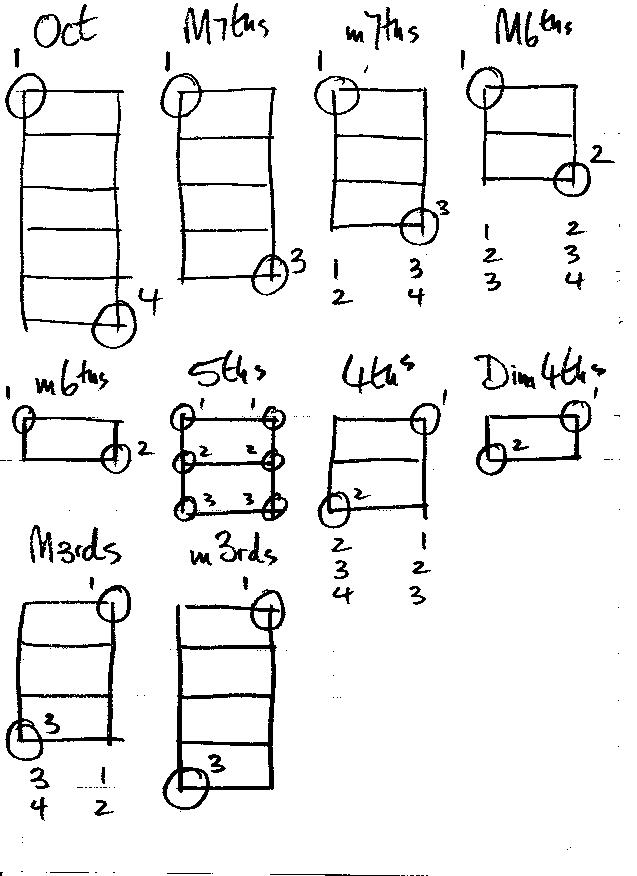
Since the 4th and 3rd strings are tuned an octave lower than the 2nd and the 1st, the double stops on the lower pair would be the same shapes as for the the higher pair as noted above. This leaves the shapes between 3rd and 2nd strings with altered tuning, but the shapes are the same as used in standard tuning.
Eg, between 3rd and 2nd strings for B major there is the..
1) First finger double stop.
2) 1st on the 2nd string + 3rd on the 3rd string = Major 7th interval, but for B7 the interval needs to be a minor 7th.
3) 1st finger on 3rd string + 3rd on 2nd = Major 6th, the 4th finger could be used instead if the stretch is too far for the 3rd.
4) 4th on the 3rd string + 3rd on 2nd = major 3rd, and if fingers reversed will make Aug 4th if the flat 7th required on 3rd string.
Mando chord charts are not much use for fiddle shapes, have a look at the rough chart I made, but I made a mistake with the Dim4th which should read Dim5th, and thats the same shape as Aug4th.
Edited by - buckhenry on 05/29/2025 19:25:51
buckhenry - Posted - 05/29/2025: 22:43:04
2) 1st on the 2nd string + 3rd on the 3rd string = Major 7th interval,
I made a mistake there, the interval is actually a minor 2nd, but still relevant if the 3rd finger note is flattened to make a B7 chord.
msfiddlestix - Posted - 05/30/2025: 06:07:52
quote:
Originally posted by buckhenry2) 1st on the 2nd string + 3rd on the 3rd string = Major 7th interval,
I made a mistake there, the interval is actually a minor 2nd, but still relevant if the 3rd finger note is flattened to make a B7 chord.
Ahh.. this makes it easier and it makes sense... thanks!
Terms of Use | Privacy Policy | Privacy Consent (EU/GDPR Only)
Copyright 2026 Fiddle Hangout. All Rights Reserved.


