DVD-quality lessons (including tabs/sheet music) available for immediate viewing on any device.
Take your playing to the next level with the help of a local or online fiddle teacher.
Monthly newsletter includes free lessons, favorite member content, fiddle news and more.
Premier Sponsors


|
Please note this is an archived topic, so it is locked and unable to be replied to. You may, however, start a new topic and refer to this topic with a link: http://www.fiddlehangout.com/archive/57238
RinconMtnErnie - Posted - 10/23/2022: 20:41:34
For years I've wanted a cigar box fiddle, especially around Halloween time for parties. It's too late for this year, but I've started on one for next year.
I'll start with the question. I own a violin peg reamer, which I got to install a set of Perfection planetary pegs on an instrument where it made sense for me to do it rather than going to a luthier. I think what I have is a Janek R115V reamer with a 1:30 taper. Am I correct in thinking this is also the right tool for an endpin?
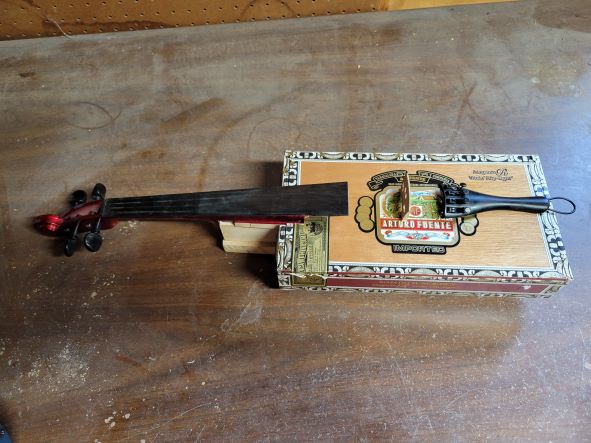
I'm setting the bar really low on this project. It's going to be cheap, quick and dirty with the goal of having an instrument that is visually interesting and is playable, but probaby won't sound well. This weekend I managed to start roughing it out, as shown in the attached photo.
I'm not going to build a neck. I'm cutting off the neck of an old silent violin that I don't really have a use for. Because of the way it's built, it has a flat horizontal surface that I can use as a reference to get the neck angle right. For that reason, I'm loosely using the Steven Miller method of construction where the cigar box floats on a structural platform that bears all of the string load. (Miller calls this a "strut", but that's not an engineering strut.)
I haven't spent much and shouldn't need to spend much more. I had the neck and fingerboard. The one significant expense was a piece of 2x2 maple to extend the fingerboard because the cigar box is only 11" long. It was not cheap, but I only used a few inches of it. I am using a scrap piece of oak for the platform. It even has a big screw hole in it that I will plug. I would rather use maple, but this is free. The cigar box cost me $2 from a local cigar store. It's an Arturo Fuente box, which had the best dimensions of what was available. It does have some odd protrusions on the end, which are thin strips of a soft wood hot glued to the box, covered in a black plastic sheet. I have to remove part of those strips, which is a bit of pain. I'm most worried about gluing to those sections. I removed the hot glue as best I could with a chisel heated with a heat gun.
I had a Wittner tailpiece lying around, so I'll try to use that. This construction requires a long end block, much bigger than a conventional end block. I'll rough that out of some scrap SPF (spruce/fir/pine) lumber that I had put on the firewood pile.
The old neck is red. I may leave it, or I may paint it black partly to look a little more old-school and partly to blend in the new neck piece.
The plan is to not over-complicate this and get it over quickly. In theory it could be finished in November, but I have a trip planned plus there is Halloween and Thanksgiving. So it will not likely be finished until the end of the year.
Mostly I'm doing this as a learning experience. For example I'm going to do this all with hide glue, and that will be new for me. I'm not expecting a great sound. In fact there's a good chance I'll buy another cigar box fiddle from a luthier later.
Edited by - RinconMtnErnie on 10/23/2022 20:42:33
The Violin Beautiful - Posted - 10/23/2022: 23:37:50
Yes, the same reamer you use for the pegs can be used for the endbutton hole. To get the best fit, you may need to cut the endbutton down on a peg shaver to get the taper to match, as the manufacturers don’t necessarily put the correct taper on the shafts.
Leave the hole as small as you can for the health of the bottom block.
fiddler135 - Posted - 10/24/2022: 06:09:53
quote:
Originally posted by RinconMtnErnieFor years I've wanted a cigar box fiddle, especially around Halloween time for parties. It's too late for this year, but I've started on one for next year.
I'll start with the question. I own a violin peg reamer, which I got to install a set of Perfection planetary pegs on an instrument where it made sense for me to do it rather than going to a luthier. I think what I have is a Janek R115V reamer with a 1:30 taper. Am I correct in thinking this is also the right tool for an endpin?
I'm setting the bar really low on this project. It's going to be cheap, quick and dirty with the goal of having an instrument that is visually interesting and is playable, but probaby won't sound well. This weekend I managed to start roughing it out, as shown in the attached photo.
I'm not going to build a neck. I'm cutting off the neck of an old silent violin that I don't really have a use for. Because of the way it's built, it has a flat horizontal surface that I can use as a reference to get the neck angle right. For that reason, I'm loosely using the Steven Miller method of construction where the cigar box floats on a structural platform that bears all of the string load. (Miller calls this a "strut", but that's not an engineering strut.)
I haven't spent much and shouldn't need to spend much more. I had the neck and fingerboard. The one significant expense was a piece of 2x2 maple to extend the fingerboard because the cigar box is only 11" long. It was not cheap, but I only used a few inches of it. I am using a scrap piece of oak for the platform. It even has a big screw hole in it that I will plug. I would rather use maple, but this is free. The cigar box cost me $2 from a local cigar store. It's an Arturo Fuente box, which had the best dimensions of what was available. It does have some odd protrusions on the end, which are thin strips of a soft wood hot glued to the box, covered in a black plastic sheet. I have to remove part of those strips, which is a bit of pain. I'm most worried about gluing to those sections. I removed the hot glue as best I could with a chisel heated with a heat gun.
I had a Wittner tailpiece lying around, so I'll try to use that. This construction requires a long end block, much bigger than a conventional end block. I'll rough that out of some scrap SPF (spruce/fir/pine) lumber that I had put on the firewood pile.
The old neck is red. I may leave it, or I may paint it black partly to look a little more old-school and partly to blend in the new neck piece.
The plan is to not over-complicate this and get it over quickly. In theory it could be finished in November, but I have a trip planned plus there is Halloween and Thanksgiving. So it will not likely be finished until the end of the year.
Mostly I'm doing this as a learning experience. For example I'm going to do this all with hide glue, and that will be new for me. I'm not expecting a great sound. In fact there's a good chance I'll buy another cigar box fiddle from a luthier later.
And it is a good idea to make your own peg shaper, from a piece of hardwood, with a tapered hole that you make with your reamer. That way the end pin taper will fit the hole taper. I am sure you can find a plan/ pattern online.
ChinnRest - Posted - 10/24/2022: 16:47:53
Ernie, that looks like a fun project!
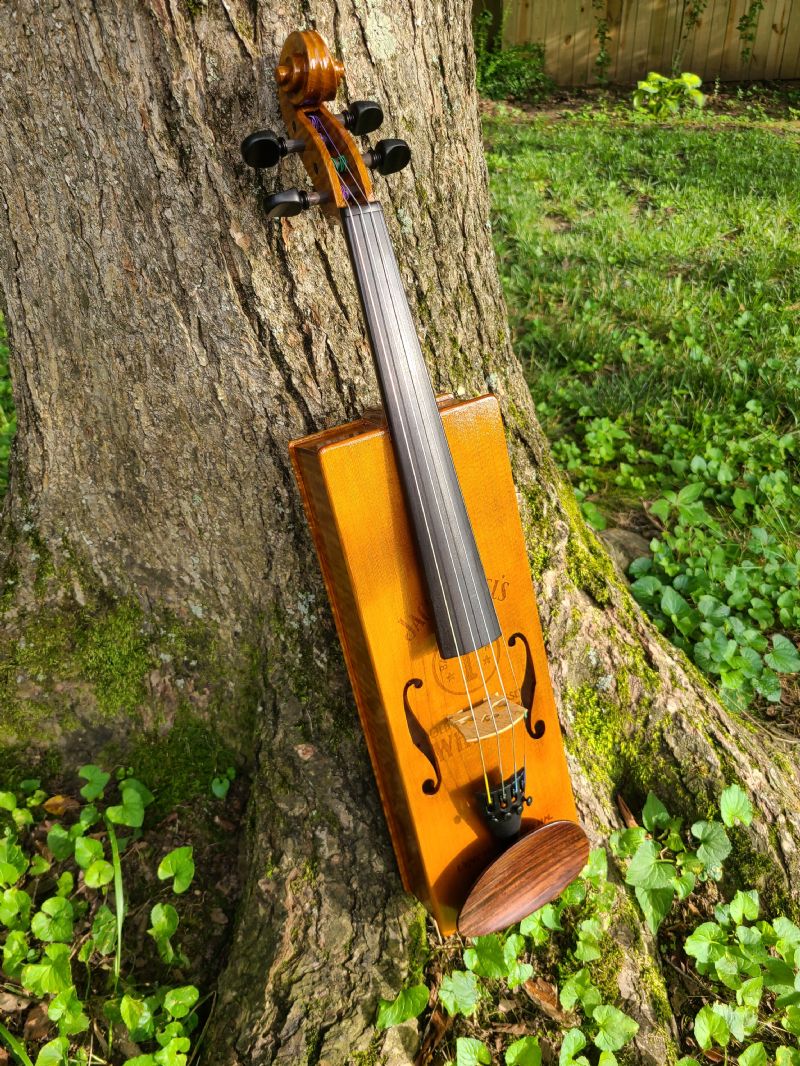
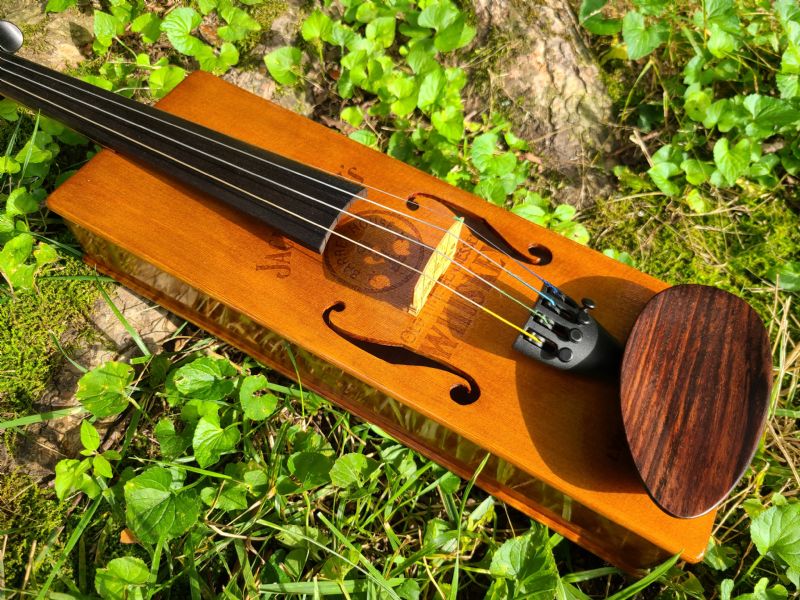
I’ve built a bunch of really successful cigar box instruments, including a whiskey box based fiddle.
A few things that will help-
The box won’t support the neck structurally (I have one of those boxes in my stash. You might need to either reinforce the box, or install a runner along the bottom/back that protrudes out the leading edge at the bottom (where the button would be) and install the neck to it.
That box is very wide and you will strike the bow against where the C bouts would be. Cutouts there can serve as sound holes and relief to allow full bow movement.
Don’t forget the bassbar and sound post. Since the top has no arch, it will sag without each being well installed.
RinconMtnErnie - Posted - 10/24/2022: 19:56:03
Rich and fiddler135,
Thank you so much for the information about the endpin / end button! I guess I'll buy or fabricate a peg shaver.
ChinnRest, your whiskey box fiddle looks great! It's inspiring to know you built a number of successful cigar box fiddles.
Regarding structural concerns, my plan is to have a stout plank underneath the entire box. That's what I called a "platform" and I'm guessing what you called a "runner". It's actually in my picture, but it's mostly hidden by the cigar box so it doesn't jump out at you. That is a very stout 3/4" thick by 2" wide (measured dimensions) piece of oak running from the heel of the neck to the tail end of the box. I think that's probably overkill, especially near the tail as there will be a large end block taking all of the load from the tailpiece via the endpin and saddle. A principal high load on the cigar box will be between the end block and the platform / runner, and this will have a large surface area. There will also be a high load on the saddle, so I have to make sure that's thought out.
It's more likely that this is going to be overbuilt rather than underbuilt, and that will impact weight and sound. for that reason, I am probably going to taper the platform / runner towards the tail in both width and thickness. That may make it difficult to get a chin rest on, though.
Regarding bowing interference in the lane between the brige and the fingerboard, I planned to make some sort of waist. That might be as simple as cutting out some C sections on the top and side. It might mean making something resembling a conventional C bout. I have some other ideas. the problem is all those choices affect the mechanical resonance properties and the acoustic resonance properties, and I have no idea what would be best. I'm afraid that having open cutouts in addition to the f-holes will be too much of a hole.
Regarding bass bar and sound post, I plan to have both. I'll have conventional f-holes with a table between them. I have no idea how to size the bass bar other than to make something that looks like a bass bar and do some crude tap test.
RinconMtnErnie - Posted - 10/27/2022: 20:01:02
As luck would have it, someone who used to run a musical instrument repair business (or something along those lines) was selling a set of violin repair tools on craigslist. This included a Juzek peg shaper, plus other stuff like a sound post gauge, a sound post retriever, a sound post setter, an inspection mirror, a bridge template, and a bunch of spare parts like tail pieces with fine tuners and bridge blanks. I'll probably using one of those wood tail pieces rather than the Whitner I have. The price was good so I am quite pleased.
So thanks again for pointing out that I needed the peg shaper!
Terms of Use | Privacy Policy | Privacy Consent (EU/GDPR Only)
Copyright 2026 Fiddle Hangout. All Rights Reserved.