


When placing your finger down on a certain string to play a certain note do you aim to hit only the string that will create the note or does your finger (maybe) also catch its neighbor string, which doesn’t really matter since your not bowing that neighbor string? I’ve recently started putting my finger down covering 2 strings when shifting back and forth between playing E (on D string) and B (on A string)…. And I realize one could cover 2 strings even if playing a single note on only one of the strings covered…. It’s left to whatever string you’re actually bowing. I guess what I’m asking is how much accuracy is necessary to finger just one string if your looking to bow a single note?? Hope this makes sense. Thanks.
John

I play on two strings as much as I can. To me, that's fiddling. Maybe it's because I came from guitar and like to hear the harmony notes.

two strings as much as i can, even if i am only playing one. The other may be the next note, the previous note or a harmony double stop . it puts my hand in the right "frame" if i know the surrounding notes to the one i am playing.
As above. Among other things, it reduces the flyaway finger pfenomenon. It promotes a more relaxed, yet poised hand.
I never sought to reinvent the wheel. I got a copy of Melbay's Fiddle Chords.
When I'm in a chord formation, I feel my intonation improves.
I never looked into index finger capo method. I know I didn't invent that either.
(if that's what you mean by covering two strings with one finger)
Regarding 2 fingers on one string, i.e. index and middle on the D(1st pos.) That's the rootless 1 chord, played with the open A.
Edited by - farmerjones on 08/17/2026 17:10:31
There maybe occasions for adjacent open string with 1st finger as chord or interval.
A tune I play has both adjacent open and1st finger double stop; chords go from A to E.
If you are going to let 2 fingers rest on string when playing 1 note, try to aim to keep the intonation right on both notes. Take the E-B combination - A very useful double stop for playing in E and opens up all sorts of riffs and tricks for the key of E. Same deal for A-E, and B-F#. A course some tunes do need that adjacent note to be open, so you need the ability to play a single fingered note too. Ain't no short cuts in fiddle ol son.
Playing with the bow on two strings simultaneously is common in fiddling. Placing fingers of the left hand on multiple strings is not a great idea because it reinforces bad habits.
If you have a finger down on multiple strings without a specific reason, you’re putting a barrier on your string crossings and risking the loss of cleanness in playing. Inaccurate finger placement will actually make it harder to play fast passages, as the mental map of finger positions will be clouded. You also lose out on the sympathetic vibration of adjacent strings if they’re damped by the hand.
If sausage-fingered players like Elman and Perlman could play cleanly and accurately, anyone can!
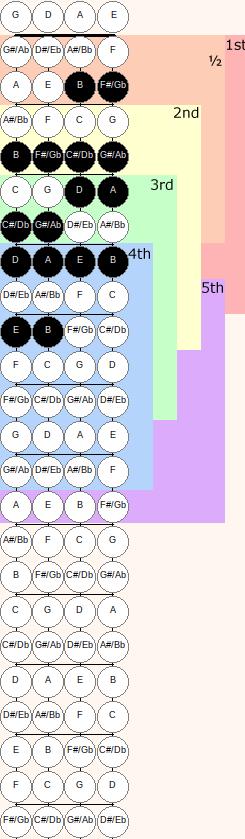
i don't want open strings to be ringing unless i let them. And my mental map of the fingerboard consists of given mode shapes on adjacent strings eg: B Dorian through 2 octaves: Apologies for the size of the pic
When the other strings are undamped, it can actually add to the tone of the one you play. You can experience this effect in reverse by playing an open string and then vibrating on a fingered note an octave above. The vibrato on the other string will transfer to the open string to some degree.
The whole violin is designed for the free transmission of certain frequencies. Damping strings any more than necessary for playing cuts down on tone significantly, much like putting a mute on the bridge or a mass on the top or clamping one of the bouts.
Yea, but i don't like it personally. I like a dry tone much the same as i don't like 4 sets of reeds on an accordion, 2 dry tuned sets max. It is totally subjective. i can leave open strings to wang about for certain things but i don't do it generally.
A triplet for instance gets lost in the open strings, whereas if i play it with all strings apart from the one i am playing damped (and the triplet fingered), it growls/cuts more. I think there are classical players that don't like uncontrolled open strings also?
you can try it by playing an open A triplet and contrast it with a fingered A triplet with strings damped. its like the difference between closed/damped jazz chords on a guitar, and open folky chords.
i think if i wanted that sort of sound i would probably play an open tuned Hardanger fiddle.
Edited by - pete_fiddle on 08/19/2026 09:40:05
quote:
Originally posted by pete_fiddleI think there are classical players that don't like uncontrolled open strings also?
Yes, but for the opposite reason. Classical players avoid the open strings when possible because they're considered to be too flat-sounding. You can't shape them as much with vibrato as a fingered note, so open strings (except in certain instances) are considered very boring and avoided when possible.
The opening of Bruch violin concerto No. 1 begins with a sustained open G. Players routinely find this frustrating, as it means starting on a note that is harder to shape. For that reason, almost everyone vibrates on the octave above in order to add to the open string and make it more interesting. In other words, the open string is a problem of too little, not too much.
For a classical player, the open string isn't thought of as ringing too much but rather as being two-dimensional. Players will even shift around in anachronistic ways as they play Bach just because they don't want to play open strings. A fiddler switching to classical playing will quickly discover that the fourth finger is regularly used instead of the open string in scales unless it's more physically awkward for the fingers.
One of the first things a player has to learn when switching to fiddle playing is to embrace the open strings. Hearing all those open strings is jarring and ugly for a classical player because the open strings sound crass. Fiddlers use them constantly, even when they're impractical from a fingering perspective or require seemingly unnecessary string crossings. It takes a while to get used to them.
quote:
Originally posted by The Violin Beautifulquote:
Originally posted by pete_fiddleI think there are classical players that don't like uncontrolled open strings also?
Yes, but for the opposite reason. Classical players avoid the open strings when possible because they're considered to be too flat-sounding. You can't shape them as much with vibrato as a fingered note, so open strings (except in certain instances) are considered very boring and avoided when possible.
i don't think we are in opposition here, i think we just agreed! 
"you can try it by playing an open A triplet and contrast it with a fingered A triplet with strings damped. its like the difference between closed/damped jazz chords on a guitar, and open folky chords."
I see your point if the triplets are detached. But If you dig in on the triplet to make it crunchy (à la Tommy Peoples) there's no ringing at all so no real difference if it's on open string or not. That's how I was taught but I guess it's a matter of style. ( overall I'm impressed your pinky is that versatile!)
"overall I'm impressed your pinky is that versatile!"
it's not. i shift...lol
Terms of Use | Privacy Policy | Privacy Consent (EU/GDPR Only)
Copyright 2026 Fiddle Hangout. All Rights Reserved.


