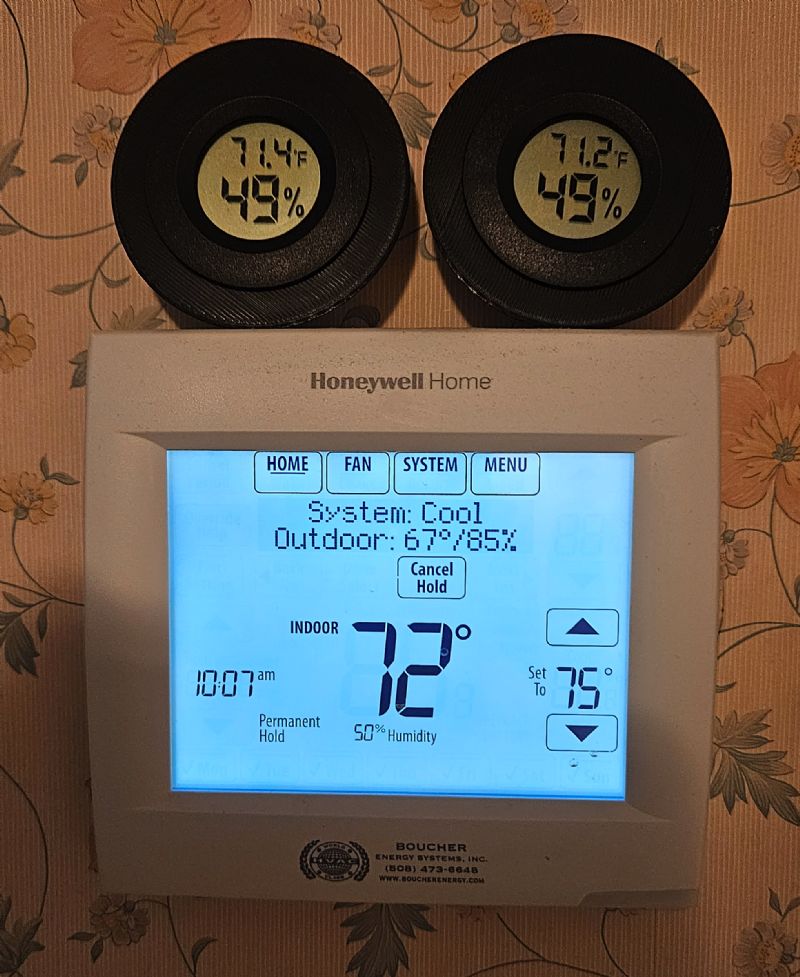
These digital humidity gauges were two/$6 on Amazon. They are remarkably accurate. They agree with each other and within 1% of our digital thermostat. I used one in the box where I store my CD-printer filament with desiccant. It went down to 10%, which is the expected max you can pull down humidity with the desiccant at room temperature, so they definitely react to a change in humidity.
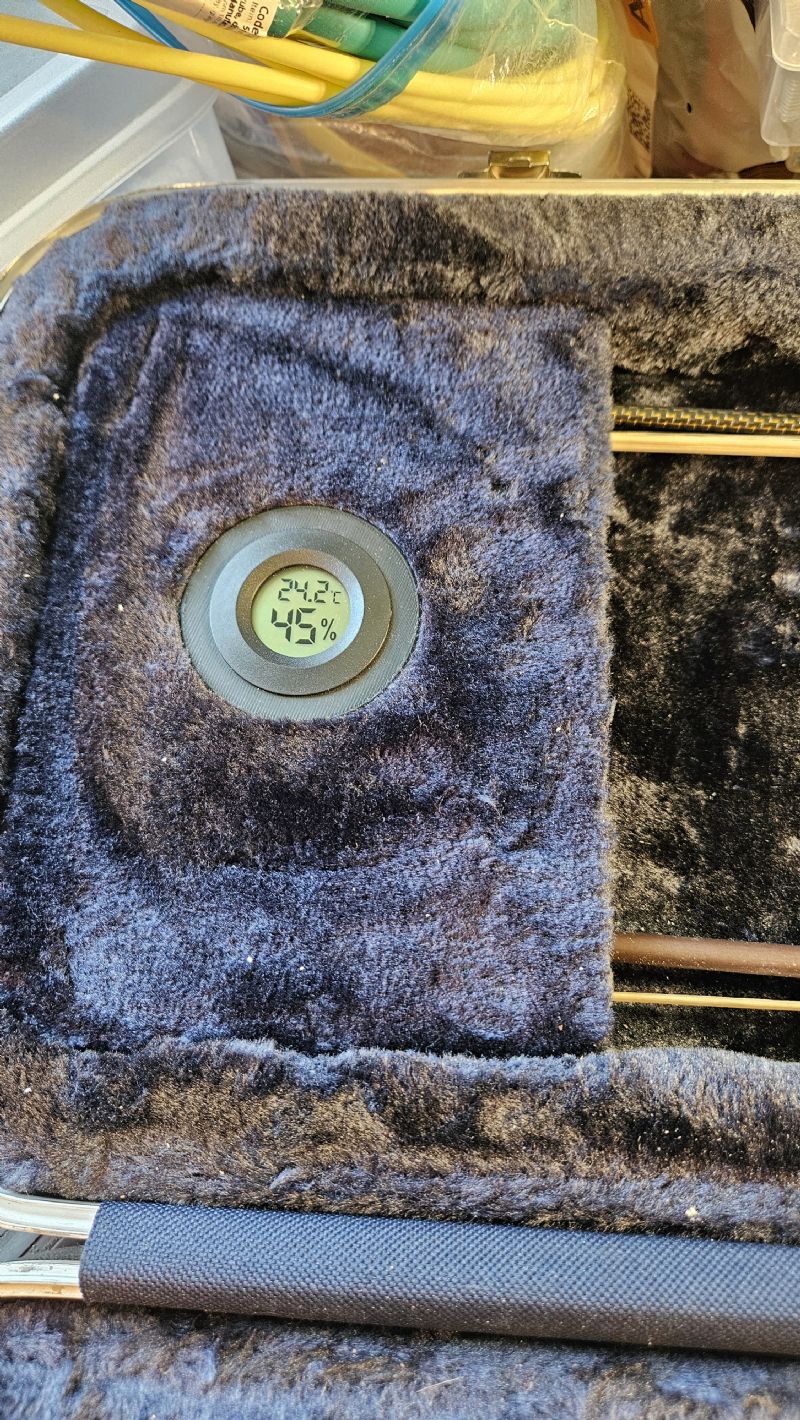
I mounted one in my case between the bow holders. Harder than I thought as that part of the case is 1/8" ply, not foam. Used a fine Xacto blade and the a Dremel to clean it up. Since the bezel on the gauge only has about 2mm overhang and I figured the hole would come out too neat and there might by fuzz on the cloth around the edges, I 3D-printer a 10mm wide 1mm thick bezel to add around it. The gauge is a tight fit and presses in snug. Battery should last 9-12 months so I'll have to pull it every once in a while to replace the battery.

If those are indeed accurate, that’s a great find.
David Burgess is obsessive about testing hygrometers and has one that he recommends because he checks the calibration himself before selling. He has written on the subject and contends that the majority are way off.
I have one in my workshop that I’ve checked against two others that appeared to be accurate over time. The hygrometers in my dehumidifiers have never been very good, usually off by at least 5%. I trust my dedicated hygrometer the most.
As quality in digital tech trickles down, it makes sense that cheaper hygrometers should get more accurate as well. Hopefully these are. It would be great to have case hygrometers that were actually good, but none of the manufacturers that make cheap cases (even most of the advanced to professional level) have accomplished this yet. You might try contacting David to see if he’s tested this model and if he’d be willing to try it out for accuracy. I expect he would be happy if it was accurate as well so that he could recommend it to customers.

I suspect it is much easier to get an electric hydrometer to work well than an analog. I bought a couple of these mechanical thermometer/hydro combos, mainly for the thermometer. The hydrometers on these are worthless. The needle only ever moves maybe third of the dial. If they changed the numbers so only the middle third went from 0 to 100, it might be better but then it would demonstrate how poor it is so they just print the whole dial to match the thermometer.
amazon.com/dp/B08XH94GM5?ref_=...n_title_4
I've seen higher end cases with built in hydrometers but they look like they are mechanical. And the reports here are that they don't work well. It's probably that a sling psychrometer is the only accurate mechanical method of measuring humidity which obviously doesn't work within a case.
On accuracy, I'm the last person to speak on what's required for an instrument. But I have read that it's changes in humidity (and temperature) that are most critical to avoid. If that's a case, would be a big deal of a reading were off, 5% isn't much. Maybe the reading is off by 5% but it does go up and down with actual humidity by the correct proportion. Say it reads 45% when it's really 40% or 50% but is that of any consequence when what you want do not want to see is it change from 45% to 60% or 30% in a short period of time?
These were the units I purchased -- amazon.com/dp/B0CXHV22GD?th=1
Two for $5.99 free shipping with prime.
They are 45mm or 1 3/5" across.
Terms of Use | Privacy Policy | Privacy Consent (EU/GDPR Only)
Copyright 2026 Fiddle Hangout. All Rights Reserved.