


Can you put those proclamations into Venn diagrams? I'm not insinuating that those who can't, teach, vice versa, or any similar premise is true in our case. I'm just saying I feel like I'm witnessing a big ol' bug, sucking the sap/lifeblood out of the beautiful, proliferating vine, flowers, and fruits of folk music, for real folks to enjoy and play. Just play and enjoy...don't fuss over it.


analysis paralysis has set in!
I have always liked and appreciated this quote; "Academia doesn't always have a lot to do with what's going on out in the barn."
I forget who said it but it's somewhere back in the Hangout archives. And since we all don't necessarily have a barn, I would add the locations of; the front porch, under a shade tree, on a street corner, or in a friend's living room as possible replacements for the word 'barn' in the quote.
And for what it's worth I kind of like these conversations.
quote:
Originally posted by groundhogpeggyCan you put those proclamations into Venn diagrams? I'm not insinuating that those who can't, teach, vice versa, or any similar premise is true in our case. I'm just saying I feel like I'm witnessing a big ol' bug, sucking the sap/lifeblood out of the beautiful, proliferating vine, flowers, and fruits of folk music, for real folks to enjoy and play. Just play and enjoy...don't fuss over it.
I think we can agree that the lifeblood is ebbing out of the music, just not on what's causing it.
Why does a discussion about music take anything away from it? That makes it sound like the music is so fragile that the slightest challenge will destroy it. I would like to think the music is more durable and that, like any other form of music, analysis only strengthens it
" Nothing beautiful without struggle."
-Plato
I think we have come to a loss of objective impasse...I love discussion...but I ain't too crazy 'bout loss of objective impasses.
Oh, and Doug, I didn't have time to listen to both mp3s but will do that now. It sounds like your role in playing the old music for the museum setting was lots of fun. That photo in the first YouTube I linked was taken at the Museum of Appalachia, near Norris, TN. It's a fascinating walk through history...John Rice Irwin and Alex Haley sorta led the way to create that outdoor museum, by disassembling various types of buildings and structures and setting them all up again on their own museum/village. We used to go there all the time and often they would have people cooking, playing music, etc., etc.
Rich I gather what you are saying is that the music is being diluted and/or changed over time, and it would be useful to put a stake in the ground as to what constitutes the genre and what doesn't. Is that a fair statement?
Back in the late '40s there was a move to 'save' Irish traditional music, resulting in the formation of an Irish Music Society, Comhaltas Ceoltóirí Éireann. Although opinions differ on whether they are preserving or fossilizing the music (see multiple threads on thesession.org), there is no doubt they give visibility to high standards of play with their Fleadh Cheoil competitions. If you want to learn 'authentic' Irish music, you could do worse than pay attention to an all-Ireland champion.
It doesn't seem to me that there is anything similarly organized to promote/preserve Old Time music. The two genres are not exactly comparable in their origins and nationalist associations, but regardless, do you think such a thing would be useful to achieve what you think is lacking? Other than that, what would be a useful course to follow?
quote:
Originally posted by JonDRich I gather what you are saying is that the music is being diluted and/or changed over time, and it would be useful to put a stake in the ground as to what constitutes the genre and what doesn't. Is that a fair statement?
Back in the late '40s there was a move to 'save' Irish traditional music, resulting in the formation of an Irish Music Society, Comhaltas Ceoltóirí Éireann. Although opinions differ on whether they are preserving or fossilizing the music (see multiple threads on thesession.org), there is no doubt they give visibility to high standards of play with their Fleadh Cheoil competitions. If you want to learn 'authentic' Irish music, you could do worse than pay attention to an all-Ireland champion.
It doesn't seem to me that there is anything similarly organized to promote/preserve Old Time music. The two genres are not exactly comparable in their origins and nationalist associations, but regardless, do you think such a thing would be useful to achieve what you think is lacking? Other than that, what would be a useful course to follow?
Yes, I think your characterization makes a lot of sense. It seems to me that Old Time has become so vague a term that it gets applied to almost anything. The meaning is more and more unclear, and that makes it an increasingly difficult sell to younger generations who are hungry for information.
I hadn't thought about the connection to CCE, but that's a great idea. I was a vendor at the national convention a couple years ago, and I was very impressed with the high level of playing I heard there from the players. I also really liked that they made a point of including regular Ceilidhs in the event, driving home the point that the dance was essential to the music. If something akin to that organization could be established for Old Time, it would be a real service to the genre.
I've always been frustrated by the "play it however you feel" argument because I think it's disingenuous and completely useless for anyone who's trying to learn how to play a particular style of music. The fact that players don't sound alike doesn't mean that there aren't stylistic considerations that are common. Classical violinists of the golden era don't sound alike at all but one would hardly call them ambivalent about the style. Some of them even studied with the same pedagogues, and their playing honored a tradition that traced back all the way to Corelli. Since Old Time has the advantage of having been recorded from its birth, there's so much of an advantage for its preservation--no guesswork is needed to understand it. But despite that advantage, there is an attitude among some players that everything you need to know about Old Time you should be able to teach yourself. But that approach just doesn't yield good results. It would be a welcome change to see an organization that would provide a more nuanced and comprehensive understanding of the genre as well as organizing events on a national or local level to encourage more engagement.
quote:
Originally posted by The Violin Beautifulquote:
Originally posted by tonyelderYes, the one thing they had in common - more than anything else is what they played - not necessarily how they played. But I'm not willing to "die on that hill" - mainly because I know how easy it is to take a tune to another place. A lot of "old time" tunes made it into to country - certainly made it into bluegrass, and even rock. And so, what's it called then?
But the players weren't all playing the same tunes. The various musicians who were recorded at the defining time played many tunes that were unique to them. There might have been some tunes that were common among musicians, but that was the case long before the existence of Old Time. The tunes alone don't define the genre. The classic old tunes are fiddle tunes, not Old Time tunes.
"...at the defining time" is the only way you can make your definition work, Good luck.
Every tune that has ever been recorded throughout history - is a recording that is unique - otherwise, why record it? ...if it is going to sound "just like someone else"? But that is not what I was talking about - and - ah - you know that. And you also know that the recordings they made were not the sum of their repertoire. I know you aren't saying there were no common tunes. I'm saying there was / is an abundance of common tunes - and fiddlers always have / always will play them differently - even within the same region. Some better than others - and obviously the better ones got the attention the others didn't.
Looking at it as though everyone was playing the same things ignores that they lived in different regions and developed any of their own tunes there over time. Fiddle tunes were less and less standardized as people moved farther into the hills and stayed there.
You are now making the very argument that I have been making all along - and trying to make it sound like I said something different.
My point has been - who are you going to choose as the "poster child" for old time fiddling? Who actually defines it? ...good luck with that too. A lot of recordings we have of old time fiddlers are recordings that aren't so old. Will you ignore them?
Or - are you saying that the collective of all fiddlers from that time define old time? ...what is that suppose to mean? Those recordings are a collection of different tunes in different styles from different places - AND THEY ARE ALL "OLD TIME" - BUT they're are all different - just as you said, Are you suggesting that we need to highlight the things they all have in common - so that it can be said: "old time always includes _______". What is that common thing? The only thing I recognize as common was the collective of tunes that they "pulled from". And - as we both have pointed out - the recorded different tunes. True - but (for the most part) they all came from further past - and got passed around. And everybody wanted to put their own stamp on the way they played it - to earn a rep -"I play it the best." Does that mean they played it "right"? .. or they defined "old time" for everyone else?
Workshops and festivals are always coming and going. I don't know how many there are now relative to anything in the past in any one place. I know what my experience has been. And I love playing the tunes. I know it easy to find if you look for it - even when it might be hard to find others. That has always been the case for me. YMMV
Old Time music is dying in some places and finding life in others. I love playing the tunes and I ain't dead yet.
So. I'm not really concern about this...
I will say this - I'm proud to know that you are trying to inspire and encourage younger folks to play. Thank you for that!!!!
Edited by - tonyelder on 03/23/2026 07:37:00
Tony, he's running in circles now. I don't think anybody is getting through...lol.
quote:
Originally posted by tonyelderquote:
Originally posted by The Violin Beautifulquote:
Originally posted by tonyelderYes, the one thing they had in common - more than anything else is what they played - not necessarily how they played. But I'm not willing to "die on that hill" - mainly because I know how easy it is to take a tune to another place. A lot of "old time" tunes made it into to country - certainly made it into bluegrass, and even rock. And so, what's it called then?
But the players weren't all playing the same tunes. The various musicians who were recorded at the defining time played many tunes that were unique to them. There might have been some tunes that were common among musicians, but that was the case long before the existence of Old Time. The tunes alone don't define the genre. The classic old tunes are fiddle tunes, not Old Time tunes.
"...at the defining time" is the only way you can make your definition work, Good luck.
Every tune that has ever been recorded throughout history - is a recording that is unique - otherwise, why record it? ...if it is going to sound "just like someone else"? But that is not what I was talking about - and - ah - you know that. And you also know that the recordings they made were not the sum of their repertoire. I know you aren't saying there were no common tunes. I'm saying there was / is an abundance of common tunes - and fiddlers always have / always will play them differently - even within the same region. Some better than others - and obviously the better ones got the attention the others didn't.
Looking at it as though everyone was playing the same things ignores that they lived in different regions and developed any of their own tunes there over time. Fiddle tunes were less and less standardized as people moved farther into the hills and stayed there.
You are now making the very argument that I have been making all along - and trying to make it sound like I said something different.
Or - are you saying that the collective of all fiddlers from that time define old time? ...what is that suppose to mean? Those recordings are a collection of different tunes in different styles from different places - AND THEY ARE ALL "OLD TIME" - BUT they're are all different - just as you said, Are you suggesting that we need to highlight the things they all have in common - so that it can be said: "old time always includes _______". What is that common thing? The only thing I recognize as common was the collective of tunes that they "pulled from". And - as we both have pointed out - the recorded different tunes. True - but (for the most part) they all came from further past - and got passed around. And everybody wanted to put their own stamp on the way they played it - to earn a rep -"I play it the best." Does that mean they played it "right"? .. or they defined "old time" for everyone else?
Workshops and festivals are always coming and going. I don't know how many there are now relative to anything in the past in any one place. I know what my experience has been. And I love playing the tunes. I know it easy to find if you look for it - even when it might be hard to find others. That has always been the case for me. YMMV
Old Time music is dying in some places and finding life in others. I love playing the tunes and I ain't dead yet.
I will say this - I'm proud to know that you are trying to inspire and encourage younger folks to play. Thank you for that!!!!
The definitive era for recording is easy to identify and has already been done by a number of people. It's not an idea that's unique to me. Whether the players in the recordings went through their entire repertoire is completely irrelevant. You keep focusing on the tunes and I keep saying that the style of playing is what's important. That means a tune written today could be Old Time if it's in keeping with the template. The point of defining an era for recognizing original Old Time music is to help establish a clearer picture of what players can do to have an "Old Time sound." This does not mean slavish copying but rather informed listening. One thing that gets me when I read comments about old recordings, recommending learning through listening, is just how much it sounds like the commenters have never heard the recordings they revere if I listen to their own recordings and compare. There is a breakdown in the aural tradition. If it's going to be used for transmission of tunes, why not try to make it effective?
Of course good fiddlers sound different and have voices of their own, but speakers can have different voices while speaking the same language in the same regional dialect. My suggestion is that there is a somewhat consistent language among the fiddlers of Old Time. The dialects changed with region but were still identifiable among players of the same region.
There are many different workshops where you can go to learn tunes, and there you can focus on trying to copy notes as you hear them and to pick up stylistic elements from whatever teacher is leading the class. The tune-centered approach expands repertoire if you learn the tunes well. But just learning tunes doesn't preserve any tradition and it doesn't maintain the link with the original.
The urge for establishing the idols for a style is one that comes from antiquity. In fiddling it dates back well into the early years of the violin's existence, and in America, it dates back to the late 18th century. Old Time fiddling competitions came about in the recorded era. The folk revival renewed interest in competitions around its time.
When the subject of listing the idols for Old Time comes up, there is a lot of hand-wringing over the idea of making a choice among so many players, as though this is an insurmountable task. I find that risible, especially when so many people have already done just that and when it has been done in every other genre. You don't have to list the full catalog of every recorded player, only those who embody the style best. And the point of a historical perspective in the music is to free it from the completely subjective opinion and to seek objectivity. I agree that complete objectivity is impossible, but that does not justify the hedonism of "play however you feel like playing" as a rule for making archaic music.
I think it might be simpler to think of Old Time as a dead form of music. Its era ended with the development of Bluegrass. That doesn't mean the music was never played, just that its defining era went into the fossil record in 1945. Playing the music now isn't keeping its original form on life support--it's trying to recreate the extinct era. Vestiges of its era are still around, as are elements that preceded and inspired it, but the era itself ended. There are creatures today that are closely linked to dinosaurs and some that have existed since that era, but we don't say that the Jurassic era is still going on today, even if some life forms still exist that were present then.
So my concern isn't in trying to keep the original alive (since it's already dead) but rather in trying to understand the fossils and honor them. The old tunes that were played were bones--everyone has them, but that doesn't make us dinosaurs. The bones have to be arranged in certain configurations, meet certain size and shape criteria, and fit into specific eras.
I say it's way past time to switch to Venn diagrams...
quote:
Originally posted by groundhogpeggyTony, he's running in circles now. I don't think anybody is getting through...lol.
Circles as such are endless; of course because they are pointless.
Anyone else want some popcorn.
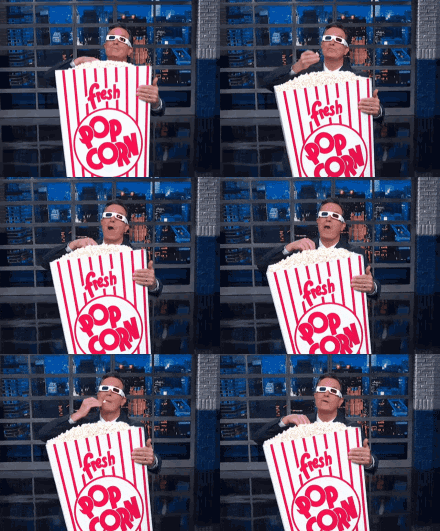
quote:
Originally posted by alaskafiddlerCircles as such are endless; of course because they are pointless.
Sounds like you're unfamiliar with the definition of a circle. No wonder there's so much confusion.
Edited by - The Violin Beautiful on 03/23/2026 16:24:03
I highly disagree with the view of OT as fossilized or “dead”. People have confirmed that players are adding great new tunes to the OT genre, just as with Irish Trad. I often encounter OT players at the local Irish sessions - people seem to cross over comfortably between the two genres - and have been invited to OT jams. There is definitely a scene here.
Would you call baroque music a “dead and fossilized” genre because its main composers passed away and that musical era is past? Players are still playing lovely baroque music, it feels alive and well (going to concert of a cellist session friend soon, she is in the Viol consort)
Haha Geo, hope you got enough popcorn there!
quote:
Originally posted by NCnotesI highly disagree with the view of OT as fossilized or “dead”. People have confirmed that players are adding great new tunes to the OT genre, just as with Irish Trad. I often encounter OT players at the local Irish sessions - people seem to cross over comfortably between the two genres - and have been invited to OT jams. There is definitely a scene here.
Would you call baroque music a “dead and fossilized” genre because its main composers passed away and that musical era is past? Players are still playing lovely baroque music, it feels alive and well (going to concert of a cellist session friend soon, she is in the Viol consort)
Haha Geo, hope you got enough popcorn there!
My point is not that the music is not being played, just that its original and defining era had a definite end and what's being done now is recreation. Yes, I would call baroque a dead music as well. The baroque era ended centuries ago and the style was essentially forgotten until it began to be studied in universities in the 1950s. Of course much music from the baroque era survived and was still played, but it was played without any regard to its origins. That doesn't mean the playing was bad, just that the playing of it did not count as baroque just because the tunes came from that era. Today baroque music has become much more popular again because of the work if scholars and players to recreate it. The baroque era has not restarted, but the study of it has become popular. Through strict definitions and dedicated study, one can now get closer to the sound that a player at a specific time and region might have had and the same equipment. So the same is true with Old Time--players can play tunes that were popularized or written during the Old Time era, but just playing the tunes does not in itself make it Old Time.
Irish fiddle music is different because it never stopped being played. It did not die out, although it is often said that there are old Irish tunes and new ones. Even in that tradition which did not have a clear cutoff, there is some eagerness to distinguish a defining era. That may or may not be a worthwhile endeavor, but it's one I leave to those with more knowledge of the history.
Wearing a costume does not actually make one part of the era the costume depicts, even if it gives one a feeling of closeness to it or of nostalgia. A pair of overalls does not make one a farmer. A Renaissance costume does not make one a Renaissance courtesan. But in a historical reenactment, knowledgeable reenactors can devote a great deal of time and effort to the study of the period so that their portrayal of it comes as close to the original as is humanly possible. Instead of treating it like a Spirit store Halloween costume, I'm suggesting we treat it like a reenactor's persona, which encompasses much more than the surface level.
Edited by - The Violin Beautiful on 03/24/2026 05:20:06
Gosh I always thought if I just put on a lab jacket and one of them surgical caps and slippers I could start up my own brain surgery business and get rich. There's just so much larnin' on here sometimes it'll blow ya out of the water.
Edited by - groundhogpeggy on 03/24/2026 05:19:10
quote:
Originally posted by groundhogpeggyGosh I always thought if I just put on a lab jacket and one of them surgical caps and slippers I could start up my own brain surgery business and get rich. There's just so much larnin' on here sometimes it'll blow ya out of the water.
That's an interesting comment because you're essentially defending the institutions of higher learning that qualify people to carry out complex operations while also decrying the academic approach to things you care about as though it poses an existential threat.
Your example is of course entertaining when you take into account that the inventor of the "ice pick lobotomy," who performed a multitude of brain procedures on people, even killing some during the process, wasn't a brain surgeon himself.
But my argument has never been that only the degree-bearing academic ought to discuss music. I have argued instead that reason and history should be considered in coming up with a definition. Perhaps the stamp of an academic institution will be necessary to convince the greater public of the validity of a definition, but my focus is on the merits of the argument itself.
And I would agree with Socrates that "The unexamined life is not worth living" and that there are few methods of learning that come close in effectiveness to a consideration of one's own views. Someone once told me "If you're comfortable, you're not learning anything." I've thought about that a lot ever since.
But Rich, OT is the same as Irish Trad! In the sense that there are people who learned it from their grandparents or parents as the music played in their families. It’s been passed down, same as Irish Trad, and kept alive (in some regions more than others, which is true of Ireland as well).
THe Baroque era may be over but the genre is alive and well…of course one can debate whether it’s necessary to play Bach armed with a special baroque bow, gut strings, and A tuned to 415. That is one camp of players, the “historically informed” camp, but there is another camp of players who think modern/personal interpretation of Bach is fine, and worth listening to.
Anyway you seem to fall into the “historically informed” camp and I lean that way myself, but if somebody plays OT in their own way, my opinion is that it’s still OT. Calling a genre dead or fossilized is kinda insulting, in my view. I”m sure it doesn’t feel that way to the people who are playing it, and learned it within their family tradition. They aren’t trying to ‘recreate’ anything - they are the living heirs…you will come across players like that in this area.
the dead - revival discussion is beating a dead horse...
at this point more like beating the horse's festering maggot infested carcass...
or in the best case maybe beating its sun bleached jaw bone... with a stick...
old time fiddle doesn't need a resurrection or any personal saviours
PS This quote from internet listing confirms my impressions…Pinecone organizes jams and concerts…
“ Old Time | Pinecone -
Old-time music is a thriving art form in and around the North Carolina Piedmont. Nearly every day of the week you can find friends getting together to share ...”
This argument would never have survived any of my philosophy classes, at least not the ones I studied in. Where did you study philosophy, Rich?
Anyway, yes you are right, without meticulous study an old time back porcher has no business picking up a fiddle...NOT.
Anyway, with all the tangled web of whatever it is you are saying, and with your focus mainly on the person rather than the responses...I must say my life is too crazy. Besides living in a twilight zone of hubby's dementia, and all the isolation and lonliness, crazy stuff I can't figure out how to manage, lack of opportunity to play or do anything else I would hope to have a minute or two to do for my own sanity, besides all of that and sleeplessness, fighting with the plumbing, the snow, now the outdoor chores for springtime, the dogs getting sick and all of our accounts having been hacked and all prices suddenly out of our reach and all of that crap increasing daily...I'm toasted. There is no relief...now that I catch up on the news this morning I see our country has set the world on the edge of the cliff of world war III and total annihilation...so...I always figured I could go out fiddling, but seems like it might happen in a plethora of other ways, unlike fiddling. So I quit. I can't play anyway. I'm out. Have fun spewing nonsense, Rich. Wondering if you were the one who complained that my playing on the sound off forum forced others to turn away and walk outta FHO, maybe yes, maybe no, but if so, and if then or now your intention is to get me gone, you win. I'm gone. As I said before, my worry sponge is saturated and dripping with toxic worry and diffiuclty...my music sponge is dry. I'm gone.
Edited by - groundhogpeggy on 03/24/2026 09:08:51
Here are a few of the younger peoplle whose music I really enjoy:
The Onlies. Not sure if the bass player is a full time Onlie, but he's a terrific musician on several instruments.
youtu.be/0YBh5us2J1I?si=dh8wb7GxLO-thomb
The Burnett Sisters are from the Boone area, and well versed in traditional music, while not afraid to push the boundaries.
youtu.be/g1ygUaLEB9Y?si=2hRcaTCai8HxMU7Y
And a newspaper article about them from a few years ago:
wataugademocrat.com/mountainti...1f90.html
I know a few of these people (and in some cases their parents, and even a grandparent) and in addition to being fine musicians they're great people. "Old Time" music is alive and well, and in very capable hands.
quote:
Originally posted by NCnotesBut Rich, OT is the same as Irish Trad! In the sense that there are people who learned it from their grandparents or parents as the music played in their families. It’s been passed down, same as Irish Trad, and kept alive (in some regions more than others, which is true of Ireland as well).
THe Baroque era may be over but the genre is alive and well…of course one can debate whether it’s necessary to play Bach armed with a special baroque bow, gut strings, and A tuned to 415. That is one camp of players, the “historically informed” camp, but there is another camp of players who think modern/personal interpretation of Bach is fine, and worth listening to.
Anyway you seem to fall into the “historically informed” camp and I lean that way myself, but if somebody plays OT in their own way, my opinion is that it’s still OT. Calling a genre dead or fossilized is kinda insulting, in my view. I”m sure it doesn’t feel that way to the people who are playing it, and learned it within their family tradition. They aren’t trying to ‘recreate’ anything - they are the living heirs…you will come across players like that in this area.
Be careful who you tell that Old Time and Irish are the same! I've heard players of both genres trash each other's styles at sessions and jams. I like to play both, but that's not a popular thing to do.
Baroque music is alive and well in that it's being played enthusiastically. But this is not the baroque era and the music is not a picture of current culture but rather an intentional recreation of a style from a specific period. This detail extends to the equipment used as well--serious players are expected to have a period-correct instrument, bow, and strings. And as people have started to study historical bows more, it's become common for players to have an assortment of bows to play music from different periods or regions. It's no longer just a "baroque bow," but now people talk about Cramer, Bach, Corelli, or Transitional bows, just to give some examples.
But the enthusiasm for the history doesn't mean the era is still alive any more than donning a Renaissance costume makes the Renaissance alive. Perhaps dressing up gives the feeling of connection to the era and puts you into the mindset that the spirit of the era is still alive. That's fine and I think it's great to be excited about things from the past. But we have to acknowledge that they're just that--the past. If we want to keep anything alive from history, it's study is the only way to preserve anything. We cannot restart a bygone era, but we can honor it.
In the 1800s, many well-to-do Germans became very interested in a revival of the Middle Ages. They went as far as to have armor made for them, to build castles in Medieval appearance, and even to engage in jousting. Their passion for the period inspired a lot of the medieval imagery in the Romantic era and in turn inspired many to study the history of the period. That being said, the Middle Ages did not resume because of enthusiasm for that time period, and as scholarship caught up to the romantic depiction, the flights of fancy became more obvious. One of my favorite authors on Medieval topics rails against the errors of the Romantic depictions in his books. His own contributions to the classification of armament remain highly influential decades later. The Middle Ages can be dead but it can still be exciting to study and reenact them in various ways. I especially appreciate those who take pains to know what they're recreating. Paleontology is popular, but that doesn't mean the triceratops is still walking around because of it, even if there are movies that imagine it happening (even then, it only occurs because of artificial conditions that revive animals but not an era).
I agree that Bach can be interpreted alone the lines of Baroque playing and of modern playing. Although I like baroque music, I absolutely adore Milstein and Grumiaux's recordings as masterworks of interpretation. But Milstein and Grumiaux weren't baroque players because they played Bach, they were Golden Age players playing violin music. My point in comparing this to Old Time is that, even if fiddlers are playing the same tunes that were popular in the Old Time era, that does not identify it as Old Time. So I'd agree that the tunes are alive and well (at least those that are still being played), but playing Old Time is a matter of reenactment.
I am also not condemning modern interpretations of old tunes. I see that as a good and worthwhile pursuit. What I don't agree with is labeling modern interpretations as old ones. I've mentioned this before, but Kreisler wrote pieces using false names because he was aware that playing his own modern compositions would be received poorly if they weren't perceived as old. Eventually, once the pieces were already accepted as good violin music, the truth came out and Kreisler was honored as a composer as well as a player. I've often wondered whether a similar thing happened with some of the fiddlers who would say that they learned tunes that were clearly post-Civil War from soldiers who had played them in the war. Of course, some of that might have been in keeping with the tradition of telling tall tales, but it's an intriguing thought. Similarly, there's a lot of music that isn't in the Old Time vein being labeled as Old Time (when I first joined this forum, it seemed like it was Doug's mission to point this out whenever a modern recording was posted). I don't think the newer music should be dismissed, I just think it ought to be allowed to stand on its own feet.
I've noticed some younger players have stopped using the term Old Time to describe their playing in favor of other terms like Trad Fiddle, Roots Music, or Appalachian Fiddling. I don't have any opinions about one these names being more or less appropriate, but I think it makes some sense to seek a different classification if the intention is not to reenact history. That doesn't slight the sources that inspired it and it doesn't water them down, either.
quote:
Originally posted by groundhogpeggyThis argument would never have survived any of my philosophy classes, at least not the ones I studied in. Where did you study philosophy, Rich?
My wife has dementia too, and I deal with it every day like you. I just wanted to say your homespun take on this topic and others on the hangout are something I look forward to. So I hope you will contribute more when you can. I can see how the trials of your life might be overwhelming, but don't be put off here by a self-aggrandizer or two. That's not a good reason in itself.
and the beat goes on ....
Terms of Use | Privacy Policy | Privacy Consent (EU/GDPR Only)
Copyright 2026 Fiddle Hangout. All Rights Reserved.


