Page: 1 2
This post is about playing Breton tunes, meaning from Brittany / Bretagne / Breizh. Here's an example tune, which I believe is in B-flat Dorian: https://www.youtube.com/watch?v=vhMRL6RoAD4. Note that an An Dro is a kind of dance, so it is not the name of the tune.
Quite a few years ago I bought the second volume of Polig Monjarret's Toniou Breizh-Izel (Tunes of Lower Brittany). The primary instruments of the tradition are bombarde and biniou, so all of the tunes are in flat keys. That volume was published in 2003. I think I bought it not long after that. Unfortunately, I wasn't very good then at playing in flat keys, so didn't do anything with it.
In the meantime, I've gotten pretty solid at playing in flat keys, plus there's a collection I play that has a lot of old medieval sounding tunes with lots of mordent ornaments. I find I can play the tunes now! So I bought a used copy of the first volume of Toniou Breizh-Izel.
I thought about transcribing the tunes to more fiddle-friendly keys, but man that would be a lot of work.
Mostly everything so far works well out of first position. But it's easiest to go up to second some. For example, to get a mordent from A-flat to B-flat back to A-flat. In general I'm not slavish to notated mordents. I'll leave some out and add others.
I haven't invested a lot of time into this yet. It's on my list of possible projects to start in the next few years when I have more time.

Have you tried tuning a fiddle Eb Bb F C?
I may give that a try that after chores.

Steve, I have not tried that. For playing by ear, tuning up a half step (maybe with low tension strings) would work. Low to high that would be A-flat, E-flat, B-flat, f.
But that doesn't help playing from sheet music. The thing to do there is probably transcribe down a half step. That's no big deal for a handful of tunes. It would be a lot of work for hundreds of tunes.
Ernie, our band played a short tour of Europe in 1978, and one of the first shows was in Brittany. The show was in a community center and I don't remember the town, but it was way out there. I think it might have been a regional holiday of some kind, and four years earlier a separist group had blown up a French TV tower in the region. We didn't understand the Celtic connection, but the fiddle tunes were warmly received and it was very lively evening with lots of dancing. At one point we looked out in the crowd and saw a pair of feet bobbing up and down at head level. Either someone was dancing on their hands, or friends were bouncing the person up and down (hopefully not bashing their head on the floor). Never seen anything like that before or since - kind of a Breton mosh pit!
PS - I'm attaching a recording from that tour. This was in Germany, but has the kind of energy they were responding to in Brittany. Don't think I can play that fast these days.
Edited by - DougD on 11/10/2025 09:10:32
Sounds suspiciously like Lee Highway Blues, Doug.
"But STILL there's a difference."
"Hitchhikers Blues" comes from the Brushy Mountain Boys of North Carolina, with I think "Lost" John Ray on fiddle. I think Walt Koken played banjo some with John at Union Grove one year, maybe eveln in the competition.
Its on this Folkways record: folkways.si.edu/37th-old-time-...ithsonian
I don't think we even changed the tempo that much.
BTW, I think "Lost" John is featured in a film clip by David Hoffman that's on YouTube. We used a little of that in the Highwoods documentary.
Edited by - DougD on 11/10/2025 13:48:30
I feel the Hitchhikers Blues!! What an atmosphere. Also love the background info on this recording! BUT.... What is being said/yelled? Can you please reveal that, Doug?
Thanks for sharing that story, Doug! That tour must have been quite the experience. You guys all sound really good. The recording quality is better than what I expected from a live recording.
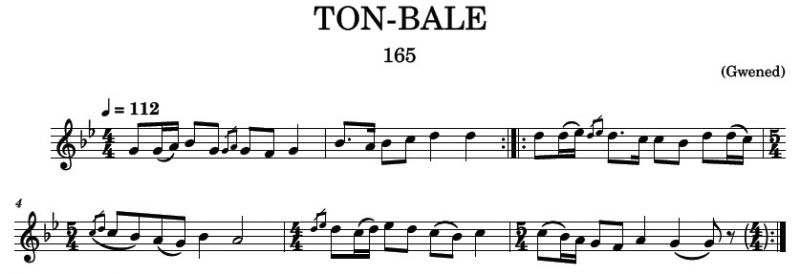
I entered one of the tunes into Musescore. (So I generated the image, it is not a copyrighted image.) It is a Ton-Bale, which according to the internet is literally a "tune-bullet", which is a march. In this case I think it is some sort of processional march, not a military march. This is a good example of an easy tune.
Edited by - RinconMtnErnie on 11/13/2025 16:02:52
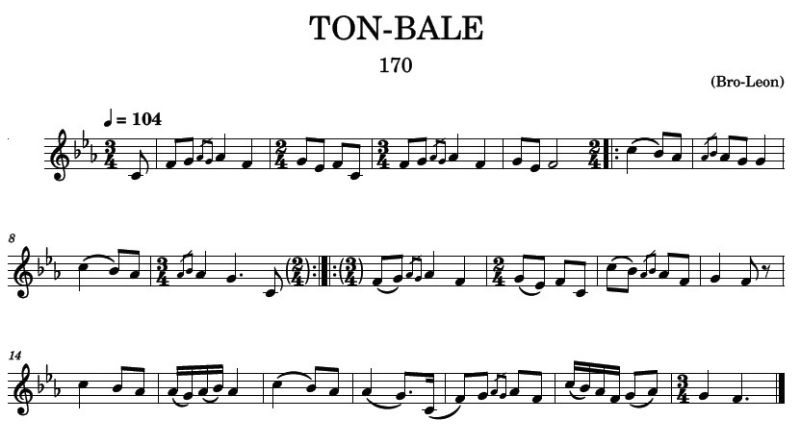
I entered another Ton-Bale (march) into Musescore. (So once again I generated the image, it is not copyrighted.) I think ton may be tone, not tune. I don't plan to upload any more.
The reason I uploaded this one is that it is a good example of a tune with a mordent from A-flat to B-flat and back. To do that I have to shift positions right after a string change. I can do it, but it will take some practice to do it effortlessly. I don't see any need to play in another key. It's certainly easier than playing Hitchhikers Blues!
Ernie, I understood what you meant about the awkward turns and now I see them in the score. It makes me wonder what that collection really is. Is it a collection from folk tradition, or new compositions? I see names in the upper right corners - are those composers? When I look at sheet music I mentally "see" it on a keyboard, and these would be easy that way (although probably hard to "march" to with the changes in meter.) One of the oldest publications we have is Knauff's "Virginia Reels," which was really meant for young ladies to play on their drawing room pianos, not so much for fiddlers. I wonder if this might be like that?
I have very limited experience with bombards (not so easy to find a place in the live mix for a contra dance band with a bombard) but I understand they are made in different keys (and mechanical complexity) like fifes. I think music for the fife is conventionally notated in D, regardless of the actual key of an instrument. Could that be the case here?
Edited by - DougD on 11/15/2025 01:31:40
The Breton tunes I've heard remind me of this recording I made of a tune called "He Man Du":
youtu.be/hEtmFqWdGps?si=Krl0cA5k52WjaxFq
This is a "waulking song" from the Hebrides of Scotland, used to keep time while "waulking the tweed," which cleansed, softened and compacted the woven cloth. Here's a group of women performing this task:
youtu.be/bOIZC16Jtz8?si=6m30ESEaPRjxdsed
Maybe some common Celtic roots there.
Here's a group of (I assume) re-enactors "waulking" cloth while singing "He Mandu."
youtu.be/2P6Rayojmyo?si=TvHnHJrQy7koNmBw
Thanks for the replies, Doug! I've never heard of a "waulking" tune.
The collection is of traditional musicians by Polig Monjarret, which he started around World War II. Here is an English obituary that gives a nice summary: https://www.irishtimes.com/news/a-pioneer-in-reviving-breton-music-and-culture-1.399840 . The primary instruments are the bombarde and the binioù (Breton word for bagpipe). Here is a better video to give the idea: https://www.youtube.com/watch?v=dXinY_WxTq8.
So the collection was not meant for fiddle at all. That said, these kinds of tunes are in a number of collections. For example: (1) The Massif Central Tune Book, (2) Dansons La Morvandelle and (3) Chris Haigh's French Fiddle Tunes. The first two aren't necessarily for fiddle per se, but they work well on fiddle.
Here is a collection of Breton tunes from a Hurdy-Gurdy web site: https://gurdyworld.com/music/French-Breton-Tunebook.pdf . I just found that today. All the tunes I tried work find on fiddle!
Have you ever tried to play next to one of those things on the fiddle?....It's excruciating...They are extremely loud. Like a smoke alarm and in weird keys for fiddle but not for them. Seems like all the tunes they play should be in normal fiddle keys, but they are not.... Just to annoy fiddle players imo.
Pete,
No, I have never played fiddle next to a bombarde! And living in Arizona, that's not likely to happen anytime soon.
You're confirming what I've read about loudness. My understanding is that playing one indoors is grounds for divorce.
There's plenty of room for confusion about the keys for these sort of tunes. Being as the Bombard is a Bb instrument, ie: A notated C natural sounds as a Bb note (edit: or is that the other way round?). Then take into account that the instrument could be in Baroque tuning also, which is a semitone down from modern concert pitch etc..... Is the tune notated in the relative minor key sig? or the parent key of the mode key sig? or is it notated by someone who doesn't know or care about key sig's....All very confusing.....To me anyways.
Edited by - pete_fiddle on 11/16/2025 10:20:46
I really like playing in Bb, not terribly hard to do, only the upper Eb/Bb notes are tricky, but once you've found them it's easy enough.
Yep i'm ok with F, Bb andEb, Ab not so much. but if a tune was composed and notated in Ab by a fiddler, i think i would get round it ok. But i would need to know the reason why they composed it in Ab....And Db (C#), would have to have a very good reason for being in that key!
In this case, most of the tunes are in modal scales, so key signatures can be misleading. Two flats (B-flat and E-flat) is B-flat major. Three flats (add an A-flat) is B-flat Mixolydian, with a lowered seventh. Four flats (add a D-flat) is B-flat Dorian. So more likely than not, the tonic is B-flat in all these cases. And because D-flat equals a familiar C-sharp, B-flat Dorian (four flats) is just as easy as B-flat Mixolydian (three flats).
I'm on travel now without a computer. If I feel ambitious next weekend I'll add some examples.
Edited by - RinconMtnErnie on 11/17/2025 11:28:19
I'm back home with access to the collections. I went through a number of tunes with three flats. The majority are probably in E-flat major, but a good number are in F Dorian and C Aeolian. I'm not seeing any tunes in B-flat Mixolydian as I was expecting.
Sounds like they have been notated for concert pitch instruments, from the playing of instruments like bombarde and biniou koz. Which are Bb or Eb transposing instruments. Ie: Written C natural sounds as either Bb or Eb.
Edited by - pete_fiddle on 11/20/2025 00:48:17
That’s a lot of flats!
If I was learning these tunes by ear, I’d be seriously tempted just to tune up a half step (tune my A to B flat) to avoid all the flat fingering…
Curious what local fiddlers do…maybe they are all just really used to playing in flat keys!
if the transposing instruments (bombarde and the biniou koz), where tuned to Baroque pitch you wouldn't have to tune up, as the tunes would be around the corresponding modern concert keys of D and A..
Interesting to me is that the bombarde and the biniou koz had to be in absolute perfect tune, and where probably made by a local (edit: or much respected), maker (like the uillean pipes where), but as a "pair" of instruments for local dances. (according to AI).
So they where probably tuned around about Bb & Eb, with intervals tuned to the makers liking, rather than tuned to the modern A=440hz concert pitch.
Ps: i have heard Frankie Gavin tuned up half a step...
Edited by - pete_fiddle on 11/20/2025 10:47:56
i think the local fiddlers would avoid playing with these instruments of torture and play in D and A...
I decided to go through some of the tunes with 4-flats this evening. Those tunes are relatively rare. So I only went through a handful of tunes. I believe they are mostly in F Aeolian, which is not what I was expecting. I could be wrong.
I'll admit I can't play very well by ear in those keys. In the videos linked in this thread plus others I found, the instruments are tuned to B-flat or C. I haven't found any tuned to A.
Page: 1 2
Terms of Use | Privacy Policy | Privacy Consent (EU/GDPR Only)
Copyright 2026 Fiddle Hangout. All Rights Reserved.