


GDAE Yes that’s the tuning. So strictly speaking it is a Tenor Violin. Tuned the same as my tenor violas’ but played between the legs bowing in reverse. I tried this instrument a few years ago but gave up on it because I couldn’t hear anything from it in a large, loud Irish trad session. Everyone out in front of it could hear it clearly and reckon it was fantastic but that’s no good to the player.
It was good to play due to having the same string length as a tenor banjo and fun to play at home or with small groups of players.
So recently I dusted it off and put the bridge down behind the soundpost bringing the string length from the same asa 1/2 cello to a 3/4 cello. This extra string mass gives a little more power to the 1/2 size body. Then I drilled two sound ports each side of the heel to direct some sound upwards. In order to keep the balance of the Hemolze thing I cut out paper patches and glue them over the f holes with simple easily reversible rice glue. I put on a viola tailpiece to keep the after length right and made a new bridge of bamboo with a vertical grain. The bonus with having a lower bridge is that the instrument is raised a little higher so the sound ports are that little bit closer to the player’s ears.
I took it out at last night’s session with only pipes, fiddle and whistle and it very promising I could clearly hear sound directly from the sound ports.
Onwards and upwards.
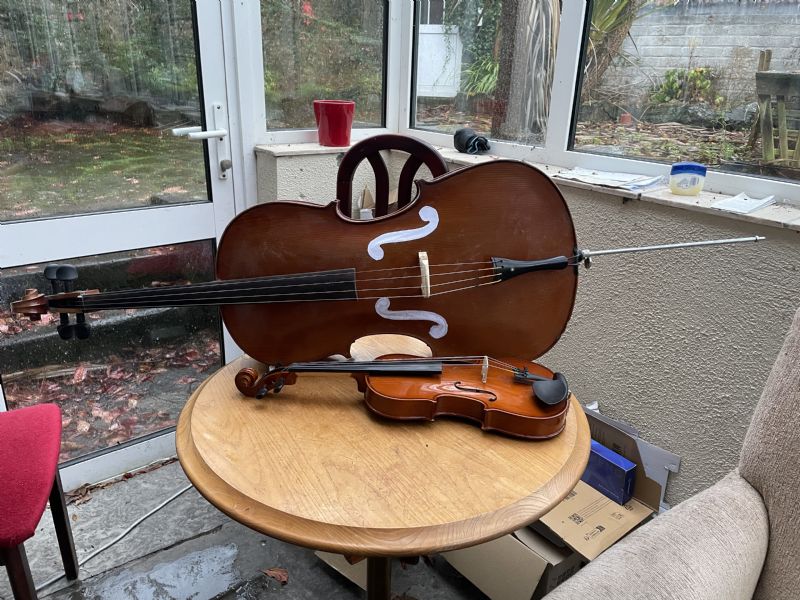
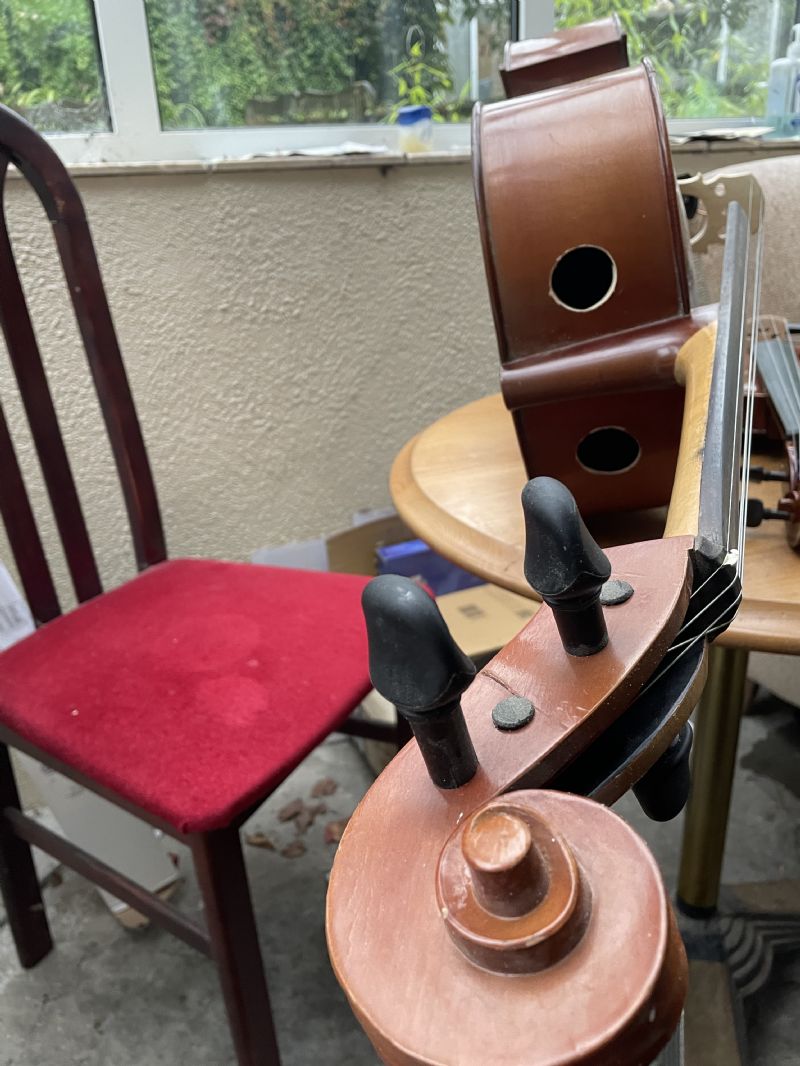

Oh yes it also has Wittner tuners.

Marty yes, that is heckuva big fiddle! I wonder if a cello player would take easily to it.
Sound holes on top is an interesting notion! Does that detract from sound projecting out the front, or doesn’t affect it…I’m no luthier…
Switching the position of the holes to the ribs directs the sound more to the ears of the player, but I highly doubt it makes it any more audible to the rest of the room. The f holes on violin family instruments were developed over centuries and refined for optimal projection in halls in the eras before electronic amplification existed. Their shape is not an accident or merely an ornament, and the wings play a significant part in the pumping of the air out of the body. They’re placed right in the middle because that’s where all the energy is focused in sound production and it’s where the plates are rocking the most to move the air excited in the body by transmission of vibration. Cutting holes in the ribs interrupts the transmission of vibration from the top to the back, so I would not be surprised if it’s actually reducing overall volume.
Violins function in a directional manner, which is why the position of the player makes such a big difference to the projection in a hall. One of the crucial lessons players learn about playing on stage is to be sure that the treble f hole faces the audience so that sound output is maximized for the audience. This is especially important when playing music with larger instruments that compete in power and it’s a key component of a soloist’s ability to be heard above the sound of an entire orchestra without any artificial amplification.
I have a guitar that has a sound port. It definitely helps me hear what I’m playing. I don’t think it affects the sound out front, but I’m not 100% sure about that.
I must say that I do not understand the internal acoustics of string instruments very well. It all seems quite mysterious to me...
Rich is spot on. The overall volume is reduced, but only slightly. The way I see it not being able to hear myself is a non-runner for me. I have 4 cello instruments 2x half & 2x full size. They have been sitting gathering cobwebs for the past few years so I have to find a way to make them work for me. This Sunday there is a monthly session (one of many) where there is likely to be 25 to 30 musicians (now don’t be jealous). It will be a good test for it. I just need to get the reverse bowing up to speed. And bye the way if any of you want to try this at home (highly recommended) it has the the top three strings of a 3/4 Larsen cello set from 4th to 2nd and a Savareze gypsy jazz guitar string .014” on the 1st.
My next plan is to do something similar with a full sized cello and tune it down to a GDAE bass in fifths.
Strabo, Yes, I remember that when I was guitar shopping I tried some with the sound ports! They claim that it doesn't affect sound projection out front - but I didn't have test listeners around at the time to verify ...
...but yes, when I hear friends play it sounds SO nice sitting in front of their guitar - much better than being the player myself. (Or, it could be that they are just better players than me...yup could be that...hmm!)
Edited by - NCnotes on 10/03/2025 09:33:03
Making banjos has been my main thing. Banjos don’t have sound holes but do have a very responsive Mylar/skin head that acts like a speaker. It requires air movement to generate the sound. If the air space behind the head is fully sealed it acts as a mute. So we also need air movement inside our fiddle if there’s not enough the air will dampen the sound. Fiddle’s also require the right air pressure inside the body and if the air pressure is too low it won’t produce a good volume of sound. If an instrument is already nicely vented ie sound or f holes, adding more holes is going to reduce the internal air pressure and the volume will suffer. If the ports in the top are designed into the instrument to maintain the correct internal air pressure the volume won’t be affected. I had to cover the f holes to keep the correct air pressure and I used paper to maintain the responsiveness in the top plate. I thought it would look stupid but I actually like the way it looks.
Good on you, Martyjoe! Sometimes inventors come up with a real winner and sometimes they don't but it's always worth a try.
Also effects tone. like the difference between an Ahh.. and an OoH...maybe?
quote:
Originally posted by HectorGood on you, Martyjoe! Sometimes inventors come up with a real winner and sometimes they don't but it's always worth a try.
Yes. It's a classic case of work in progress. I've found that all the logic and theory in the world can go out the window when it is put to the test in practice. As Rich pointed out there is a reduction in volume which became evident when I was playing in a session with 35 other musicians in a local pub. It was a definite improvement in terms of what I could hear seeing as I couldn't hear anything before. But I still wasn't satisfied, actually more disappointed! So I plugged one of the sound ports and removed the paper from the treble side f-hole for the following nights (Monday) session. A slight improvement in volume to me improved volume out front and slightly better tone overall. I still think I can do better so yesterday I repositioned both the soundpost and the bridge which shortened the playing string length and redid the whole paper thing to cover only the bottom holes of the f-holes. We are getting closer! Next session tomorrow night.
Terms of Use | Privacy Policy | Privacy Consent (EU/GDPR Only)
Copyright 2026 Fiddle Hangout. All Rights Reserved.

