myHangout Homepage
[Send Peter a message]
Teaches Lessons:
Online, In Person
Levels:
Beginner, Intermediate, Advanced
Teacher Since: 1969
Pricing: $50/hour
Listing Created: 11/17/2011
Listing Updated: 4/22/2015
More About Me
TEACHING PHILOSOPY:
When you pursue any activity thoughtfully over a very long time, you naturally by experimentation and observation develop an understanding of patterns and principles relating to that activity. I have been teaching fiddling in private and class settings for over 40 years, always trying to find the best ways to connect to students and to help them develop their skills, knowledge and talent. A few guiding principles and techniques have emerged, and I use them to help students along in their path to musical expertise.
1) Fiddling is an aural tradition, so students should listen to good fiddle music as much as possible. Putting the music in your head by repeated listening is a necessary precursor to learning to duplicate the sound.
2) Every student is unique. The same method of teaching doesn't work for every student. If one method isn't successful, try another one. I often ask students what method of instruction works best for them; sometimes they already know.
3) Listen to students as they express their needs and concerns, and encourage them to listen carefully to your instructions.
4) Sometimes spoken things have to be repeated before they are understood. Make sure you understand what your students are saying and make sure they understand what you are saying.
5) If you both talk little and play much, more gets done.
6) Always have new tunes to work on, even when focusing on technique. That way your playing won't get stale.
7) Make sure students learn and retain something at every lesson.
8) Repeated repetition is vital. I repeat: repeated repetition is vital. :) :) :)
9) Information needs to get broken up into easily digestible chunks.
10) Most people are not good at multi-tasking. Focus on one small thing at a time, make progress on it and move on.
11) Students shouldn't feel that they have to achieve perfection at one thing before they tackle another. Different skills work together in a complex interaction, so you have to work on many things, focusing on one thing at any given moment, and they gradually improve over time.
12) Students should have several things to work on at home so that they don't feel like they are getting in a rut.
13) Fooling around on your instrument is essential to the creative process and developing a personal style, but in the earlier stages of learning to fiddle, ten minutes of concentrated thoughtful practice accomplishes more than an hour of "noodling around" or careless repetition.
14) When it comes to playing tunes, if you are reading notes, you are not fiddling. Real fiddling begins after the tune is memorized. (This of course does not apply to improvised playing.)
15) If reading notes helps you to memorize them, that's okay.
16) If learning by ear helps you to memorize the notes, that's okay.
17) Real fiddling is much, much more than executing a sequence of notes. It's an amalgam of notes, sound effects, rhythms, complex bow dynamics, phrasing, tonal shadings and something people call "soul" or "spirit".
18) These things can only be learned by lots of listening.
19) Students need to listen to lots of great fiddling by great fiddlers in order to get beyond the notes. It's like the old saying: if you want to see farther than other people, stand on the shoulders of giants.
20) One of the most challenging things about playing the fiddle is learning how to play in tune. Intonation is learned by extremely slow play and careful examination of pitch. When practicing intonation, never let a note go by without correcting its pitch. Some students have a better pitch sense than others, so it's the teacher's job to provide ear training. Playing out of tune over and over simply reinforces bad finger positioning.
21) In the early stages, students need to have lesson time and quality practice time devoted to mastering fundamental skills, one at a time. It's the teacher's duty to continually reinforce these skills until the student performs them automatically.
22) Speaking of fundamentals, in fiddling there are many workable ways to hold the bow and fiddle. Different methods are advantageous to different styles of playing. If it produces the right sound, it's okay for that style as long as it does not cause physical problems. I personally adjust my bow grip, violin hold, and vibrato style according to the type of music I'm playing.
23) Some of the key issues that need to be focused on initially and revisited as often as necessary are:
a) Developing a workable and comfortable violin and hold;
b) Developing flexibility in the finger, wrist, elbow and shoulder joints while playing; all parts need to move, nothing should be stiff;
c) Developing balanced movements during playing so that movements are efficient, free and easy;
d) Eliminating unnecessary body tension while playing;
e) Playing in tune;
f) Developing a good bow stroke and learning to keep the bow at a right angle to the string;
g) Understanding the relationship between bow placement, bow pressure and bow speed and putting this knowledge to work to produce good tone, whether loud or soft;
h) Memorizing the building blocks of fiddle tunes; scales, arpeggios and roll patterns;
i) Learning how to transpose keys by playing the same tune in different keys in first position;
j) Learning how to play any given first position note pattern in 2nd, 3rd and 4th position without changing keys;
k) Learning how to shift positions smoothly; and
l) Learning how to execute sliding movements tastefully and musically.
BRIEF BIO:
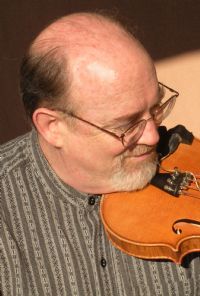
Peter 'Doc' Rolland (www.peterrolland.com) has had a 41-year career as a professional fiddling entertainer and fiddle teacher that has kept him "young at heart." His early training on the violin was from his father Paul Rolland, a founder and president of the American String Teachers Association (ASTA). With his father's encouragement, Peter applied his father's example to the genre of fiddling while he pursed his doctorate in mathematics. He organized classes and taught fiddling at five universities in the west. Through research into fiddling repertoires of elderly fiddlers supported by the National Endowment for the Arts and the Arizona Commission on the Arts he has preserved and purveyed Arizona's fiddling and authentic cowboy music traditions to audiences in the United States, Canada and Western Europe for over three decades. He has won numerous fiddle contests at the state and national level, and trained many fiddle champions and professional performers. In addition to gigging in many different genres (old-time fiddle, cowboy, bluegrass, traditional country, Celtic, etc), he does school workshops and residencies, teaches at fiddle camps and maintains a private teaching studio. He is an experienced fiddle contest judge and has been a judge at the national contest at Weiser Idaho three times. He has operated a small violin shop and string instrument rental service since 1983. He has honed his skill as an arranger over 35 years of teaching fiddling classes, and Northeastern Music Publications, Inc. has published his folio of traditional fiddle tunes and cowboy songs arranged for school orchestra. As a music teacher he emphasizes freedom and ease of playing with good motion patterns and a relaxed balanced efficient technique, learning traditional tunes, making the fiddle talk, playing expressively, understanding style, diagnosing and analyzing technical problems, double stops, chord knowledge and understanding fiddle harmony. In 2009 he produced and released the DVD of Paul Rolland's film series "The Teaching of Action in String Playing" (www.paulrolland.net). In April-May of 2010 he did a teaching and performance tour of Germany, Belgium, England and Scotland. In Trossingen, Germany he was the featured clinician at a German Classroom String Teacher's conference and gave four workshops on American fiddling and how to incorporate it into the classroom. At the ESTA conference in Brugge, Belgium he presented a lecture/demonstration on both Rolland methods and American fiddling. ASTA published his article on fiddle teaching in the AST spring issue, 2011. He founded Rolland Fiddle Camp (www.peterrolland.com/Rolland_Fiddle_Camp.html) which had it's first annual summer camp in Colorado in 2011 and is scheduled to repeat on July 8-14, 2012. Since the fall of 2011 he taught annual fiddle workshops at George Mason University. In August 2014 Doc Rolland's Americana String Ensemble gave 24 concerts in 23 cities in China. More information at his website www.peterrolland.com and Facebook.
Peter Rolland * 480-969-9744 * e-mail: peterrolland@cox.net * 1616 W. Mountain View; Mesa, AZ 85201


