DVD-quality lessons (including tabs/sheet music) available for immediate viewing on any device.
Take your playing to the next level with the help of a local or online fiddle teacher.
Monthly newsletter includes free lessons, favorite member content, fiddle news and more.
Premier Sponsors


|
Please note this is an archived topic, so it is locked and unable to be replied to. You may, however, start a new topic and refer to this topic with a link: http://www.fiddlehangout.com/archive/60323
capefiddle - Posted - 09/09/2025: 10:02:57
I’m trying to wean myself off from the fret tapes and started removing them from the fingerboard (I started with the top one and recently removed the 2nd). I also started practicing with the tuner on all the time trying to achieve hitting the correct notes, or at least see how far off I am so I can adjust where the finger is placed. With that, trying to train my ears, as well. Not easy. My question is, do you always hit the correct notes when playing? Should I expect to always play the note accurately? I realize to play perfectly I should strive to hit the note accurately. Is that possible or just something to strive for?
Thanks.
John
UsuallyPickin - Posted - 09/09/2025: 11:10:53
Two things. Listen for the correct tone, use slides and vibrato . Yes you will eventually be able to hit the correct pitch. Warm up with scales. That will train your ear and your fingers. You can do this with your tuner on or with a cello tone playing in the backgorund. Be patient. It will work out. R/
wrench13 - Posted - 09/09/2025: 12:07:00
It just takes a lot of sharpening your ears for the right tone. Everyone misses by a tiny amount but almost instantly corrects for pitch. Everyone! I think it was on here, where someone mentioned a study where highly trained classical players had sound proof ear muffs put on. To a man, their intonation went right out the window. I know I run a few scales and arpeggios in several keys first, when ever I take the fiddle out, just to smarten up the left hand. I also slide most times, when I have to go up to a unison note - thats when you really hear any pitch errors!
farmerjones - Posted - 09/09/2025: 13:42:11
Get used to hearing the harmony of the fingered/stopped note plus an open adjacent string. As been said, don't be afraid to slide into it.
The longer the note, the more accurate the pitch must be. In other words, shorter than a quarter note, needs to be close, but not at the mercy of the rhythm or the next note.
Phrase ending notes should be really close.
Here's the hiarchy: 1) in tune with myself. 2) in tune with the group. 3) in tune with a digital tuner. Don't make yourself crazy chasing a digital tuner. Occasionally record yourself and listen back. Don't get bogged down with perfection.
buckhenry - Posted - 09/09/2025: 18:27:12
I once read these words of wisdom... "rather than train the fingers on the fingerboard, train the mind on the fingers". To me this means... 'train the 'inner ear' to hear (anticipate) every note before it is played'. When the mind hears the pitches the fingers are compelled to follow. I believe the quickest way to train this is to: find the fingered notes that harmonise with an adjacent string and tune them up; practise scales and arpeggios by anticipating every note, sliding and vibrato not permitted. When a fingered note is out of tune repeat until tuned, your tunes could also be practiced like this. Thus, you are actually singing ( in your mind ) what you are about to play, and when this technique is finely tuned the slightest 'out-tune-note' in a bunch of notes no matter how fast they're played will be detected, for it is the mind that plays the notes.
stumpkicker - Posted - 09/10/2025: 09:09:45
Back 15+ years ago I had a program on my pc, you could play notes on your string instruments and it would show you how close you came to hitting the notes exactly. So that may sound like it would be frustrating BUT, you could also track master violinists like Perlman or Heifetz and you would be surprised how they were usually a shade off the note they were trying to play. And the first generation of b’grass fiddlers, love’em but spot on accuracy wasn’t their wheelhouse !. ;-)
farmerjones - Posted - 09/10/2025: 10:29:46
Yes! I remember that app! I think it was called Intonia, or similar?
Yep. I was the same distance off on every note so I never checked again.
Now, someone will go all 'chatGTP' on the difference between accuracy and precision. . . .
capefiddle - Posted - 09/10/2025: 10:47:40
“Perlman or Heifetz and you would be surprised how they were usually a shade off the note “……..
The Diadario tuner I use has LEDs of green, yellow and red. Sometimes I hit a green now and then. Being a “shade” off would be satisfying for me at this stage of my budding fiddle career.
DougD - Posted - 09/10/2025: 11:15:25
I'm not going to go all "chatGTP," but I do wonder if that program was based on an equally tempered scale. If so, then violinists, as well as good fiddlers, might well be "off."
Edited by - DougD on 09/10/2025 11:16:57
DougD - Posted - 09/10/2025: 11:36:01
And I think it was Wyatt Earp who supposedly said "Speed is important, but accuracy is everything!"
farmerjones - Posted - 09/10/2025: 12:09:05
If I remember right, there were possibly a 1/2, dozen settings? There are Asian and Eastern scales with more than 12 tones. But I think you could've set that.
I thought I was off because I was plucking my strings to tune. Being non-right handed, it took a long time to be able to bow well enough for a tuner to read it.
Lonesome Fiddler - Posted - 09/10/2025: 13:42:43
Subtle variations in pitch can lend personality to your playing. It's one of the things that makes the sound of a fiddle more like that of an actual human voice. Plus, it usually ain't the Berlin Philharmonic you're jammin' with at the local coffee house.
pete_fiddle - Posted - 09/10/2025: 13:46:29
Play it like you would sing it. If that's not good enough sing it and play it some more... Until it is.
Edited by - pete_fiddle on 09/10/2025 13:48:17
buckhenry - Posted - 09/10/2025: 22:42:37
Sometimes 'subtle variations in pitch' are needed to stay in-tune.
For example the Bb note in the Gm quadruple stop is slightly higher than the same Bb pitch in a descending melodic line.
I wonder how an 'intonation program' decides which pitch variation is required for the B natural as played with open E and the same B natural played with open D.
pete_fiddle - Posted - 09/11/2025: 01:39:15
quote:
Originally posted by buckhenrySometimes 'subtle variations in pitch' are needed to stay in-tune.
For example the Bb note in the Gm quadruple stop is slightly higher than the same Bb pitch in a descending melodic line.
I wonder how an 'intonation program' decides which pitch variation is required for the B natural as played with open E and the same B natural played with open D.
i think that while playing the melody line, expressing the Function of the note within the context of the scale or chord sounds good. i think it gives a sense of forward motion to a melodic line. And also expresses your intentions. An extreme example of this is the Melodic minor scale maybe?...How sharp is that 7th when ascending? Or how flat is that 6th when descending?
tonyelder - Posted - 09/11/2025: 07:26:20
 I'm probably going to regret saying this, but that's never stopped me before.

I'm not so sure that "perfect" intonation for every note is all that we need to aim for. Of course, if a "fiddler" is way off - that's one thing, but a lot of "fiddle" music is richer when the tune is allowed to be somewhat expressive while coloring outside the lines a little. If fact some tunes were purposely written that way.
What I'm not saying: So, don't worry about it.
What I am saying is (as buckhenry said earlier) - "rather than train the fingers on the fingerboard, train the mind on the fingers" - Listen to what you are playing and aim at having "great sound" when playing rather than having "great intonation".
I think - some tunes were written with the intent of slurring notes - making the tune show-off some notes off pitch.
Yes. Intonation is important, in addition to..... all the other stuff. 
Edited by - tonyelder on 09/11/2025 07:30:29
pete_fiddle - Posted - 09/11/2025: 07:41:12
Perfect intonation is the intonation that sounds perfect..... To you
Old Scratch - Posted - 09/11/2025: 08:04:25
Uh-oh - we're getting dangerously close to that unresolvable argument about whether a fiddler should have all the intonation and tone of a concert violinist or those of, um ... a fiddler ... !
DougD - Posted - 09/11/2025: 08:45:46
capefiddler - I'm curious. Have you learned any tunes yet, or are you still concentrating just on technique? I think you've had two teachers so far, and I wonder about their methods. I'm of the belief that the best way to learn to fiddle is to play tunes, even if its just "Three Blind Mice," along with scales and chords and some thought to bowing methods. I guess a tuner can help with intonation with very long, slow notes, but beyond that I've never understood how it can be very useful.
PS - Regarding your question about hitting notes accurately - yes it is possible, and yes its something to strive for. Both, but you have to be able to recognize when its right, and its not always easy to achieve.
Edited by - DougD on 09/11/2025 08:50:34
capefiddle - Posted - 09/11/2025: 09:01:55
Hi Doug....Yes, correct, I'm on my 2nd teacher, who I really like. She is very focused (or I should say, she focuses me) on technique but does it in a way while I play tunes. I've been playing The Wren and we use that as a "learning tool". She is a good teacher and a great fiddle player. I attended a session at Maine Fiddle Camp this past June. There I learned, on top of The Wren.... Coleman's March, Road to Boston, and Mare's Wedding. Currently learning Whiskey Before Breakfast. And a bunch of other tunes I've learned. Not by any means saying I play them all anywhere near perfect, but I use that bunch to learn by (Old Joe Clark, June Apple, Angeline the Baker, Blackest Crow, Cluck Ol' Hen (one of my favorites and fun to play). And yes, I've also been playing scales. Doing that with the tuner involved. I've also been attending a jam session once a week where there are 4 or 5 of us with similar proficiency levels (although I'm probably the newbie musician of the group).
This thread is very inspiring and helpful... so thank you for all the great responses.
John
DougD - Posted - 09/11/2025: 10:10:58
Sounds good. "Road to Boston" is a great beginner's tune. Have you seen this pandemic era video by the Maine Fiddle Camp staff? youtu.be/zA6e1yjcBg4?feature=shared Lissa Schneckenburger (lower right hand corner) is a terrific musician and singer (even if she's one of those "violinist" types)! If you ever have a chance to attend a workshop with her it would be well worth it.
capefiddle - Posted - 09/11/2025: 10:26:23
I think, if I remember correctly I have seen that video. Lot of familiar faces from my June session in the video. Lissa was at my week's session but I did not have any classes with her.... I've seen a few videos of her before. I did see my teacher there, upper left hand corner with blue shirt. She also does calling for Contra Dancing. Liked her a lot. That is a fun song to play. Last day the whole camp (200+ musicians) serenaded the cook staff by playing Road to Boston. Played it a bit faster than what I could keep up with though :-(
ChickenMan - Posted - 09/11/2025: 12:41:12
quote:
Originally posted by buckhenrySometimes 'subtle variations in pitch' are needed to stay in-tune.
For example the Bb note in the Gm quadruple stop is slightly higher than the same Bb pitch in a descending melodic line.
I wonder how an 'intonation program' decides which pitch variation is required for the B natural as played with open E and the same B natural played with open D.
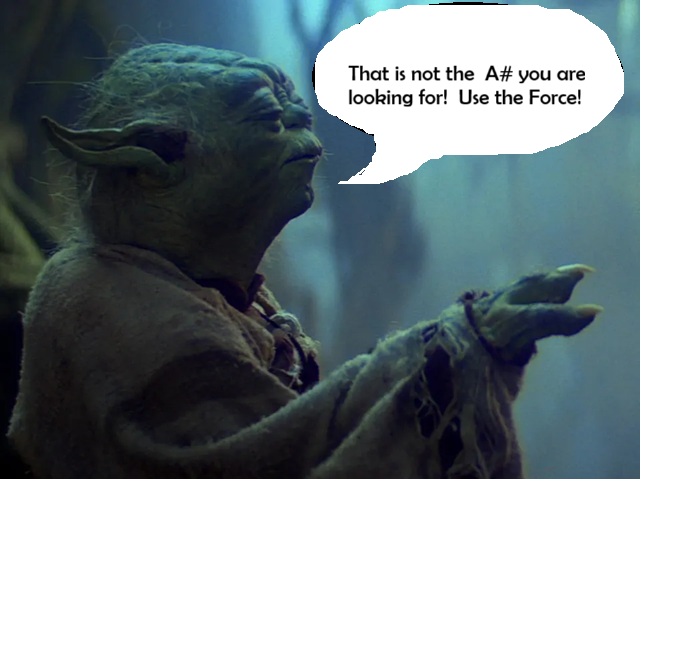
And this right here is why pianos and fretted instruments are a compromise and early keyboard instruments had split black keys, because A# and Bb etc are not the same note. I strongly suggest the book How Equal Temperament Ruined Harmony (and Why You Should Care). In the prelude section the author relays a conversation with the Cleveland Orchestra conductor about Beethoven's Ninth. It starts with about 2 minutes of a D minor chord but then shifts to Bb major, and the conductor found it difficult to get the Bb to sound right, because the players were not getting that major third despite the conductor trying it over and over in rehearsals. In the book the author makes a compelling argument that when even temperament was devised (so keyboards could play in more than one key) harmonies lost their sweetness and we've all become accustomed to ET and think nothing of it. But string players, particularly small ensemble players, make changes, widening the third here, narrowing it there, in order to have sweet harmonies.
Off the soapbox, Billy, get back to fiddling.
Edited by - ChickenMan on 09/11/2025 12:42:15
buckhenry - Posted - 09/11/2025: 19:46:58
"......making the tune show-off some notes off pitch...."
I have never heard about 'notes off pitch' to be a common fiddle technique.
What I have heard about is.. 'playing out'; deliberately playing notes 'out of key', thus chromatic notes.
Usually related to secondary dominates, or passing chords, or chromatic approach notes.
I remember having some fun once with 'Soldiers Joy'; in the second phrase where the tune moves to the V7 chord I play G Eb Eb, which ensured a reaction from the band members, I call that the 'joke note'...
"......a fiddler should have all the intonation and tone of a concert violinist....."
I don't think there is any fear of that. This thread is an inquiry into basic intonation.
The references to 'expressive intonation' are an attempt to debunk the use of 'electronic tuners' and 'intonation programs' as a method of learning to play in-tune on fretless instruments.
tonyelder - Posted - 09/12/2025: 07:16:12
quote:
Originally posted by buckhenry"......making the tune show-off some notes off pitch...."
I have never heard about 'notes off pitch' to be a common fiddle technique.
Yes you have. 
Use different words if you like... it was just my quip way of describing a common technique that uses off-pitch elements that aren’t accidental or sloppy, but rather intentional and expressive. It implies the fiddler is using pitch bends, slides, or microtonal inflections to highlight certain notes for emotional or stylistic effect.
And there's the off-beat note or 2 in a phrase...
amezcua - Posted - 09/12/2025: 07:51:25
For a beginner you first need to tune the A string to A4. The 4 tells us what octave it`s in on a piano. Even an out of tune piano will play somewhere near A4. An electric tuner will be accurate . Use that to get that one string tuned.Then put the tuner away and tune A to D open strings. That`s a Fifth .When you play both strings together you may hear Beats that show the tuning is not right yet .Tune slowly up or down on the D string only to slow down the beats. If the beats slow down and then speed up again you have gone too far. Lastly always tune up to the note . If you tune too high and have to come down you should go a bit lower and then come up to finish.So A and D are in tune with each other .Now tune D and G. This time do not touch the D string --only the G. The A to E is next . Only alter the E string . That`s all the tuning you need for now .
Look up Beats to know exactly what they are and what they sound like .
DougD - Posted - 09/12/2025: 09:31:45
buckhenry - Don't know if this is what you're referring to, but in the preface "Notes on the Treatment of the Music" in his book "Dance to the Fiddle, March to the Fife," Samuel Bayard wrote:
"Arrows above notes, when pointing upward, indicate a slightly augmented interval; when pointing downward, a slightly diminished interval. In all cases, the sharping or flatting is less than a semitone. These are the "neutral" tones: somewhere between natural and flat, or natural and sharp."
Its sometimes hard to tell if this intonation was intentional on the part of the player or due to a problem with technique, but it evidently was consistent.
He used the same convention in "Hill Couny Tunes."
pete_fiddle - Posted - 09/12/2025: 13:05:05
i think we just do our best to make it sound like we want it to sound... And learn along the way. Nobody is looking at their electronic tuner whilst they are playing. i try to keep the chord notes in tune, and imagine the patterns of the 7 modes through 1 octave to help me in my leaps of faith, but that's about it. its all seat of the pants stuff, and what makes fiddle fun.
buckhenry - Posted - 09/12/2025: 16:47:34
Thanks Doug - great resource of tunes. I was interested in checking out those arrows, I eventually found them in tune no. 13, indicating sharpened I and V notes occasionally, can't imagine why.
I'm going with what Pete said..."we just do our best to make it sound like we want it to sound"...
DougD - Posted - 09/12/2025: 17:41:22
I think those marks in #13 are accent marks or bowing indications. The intonation arrows have tails - look at #51 and #118. They are typically for notes that determine major or minor key, or Mixolydian vs major modes, etc.
If you can find it, check out "Hill Country Tunes." Its a little more manageable size collection, and its typeset instead of handwritten, so the arrows are easier to see. Plus it includes many tunes from Sarah Armstrong, several of which have become very popular these days
Edited by - DougD on 09/12/2025 17:43:36
buckhenry - Posted - 09/12/2025: 22:41:36
I'm gonna get shot down in flames for this, oh well, here goes..........
That was interesting study of those tunes in 'Hill Country Tunes'. Sarah Armstrong must be a good fiddler because she hardly played any of those 'off pitch notes'. Some of the transcriptions were from 'whistled by', 'sung by' and 'copied from manuscripts', which are completely devoid of those little up-n-down arrows indicating notes off pitch. Only the transcripts of 'played by' have the arrows.
This makes me believe that those tunes 'were not purposely written that way'. And that the 'off notes' are not 'colouring notes' but a technical confusion with the placement of the second finger notes. They are consistent in that the natural Fs, Cs and Gs are often played higher, and the equivalent sharp notes are often played lower no matter what key they're in. Even the third finger Gs have received the same treatment.
Having taught beginner violin for some years I had to constantly remind students about low and high ( 2nd, 3rd ) fingers. I'm not convinced that they're notes of colour.
Dan Gellert - Posted - 09/13/2025: 17:45:13
An electronic tuner cannot help you to learn good intonation. Neither can fingerboard tape or other markers.
First, learn to bow pairs of strings evenly. Then you can learn to get the open strings in tune.... really IN TUNE (just perfect fifths, NOT tempered)! Now, when you pick up the fiddle, ask your ears where those fingers should be-- Play the open a and d together, then put your first finger down to finger b on the a string, and keep playing and experimenting until you hear that clear ring that tells you it's in tune. (BTW that b will be a significant bit flat of what your tuner says is "b"! You have to finger that b a bit higher to ring true with the open e...) Third finger down on the a gives you a perfect octave from the d, which is really easy to hear!
etc. etc. -- Always use your open strings for pitch reference when you can. You can get apps that will play a steady drone at whatever pitch you choose, and those can be a big help. Take your time and listen!
ChickenMan - Posted - 09/13/2025: 20:33:43
quote:
Originally posted by Dan GellertAn electronic tuner cannot help you to learn good intonation. Neither can fingerboard tape or other markers.
First, learn to bow pairs of strings evenly. Then you can learn to get the open strings in tune.... really IN TUNE (just perfect fifths, NOT tempered)! Now, when you pick up the fiddle, ask your ears where those fingers should be-- Play the open a and d together, then put your first finger down to finger b on the a string, and keep playing and experimenting until you hear that clear ring that tells you it's in tune. (BTW that b will be a significant bit flat of what your tuner says is "b"! You have to finger that b a bit higher to ring true with the open e...) Third finger down on the a gives you a perfect octave from the d, which is really easy to hear!
etc. etc. -- Always use your open strings for pitch reference when you can. You can get apps that will play a steady drone at whatever pitch you choose, and those can be a big help. Take your time and listen!
This is 100% how I learned and still play. Ears, train 'em and use 'em. Your fingers will follow the ears.
The Violin Beautiful - Posted - 09/15/2025: 06:06:05
Ruggiero Ricci shared a great intonation exercise in a masterclass some time ago that has always stuck with me.
Simply play a scale using one finger. This really puts pressure on your ear to find the right pitch and it deliberately challenges the muscle memory of the fingers by abandoning the fingering patterns that go with scales. To challenge yourself further, put effort in to avoid sliding into notes so that you’re actually hitting each note squarely. This is very difficult to do. If you’re struggling, an adjacent string can be used as a drone. Ricci pointed out that although some degrees of the scale will be dissonant with the drone, the open string is nevertheless a useful reference point for intonation accuracy.
Ricci was the first to record repertoire so difficult that no other violinist, even Heifetz, would dare to record it at the time. That takes incredible bravery and masterful technique.
chas5131 - Posted - 09/15/2025: 10:50:34
Close your eyes and listen for a bit once a day.
A lot of good advice in this thread. Thanks for all that.
Just adding what I think is worth adding to the practice tips in this thread.
buckhenry - Posted - 09/15/2025: 23:16:06
Playing 'one finger' scales certainly does test the ability to play scales in tune.
Perhaps a pre-requisite would be to master scales in first position.
And good shifting technique may also be a pre-requisite.
pete_fiddle - Posted - 09/15/2025: 23:58:32
Also when shifting with one finger, to know what notes are around the finger you shift on, in relation to the key, tonic, mode, chord or arpeggio etc.
In essence playing scales with one finger "is" shifting.
The Violin Beautiful - Posted - 09/16/2025: 06:42:47
quote:
Originally posted by buckhenryPlaying 'one finger' scales certainly does test the ability to play scales in tune.
Perhaps a pre-requisite would be to master scales in first position.
And good shifting technique may also be a pre-requisite.
Yes, it does require plenty of shifting to play with one finger. Familiarity with shifting is helpful, but the focus is primarily on hearing pitches and understanding interval spacing in the degrees of the scale. If you're constantly changing position, it also gives you the opportunity to correct left hand posture mistakes, as you must make use of a hold that allows shifting and isn't collapsed. There is a whole neck to traverse, so an exercise that forces continuous shifting makes you much more mindful of it.
It's such a simple exercise, yet it is quite difficult to accomplish and its effects are wide-reaching. Even if you're not familiar with playing in other positions, it can be a good introduction.
pete_fiddle - Posted - 09/16/2025: 08:40:36
i think it would be good to have a mental map of the fingerboard in a given context "Before" learning to shift. This would maintain a left hand, and wrist position that makes any subsequent notes accessible. And also yield a practical and ergonomic shifting technique in the given context.
Edit: For example it would not be a good idea to have your hand and wrist in a position to play the Phrygian mode through an octave, if you needed to play the locrian mode through an octave, (both on modes through 1 octave, on adjacent strings, and starting on the same note, and the same finger).
Edited by - pete_fiddle on 09/16/2025 08:51:23
buckhenry - Posted - 09/16/2025: 23:10:15
.....hand and wrist in a position to play the Phrygian mode.....
Are you still referring to the 'one finger' scales...?
What is 'phrygian mode' hand and wrist position..?
Can you clarify?
pete_fiddle - Posted - 09/17/2025: 00:28:48
i have to slightly pancake (collapse) my wrist to play the second tetra-chord of the locrian mode. And also slightly bend it forward to play the first tetra chord of the lydian mode, (that's the one i meant, not phrygian but it is still a different hand position).
in short, i don't just shift one finger. i shift the whole octave to a new "mode shape", and the finger i shift on, becomes a note within the new mode shape. Whatever that happens to be. like chord charts for a guitar or the"caged system " for mandolin.
My hand and wrist could be in a completely silly position to play any subsequent notes (or double stops), otherwise. But the note i was playing could be perfectly in tune.
Edited by - pete_fiddle on 09/17/2025 00:43:15
pete_fiddle - Posted - 09/17/2025: 01:48:07
Try alternating between an octave of Eb lydian in 1st pos, (on the D&A strings), and an octave of Eb Phrygian in 1st pos, (on the D&A strings), i think you will see what i mean...Hand and wrist alter..... (Well mine have to anyways), but the Eb note stays where it is, under the 1st finger.
buckhenry - Posted - 09/17/2025: 03:20:06
I 'think' I'm understanding what you mean.
....second tetra-chord of the locrian mode....
The 'backward extension' of the first finger requires a slightly collapsed wrist....
... first tetra chord of the lydian mode...
All fingers are extended forward requiring the wrist to bend out, away from fiddle.
... i shift the whole octave to a new "mode shape"...
The finger spacing changes when shifting position, ie 1 2 34 becomes 1 23 4, then shift higher it becomes 12 3 4.
...alternating between an octave of Eb lydian and Eb Phrygian...
There is a very slight turn of the wrist to accommodate the 'folded back' fingers for the phrygian mode.
pete_fiddle - Posted - 09/17/2025: 04:19:28
yep you've hit the nail again thanks for giving it a go. it's difficult to write about these things.
ps i like the way you've written the tetra chords out 12 3 4 etc
Edited by - pete_fiddle on 09/17/2025 04:32:04
Old Scratch - Posted - 09/17/2025: 08:37:30
Tangentially related discussion going on, 'Intonation of Old Fiddle Masters': thesession.org/discussions/505...nt1018945
Terms of Use | Privacy Policy | Privacy Consent (EU/GDPR Only)
Copyright 2026 Fiddle Hangout. All Rights Reserved.