
DVD-quality lessons (including tabs/sheet music) available for immediate viewing on any device.
Take your playing to the next level with the help of a local or online fiddle teacher.
Monthly newsletter includes free lessons, favorite member content, fiddle news and more.
Premier Sponsors


|
Please note this is an archived topic, so it is locked and unable to be replied to. You may, however, start a new topic and refer to this topic with a link: http://www.fiddlehangout.com/archive/59756
learn2turn - Posted - 02/25/2025: 06:30:38
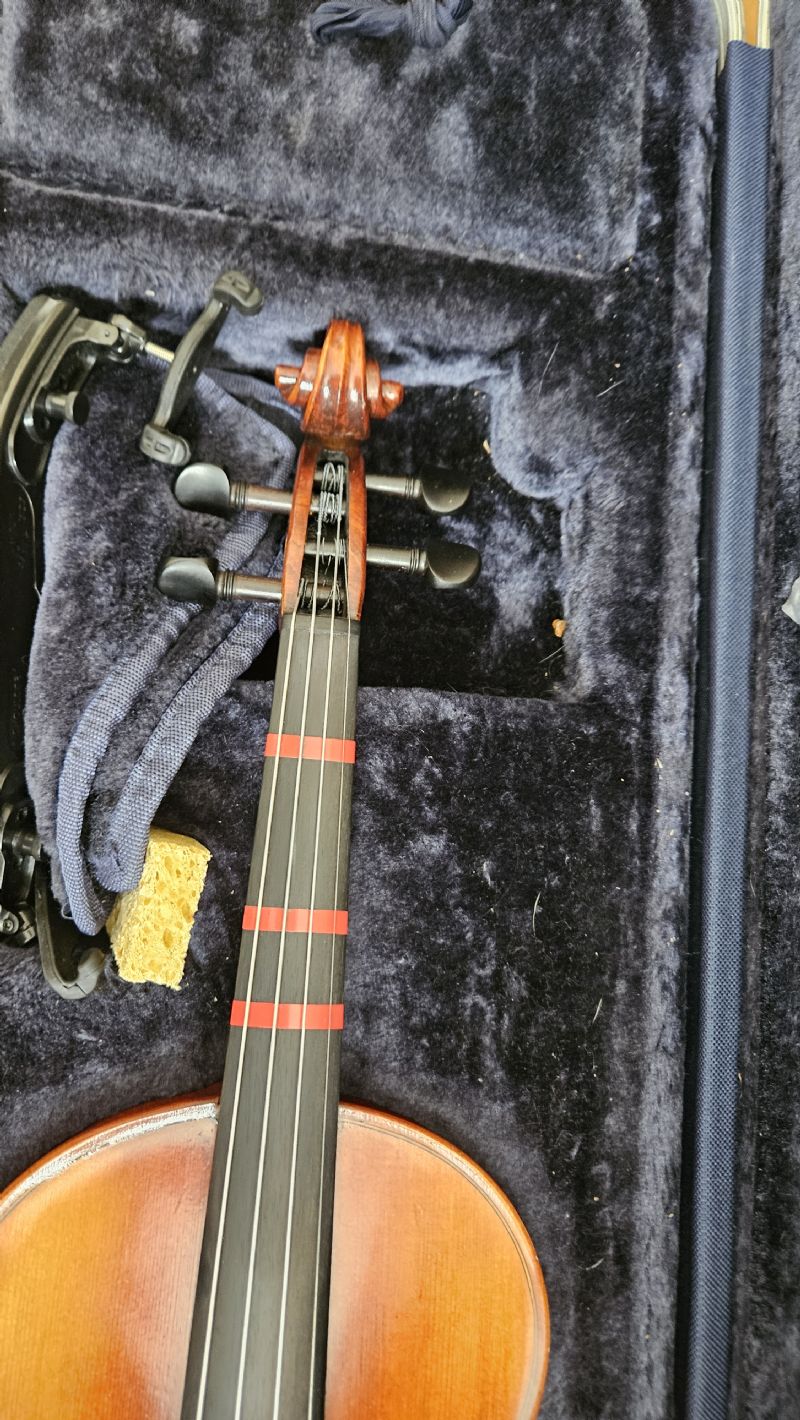
The used student fiddle I started with had tape on 2, 5, and 7. I figured I might as well leave it on as I started to learn to play; I've been playing since late December, about two months. I'm wondering how long I should leave it on and when I should take the plunge and pull it off. Once I take it off, there's likely no going back as I don't have more tape and may not get it positioned correctly if I did.
I try not to peak while playing. If I'm looking, it's mostly to check my bow angle. But it does help getting started, like if I start a song on an F# or an A on the D string.
-Ken
capefiddle - Posted - 02/25/2025: 09:38:21
For what it’s worth, I still have tapes. I just replaced the tapes as the original was coming undone. You can look online where to locate them and check your placement with a tuner. I’ve read you can leave them on for 2 years or until you feel comfortable without them. My 2 cents.
The Violin Beautiful - Posted - 02/25/2025: 09:47:11
If you’re not looking at the tapes to check, you can probably remove them. You may be used to the feel of the tape at those spots, but I would encourage you to put your energy into checking pitch by ear and not relying on the eye or the finger much, if at all. Lots of students learn that way, but the transition to relying on the ear alone can then be more complicated.
Tapes are easy to replace. Any shop can do it for you, especially one with a rental program. Don’t be afraid to take the tapes off if you think you’re ready. If you have a teacher, ask the teacher for an opinion.
ChickenMan - Posted - 02/25/2025: 09:54:23
The time was yesterday  they are a crutch, and your fingers are likely working pretty good, time to let your ears take over. The ears are far more important than the tape.
Edited by - ChickenMan on 02/25/2025 09:55:50
NCnotes - Posted - 02/25/2025: 10:57:27
If it sounds in tune without looking/checking, yup time to take off the “training wheels”! Although probably no harm in leaving longer if you are unsure…
I had tapes for at least the first six months, I think ( as a kid, I did not practice daily though :-)
doryman - Posted - 02/25/2025: 12:56:06
I know several adult fiddlers whose intonation is so bad, I wish they they had never taken off the tape (if they ever used it in the first place)!
martyjoe - Posted - 02/25/2025: 12:56:44
Maybe if You wanted to reinstall them you could try using the StewMac Fret Calculator to find the positions again. I think that you are better off without them.
pete_fiddle - Posted - 02/25/2025: 14:05:51
"When to lose tape on fingerboard"
ideally before you put it there.
Dick Hauser - Posted - 02/25/2025: 14:39:31
I like to play along with recorded music. If a specific note(s) give me trouble, I will use tape until the problem is gone. When playing along with music, I usually play the scale several times first. This approach seems to have taught my ear how to recognize notes and my fingers to finger them accurately. Playing along with recorded music also helps me identify and correct timing problems sometime. The notation in music books seems to keep getting smaller all the time, and lack of spiral binding makes it difficult keeping books open.
farmerjones - Posted - 02/25/2025: 16:51:27
Early on I would check my finger placement by bowing an adjacent open string and the fingered string together. Listening for a pleasant interval.
Try sliding a finger up or down a string while bowing an adjacent open string at the same time. You should be able to hear the sliding string come into harmony.
I've always thought it was wrong to wait on learning double-stops and drones. This is what a fretless instrument is all about. Learn to love the fretless-ness. This ain't no mandolin.
HappyTune - Posted - 02/25/2025: 18:30:13
I took mine off at about two months when I tried another fiddle (without tape) and found I could still play.
If you wanted you might just leave one on.
Peghead - Posted - 02/26/2025: 06:19:25
When they fall off don't replace them
Edited by - Peghead on 02/26/2025 06:20:51
buckhenry - Posted - 03/18/2025: 19:03:56
Since you asked, I say lose the tapes now.........
There are simple exercises to tune up your fingers, F# and A on the D string are a couple of them. The mental focus required to tunes these notes will be required for the rest of your fiddle journey.
If you play other instruments your ears will be tuned up by now.
pete_fiddle - Posted - 03/19/2025: 15:56:49
Ahh..... C'mon you can't see it ... You dont need it at all. If you need that sort of guidance just play mandolin, at least you can look at the frets and the dots on the fingerboard. With fiddle you have to HEAR it. Trying to look at tape on the fingerboard isn't going to help at all.
Just my strongly held opinion though LOL...
alaskafiddler - Posted - 03/24/2025: 16:06:45
Kind of reminds me of question...
When do you lose training wheels on a bicycle?
Simple answer would maybe be - when you don't need them... but part of question if "need" at all.
I never had to address that, as I started without (didn't even know were a thing). Starting out on day one, with part of it involved learn how to balance; probably a bit wobbly at first, stumbled, but just got back on, managed learn how to adjust and correct. How my kids learned as well.
With fiddle, maybe wobbly/stumble, but what's worse can happen; at least never felt had to worry about falling, physical injury, can easily just get back on and adjust.
wrench13 - Posted - 03/25/2025: 03:03:13
Never used tape. Never even occurred to me to try.
Learned to ride a bike same way. No training wheels - my uncle ran along side and let go of the bike, and off you went. A whole generation of us learned the same way.
Lose the tape, use the ears.
TuneWeaver - Posted - 03/25/2025: 08:25:41
Recently, I've was playing a tune that required a high c#. I realized that since I removed the tape I had placed on my fingerboard to remind me of that spot I'm hitting the note dead on! SO.. Having had the tape was a great way to train my finger. 50 years of laying and I still appreciate tape..
learn2turn - Posted - 03/25/2025: 12:32:23
(original poster) One thing I've noticed with tape on my fingerboard is I pretty much only use it to find the first note or two. Then I stop looking.
I attended the second jam I ever attended last Friday, more of an intermediate jam than the first one I attended, but vocal songs, not fiddle tunes. I was considering taking the tape off after that jam. There were a much greater variety of keys for songs called. Not just G and maybe a few in D. Several other keys I don't have much experience in including at least one that definitely had a minor sound, either E minor or E Dorian. With concentrating so much on just bowing some simple notes that fit the changes, I did find the tape useful to find the first couple notes. I had played to take the tape off after this jam but now I'm thinking I'll give it another jam or two.
Eric Sprado - Posted - 03/25/2025: 13:41:08
Take the damn tape off! I've been playing since 1953. If you are playing A on the D string just play it with the adjacent A string to check it. If you're playing D on the A string play it with the open D to see if they match...Lots of ways to check every note..
DougD - Posted - 03/25/2025: 14:19:19
Good to hear from you, Eric. I was just wondering about you the other day. Good advice too!
buckhenry - Posted - 03/25/2025: 21:19:37
It' s impossible for the tapes to be accurate anyway, because the intonation will depend on the nature of your finger; a fat finger will be in a different place than a thin finger, and the finger pressure will also be a factor. If you know songs that begin with specific intervals you can tune all your fingers to them....
Jaws Theme; minor 2nd, open string to first finger first fret.
Happy Birthday; major 2nd, open string to first finger second fret.
Somewhere My Love; minor 3rd, open string to second finger third fret.
Oh When The Saints; major 3rd, open string to second finger fourth fret.
Amazing Grace; Perfect Fourth, open string to third finger fifth fret.
Twinkle Little Star; perfect fifth, open string to fourth finger seventh fret.
If you prefer to compile your own list of songs, try this site.....
earmaster.com/products/free-to...ator.html
boxbow - Posted - 03/26/2025: 09:21:03
Tune your instrument carefully first and foremost.
Frets are for mandolins and guitars where they do some good. Banjos often benefit from them.
Fiddles don't need them. But, if you must, tape only the perfect 4th interval. That's the ring finger stopping at the octave of the open string below as described earlier in this thread. I've found that establishing that location during a brief warm up before practice makes all the difference in keeping my ears in tune. I do it by ear, though. No tape at all. I also play an open string against the string below stopped with the pinkie, as described above. Should give you a perfect unison.
None of this is much help if my instrument isn't in tune. Do the open strings sound out of tune when I play with others? Either I'm out of tune or my fiddle is. Possibly both. Yet another reason to get out there with your fiddle and play with others.
learn2turn - Posted - 03/26/2025: 10:30:15
Re the 7th stop suggestion. I do intend to lose the tape soon. The fiddle I bought used has 2nd, 5th, and 7th stops taped. I've already planned when I take the tape off to lose 2nd first, 5th next, and 7th last.
alaskafiddler - Posted - 03/26/2025: 22:57:20
Rather than actual intonation; I think idea for some folks using tape markers as more general finger/position guide, to help map, comprehend of layout. Like how beginning fretted instrument players look at position marker dots or just counting number of frets, to just able differentiate fourth fret or fifth.. Also bit of reminder, or confidence reassurance.
In their mind, probably not ready to tackle good intonation... they just need something, to get approximate distance or get them in rough ballpark of pitch class.
Edited by - alaskafiddler on 03/26/2025 23:02:24
boxbow - Posted - 03/27/2025: 06:24:50
quote:
Originally posted by learn2turnRe the 7th stop suggestion. I do intend to lose the tape soon. The fiddle I bought used has 2nd, 5th, and 7th stops taped. I've already planned when I take the tape off to lose 2nd first, 5th next, and 7th last.
Good plan. You'll cruise it.
learn2turn - Posted - 03/27/2025: 08:35:41
alaskafiddler Pretty much nailed it. I could never intonate just by looking at the tape. The tape has been simply a starting point. And once I get my hand on the fiddle and start playing, it's purely by feel and by ear. At the last jam I was at, only the second jam I'd been to with a fiddle, I get to get the key and chord changes down quickly. Getting close with one finger and then playing by ear helped getting started. And per the later posts, the 2nd stop tape is the first to go and the 5th stop is next. What I'll likely do is every two or three jams, take another tape off. One more with all three; the a few with two tapes, then a few with one.
-K
capefiddle - Posted - 03/27/2025: 12:35:24
My rental instrument will be available for me to purchase soon, if I want. I thought I'd like to compare it to other instruments so I went to the showroom today. I tried a number of other violins, none had tapes. I struggled a bit (a lot) to hit the notes on the money. But I was surprised at how many notes I could get. I can see removing the tapes on my instrument some point soon. I think removing 1 tape at a time is a good strategy. I'm just not there yet. I had to slide my fingers around quite a bit to reach the correct note, but I guess that's a good way to learn. Also, I will probably keep my Eastman 305 violin as it sounded pretty good compared to the others that were a $1000 more.
John
buckhenry - Posted - 03/27/2025: 15:49:44
I Believe we can 'tackle good intonation' from the very first day we pick up the fiddle. As many have pointed out the method of finding notes which is actually quicker than looking for the appropriate marker tape after a few practice sessions. It would be very unlikely good intonation will be achieved immediately, but it will get you in 'rough ballpark' just as looking at tapes will. And it's a skill we use for rest of our fiddle journey, might as well begin now because the longer we leave it our ears will get used to hearing bad intonation we get from looking at tapes....
StPeteNick - Posted - 04/10/2025: 19:00:16
Have you tried using drones?
If you play a note that harmonizes withe an adjacent open string you hear a nice smooth sound. If you are off even a little bit, you get a trill oscillation.
If you play the 5th "fret" on the E string (I think in terms of frets, as on a mandolin) it is an octave above your open A string. Play them both at the same time, if you are off a little, you can hear the trill oscillation which sounds really bad.
On the A string: Open A harmonizes with the open E, B (second "fret" on the A string) harmonizes with the E also, C# (4th "fret") harmonizes with the E also. The 5th "fret" is an octave above the D string, the 7th "fret" is unison with the open E string.
For the more difficult keys (Bb), I made backup tracks. They are 32 measures of bluegrass to drone against in all keys. Just look at the media in my profile.
ChickenMan - Posted - 04/10/2025: 19:07:36
Bb - harmonize with the open D, F harmonize with the open A, Eb harmonize with the open G. The other notes in that scale are already part of your system, except the pesky high Eb and Bb.
learn2turn - Posted - 04/11/2025: 06:28:37
quote:
Originally posted by StPeteNickHave you tried using drones?
If you play a note that harmonizes withe an adjacent open string you hear a nice smooth sound. If you are off even a little bit, you get a trill oscillation.
If you play the 5th "fret" on the E string (I think in terms of frets, as on a mandolin) it is an octave above your open A string. Play them both at the same time, if you are off a little, you can hear the trill oscillation which sounds really bad.
On the A string: Open A harmonizes with the open E, B (second "fret" on the A string) harmonizes with the E also, C# (4th "fret") harmonizes with the E also. The 5th "fret" is an octave above the D string, the 7th "fret" is unison with the open E string.
For the more difficult keys (Bb), I made backup tracks. They are 32 measures of bluegrass to drone against in all keys. Just look at the media in my profile.
One of the things my teacher mentioned, which I sort of already know because I play other instruments and have a reasonable understanding of theory, is certain notes will ring open strings. Play a G on the 3rd string, D on the 2nd, or A on the 1st and the string one lower will ring in sympathy.
What I"m doing now to work on my intonation is play the lower octave of the A-major scale as several of the notes fall on different half-steps than the higher octave.
-K
ChickenMan - Posted - 04/11/2025: 08:27:36
For those who are using tape, start with the third finger A string and get your D note to sonically line up with the open D string, you'll hear it when it does. Play both strings to ensure you're not just "close enough." Then put your first finger down where F# note is on E string (second "fret") and get it to be in tune with your D note. Get those two finger placements down and you are able to play 3/4 of a full octave A scale. The other two notes should fall into place, one (C#) closer to the D, the other (G) is closer to the F#. This works to get you started for key of A and also D G, A Mixolydian (like "Old Joe Clark" and other modal A tunes) and E Dorian (it's like Em). You start on different strings for the other keys, but can use the example to get yourself into position.
The first time I attempted to play fiddle a friend had one and I was already playing mandolin. She let my play it and I started out decent enough playing a little "Old Joe Clark" but once I started trying to actual play tunes at tempo, I could barely find any of the notes  The main reason is because the mandolin and fiddle have different string length and the notes are a little closer together on the fiddle (at least in this case, we compared) and my fingers were used to slightly wider spacing. I have a good ear but couldn't hit the precise notes because the secondary issue was this: frets let me be less accurate.
I share that to emphasize the importance of having a solid grasp on exact placement. Getting the F# D note connection solid will give you a leg up. If you play mandolin too, I suggest seeing it aside while you are learning fiddle. The fiddle is a harsh mistress and she requires your full attention. The mandolin with its frets will 1) make you press too hard on the fiddle and 2) keep you from learning to place your fingers precisely.
farmerjones - Posted - 04/11/2025: 13:35:54
Well stated Billy.
Do re mi fa so la ti do, is the model I used. I could hear this in my head. I should note, I employed moving Doe. The drill would be to put a finger down anywhere and find the scale from there. Then, eventually backwards and staggered steps. Before long song and tunes emerged. That when I understood "it's all in there." A tune is like a canoe. First chop down a tree and remove anything that isn't a canoe.
ChickenMan - Posted - 04/11/2025: 20:25:22
I should have said the Mando(lorian) can slow your learning precise placement.
buckhenry - Posted - 04/12/2025: 17:27:41
I think the mando is a excellent pre-fiddle instrument; one can get used to the cramped positions of the left hand; learn the various scale patterns; and most important the various intervals between the open strings and fingered notes on the adjacent strings. I would suggest to get to know these intervals through the study of the song list I previously posted. After some practice those intervals will stick in your head and will be able to find them without the song reference.
Also, get to know the intervals of the major and minor arpeggios, well enough that one can sing them. When one commences this study the 'inner ear' will begin to anticipate the notes one is intending to play, and this is where the magic is; the fingers will play what the inner ear hears.
This can be easily tested, even on the mando; play an open string, I suggest D string because it's in the vocal range, then the G (3rd finger on D). Listen to this interval, hear it in your head, try to sing it. When you are confident you can hear it, take your hand away from the mando down to your side, pluck the open D string and listen for the G, now, 'without looking', bring your hand to play position and play the G, 3rd finger. If the note was missed repeat until you get it spot on.
I believe it's a natural process to anticipate notes, especially after learning to play any instrument, the facility of which may vary. The above exercise will only speed up this process.
ChickenMan - Posted - 04/12/2025: 19:49:16
Mandolin is great to give you general finger placement, but going from one to the other, back and forth, can encourage mashing the strings like fretted instruments kind of make you do, and placement is tricky enough without going back and forth from the wide landing zone of frets to the very precise fiddle landing zone. That's my personal experience playing in a band that had me fiddle and mandolin. I had to finally just play one (in that case, mandolin mostly). Learning only complicates things. The more versed one is in mandolin, the learning curve is much steeper. Is that the right phrase? Meaning you are likely to learn quicker.
Edited by - ChickenMan on 04/12/2025 19:52:11
farmerjones - Posted - 04/13/2025: 14:39:22
I learnt mandolin and fiddle roughly the same time. But the thing what made me stick to the fiddle mostly, was the fiddlers single string goes right down the place where the mandolin double course goes. I used to take a break with both instruments. About the third tune my fingertips were spent. If and I mean if, you know how to play fiddle, I truly believe it's one of the easiest things to do. It's light. Once one understands how light to pet the cat, it hardly takes any physical effort.
Fiddling Bill - Posted - 05/06/2025: 09:40:20
Remove the tape ASAP. Work on developing your ear. I never used tape, but consider B on the A string any home base.
TuneWeaver - Posted - 05/08/2025: 15:03:28
I just put a new tape piece on my E string to help me get my pinky onto the right spot for a particular tune...I consider it sort of like a hot dog and pork and bean dinner, that is: Comfort food... Nothing wrong with a little comfort...I've played for 50 years and still appreciate a little help. No shame in that. Do what works for YOU
chas5131 - Posted - 09/15/2025: 11:27:47
Think of the tapes as diapers. Necessary at first, but…
Ok someone finish that.
wrench13 - Posted - 09/15/2025: 15:26:09
Zeke: Charlie, you figure that G is 'bout right or.......
Charlie: Depends.
Dan Gellert - Posted - 09/16/2025: 10:10:45
I don't think position markers of any kind make one bit of sense on a fiddle, ever.
Trying to use your eyes to position your fingers while holding a violin in anything like the standard fashion is only going to strain your eyes and your neck, and IMO directs your attention AWAY FROM the ear-hand coordination you're trying to learn.
Use open strings (or drone notes from another source) for pitch reference, and practice hearing and SINGING various intervals in relation to those.
TuneWeaver - Posted - 09/27/2025: 18:35:57
There are people who have 'perfect pitch' and there are people who have hearing problems and who have trouble hearing intervals when tuning.. Wonder who that could be? No rule applies to all...To some musicians it all seems to come easy but at least for me.. when people say "I sure wish I had your talent".. I want to scream, "Talent!??? I struggled for every single note.. !!!!".... and love every minute of the struggle..
Lonesome Fiddler - Posted - 09/27/2025: 20:06:24
It's the Major Thirds and the Major Sevenths that can still elude my fingers and ears. When I'm going upwards the proper pitches seem to be different than when I'm going downwards. I also have endless problems trying to pin down the octaves. My fingers seem to want to put the higher octave note a bit sharp.
farmerjones - Posted - 09/28/2025: 06:33:09
quote:
Originally posted by Lonesome Fiddler. . . . I also have endless problems trying to pin down the octaves. My fingers seem to want to put the higher octave note a bit sharp.
It's a good problem. Seems Alison Krauss does this sometimes. It makes that solo break stand out. Just like a voice, testifying!
Terms of Use | Privacy Policy | Privacy Consent (EU/GDPR Only)
Copyright 2026 Fiddle Hangout. All Rights Reserved.


