DVD-quality lessons (including tabs/sheet music) available for immediate viewing on any device.
Take your playing to the next level with the help of a local or online fiddle teacher.
Monthly newsletter includes free lessons, favorite member content, fiddle news and more.
Premier Sponsors


|
Please note this is an archived topic, so it is locked and unable to be replied to. You may, however, start a new topic and refer to this topic with a link: http://www.fiddlehangout.com/archive/57662
Johnny_Mariachi - Posted - 02/15/2023: 13:05:15
Hi all,
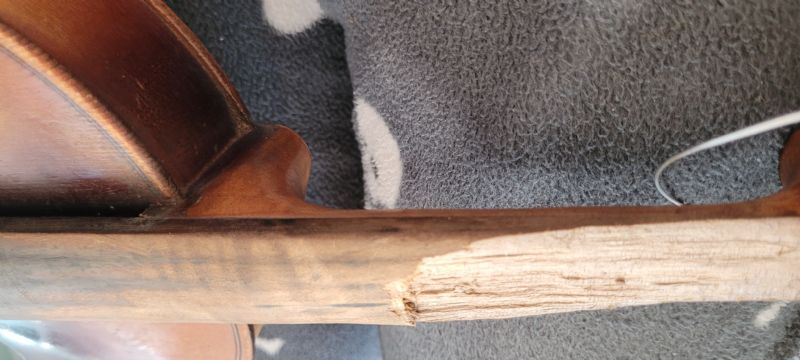
Have an old violin I thought would be an easy fix. Thought "hmmm...just needs a fingerboard" then realized the existing fingerboard is on pretty good. As if not intended to come off. Ran a knife from top and instead of a nice clean removal I have this.
Any suggestions?
Sand it down? File it down? At a loss on next step for this hurdle.
Edited by - Johnny_Mariachi on 02/15/2023 13:06:17
The Violin Beautiful - Posted - 02/15/2023: 16:04:54
quote:
Originally posted by Johnny_MariachiHi all,
Have an old violin I thought would be an easy fix. Thought "hmmm...just needs a fingerboard" then realized the existing fingerboard is on pretty good. As if not intended to come off. Ran a knife from top and instead of a nice clean removal I have this.
Any suggestions?
Sand it down? File it down? At a loss on next step for this hurdle.
You need a good opening knife, a solvent, and patience for the job.
See if you can still find a way into the glue seam from the top. If not, you can try hot water on the seam to loosen it, which might allow the blade to start separating the board. From the way it split, you're using too much force, especially for one of those non-ebony fingerboards. Let the solvent do its work so that the knife isn't going to cut through the wood. Just work a few millimeters at a time and it should come loose. Often once you start to make progress it goes very quickly. Alcohol can be used for this, but you really need to be careful to avoid it running onto the varnish.
Once the board is off, make sure the neck surface is properly cleaned off and flattened before making your new fingerboard. Also if going from the top isn't working, you can try working up from the bottom. Just be very careful not to mar the neck and work slowly to avoid any splitting.
If it's on with hide glue it shouldn't be very difficult. If it's some other adhesive it may be quite a lot harder.
Planing it off could be an option as long as you're careful not to take anything out of the neck.
Edited by - The Violin Beautiful on 02/15/2023 16:10:48
KCFiddles - Posted - 02/15/2023: 19:38:14
This takes a little attention. The production shop I used to work for used fish glue, and even with the usual tricks, that stuff was tough to undo, especially when it was fairly new! When a fingerboard needed replacement, I would slip a piece of wood in front of the neck heel to protect the violin body, cut off the "free" part of the fingerboard, and then plane the rest down to almost paper thin, and clean the rest up with a scraper. Goes much faster than one might think, if you have a good way to hold the fiddle, and a good, sharp plane. It's less than six
inches.
FiddleDoug - Posted - 02/17/2023: 12:54:48
I'll second planing it down! You'll need a properly sharpened plane, and the skill to do it. Keep in mind that replacement fingerboards are sold as BLANKS! They have to be final shaped and fitted. Of course you realize that a new fingerboard will also require a new nut, and a new bridge, which are also sold as blanks, and need to be shaped and fitted.
KCFiddles - Posted - 02/18/2023: 11:57:15
quote:
Originally posted by FiddleDougI'll second planing it down! You'll need a properly sharpened plane, and the skill to do it. Keep in mind that replacement fingerboards are sold as BLANKS! They have to be final shaped and fitted. Of course you realize that a new fingerboard will also require a new nut, and a new bridge, which are also sold as blanks, and need to be shaped and fitted.
It's hard to know where to stop when saying things that might seem obvious to others. In fact, making a new fingerboard right, and fitting it, is a time consuming PITA, even if you have all the right tools and fixtures. And skills. It's no wonder most midwestern shops charge around $400 for the job! Twice that on the coast.
Zachary Hoyt - Posted - 02/20/2023: 13:42:33
If you have a stationary belt sander like a 4x36 or bigger and a steady hand you can use that to remove the part of the fingerboard that is glued to the neck. It's easy to get in a big mess in a hurry with this approach too, so I'm not necessarily recommending it, but it's a quick way to get rid of most of the wood that is in your way.
FiddleDoug - Posted - 02/21/2023: 14:11:51
I wouldn't use a belt sander! Too easy to slip and get the sanding into part of the neck.
boxbow - Posted - 02/21/2023: 14:38:46
quote:
Originally posted by FiddleDougI wouldn't use a belt sander! Too easy to slip and get the sanding into part of the neck.
It also launches a lot of powdered ebony into the air and thence straight to the lungs and sinuses. Even with dust extraction.
Edited by - boxbow on 02/21/2023 14:39:54
KCFiddles - Posted - 02/23/2023: 07:49:23
I've got both a stationary belt sander and well-tuned planes, and plane is by far my first choice for this job if an opening knife won't get the job done.
Terms of Use | Privacy Policy | Privacy Consent (EU/GDPR Only)
Copyright 2026 Fiddle Hangout. All Rights Reserved.