
DVD-quality lessons (including tabs/sheet music) available for immediate viewing on any device.
Take your playing to the next level with the help of a local or online fiddle teacher.
Monthly newsletter includes free lessons, favorite member content, fiddle news and more.
Premier Sponsors


|
Please note this is an archived topic, so it is locked and unable to be replied to. You may, however, start a new topic and refer to this topic with a link: http://www.fiddlehangout.com/archive/46193/2
Page: 1 2
ChickenMan - Posted - 04/18/2017: 18:52:33
I know a few songs in minor keys, notably Pink Floyd's The Wall, but the vast majority of TUNES I play are in major keys or modes. Irish trad has a goodly number of minor mode tunes.
pete_fiddle - Posted - 04/18/2017: 23:33:38
quote:
Originally posted by Lonesome Fiddler
quote:
Originally posted by pete_fiddle
Say your'e humming the note C, how many different scales/modes would that give you to figure your way through?
When you walk into a jam, chances are decent they ain't playing Bartok, Schoenberg John Coltrane or Bulgarian folk tunes. If it's old time, bluegrass or Irish, you have a better than even chance that the tunes will be in a straight-up major key, with the occasional foray into something minor or mildly modal.
On a totally unrelated note, yeah I do sometimes find it hard to suss out the tonic at jams. It's largely because jammers sometimes mush a tune into nothing more than a succession of notes, with no sense of phrasing. I just can't discern where the heck the melody begins. Even if the tune is familiar to me, I can't recognize it.
i reckon a good 50% of Irish tunes i play (and hear at sessions) are modal, And the BG tunes i have attempted...well i dont think simple would describe them (maybe they are Newgrass rather than Bluegrass?) and there are a fair few Jazz sessions around that probably use Bartok and Schoenberg as influences, and Eastern European Stuff isn't hard to find around here...... but i dont know of any specific OT sessions locally sometimes they get played at Irishy Celtic sessions, i would say French Canadian tunes get played more, the OT seems to be played mostly by Appalachian dance bands with button accordion...so that would narrow the key choices down a bit
gapbob - Posted - 04/19/2017: 19:31:12
When I sit in a jam, for normal tunes I don't know, it takes me about two or three times through the tune to "get it", say about 95%, if the notes are in g d a; maybe three or four times if the notes are in C, if F, E;, Bb, B, Eb maybe five times, but probably still could not tell you the key or the chords. By mentioning those keys I include the related modes and scales. It is more about ease in finding the notes.
pete_fiddle - Posted - 04/20/2017: 00:13:54
with BG and Jazz (and a very few non Modal Trad/crossover tunes)i like to go for the chords first, this gives me the home key, cadences, and key changes etc, then i go for the scales that overlay them,and maybe if i'm feeling confident enough, make some small chord changes along with related scales/modes..then take a deap breath....gulp...and try a Break when it comes around...or maybe just shake my head and tell the others i haven't got it yet... then if i like the tune enough, i'll go home and learn the melody/chords properly, if i can find a good transcription i'll use it, failing that i get a nice version from the internet and transcribe it myself.. then go back to the next jam/session and try it again
with Irish, OT, Canadian fiddle tunes etc, i just have to learn them before i go and hope i've got the key right or i'll be playing them solo... unless there are accompanists there who know what they are doing ....or players who can transpose a tricksy tune on the fly, not many of those about in my experience,and they are usually excellent sight readers and have the dots to hand... (green with envy)
Gareth Bjaaland - Posted - 05/02/2017: 19:20:27
Simply find which note is most in harmony with the tune and it'll be the root or fifth of the key.
pete_fiddle - Posted - 05/03/2017: 00:54:29
quote:
Originally posted by Gareth Bjaaland
Simply find which note is most in harmony with the tune and it'll be the root or fifth of the key.
Respectfully
Not necessarily imo, it could be a drone or tonal centre that has no relation to the "key signiture as written" or the chords/harmonies used with the melody, but i think you are right in thinking that it would probably be a root or a fifth (and sometimes a third) that most folk would gravitate to, probably dependant on the range of their voice/instrument, and cultural preferences etc, for instance the old "O'Neill's music of Ireland" has key sigs that bear no relation to the harmonies, they simply tell you what notes are likely to be sharpened/flattened, and you could probably put a D drone(and by default an A 5th) to some of the tunes written in the key of C for example
Edited by - pete_fiddle on 05/03/2017 01:04:57
buckhenry - Posted - 05/03/2017: 03:25:26
quote:
Originally posted by pete_fiddleand you could probably put a D drone(and by default an A 5th) to some of the tunes written in the key of C for example
You are joking around aren't you....? How does a D drone harmonize with the tonic chord of C....Because if the tune is written in C it will have the notes C E ( or Eb ) G...If the tune doesn't use these notes then it is not in C......?
To find the key you need get practicing listening to tunes and finding the tonic note, no matter what type of scale or mode, there will always be a ''key note''....
Find it by humming or use your instrument, when you find this ''key note'' you then need to determine the type of scale/mode it is, simply by playing up the scale and listening very carefully as you go that each note is in harmony.... If you can find the key note then you can hear that the other notes in the key are also in harmony ........
Dick Hauser - Posted - 05/03/2017: 07:09:11
Unless the tune title/key are announced, there will always be problems determining which key is being played. Sometime you can't see the guitarists hands, etc.. The first chord in a tune may not be for the key the tune is played. For example, a tune may be in the key of "G" but start out with a "C" chord. If you go to a jam on a regular basis, you will eventually become familiar with the keys tunes are played in. Playing backup forces you to work harder on learning chord progressions for tunes. Lots of tunes are almost always played in a certain key.
pete_fiddle - Posted - 05/03/2017: 10:40:35
the thing is that a lot of tunes just defy thinking in major key "triads" or 7th chords(major minor or diminished) they depend on Diads or just plain 4ths 5ths,unisons, blue notes,and tension and resolution that fly in the face of conventional music theory, and "Shave and a hair cut" "Amen" cadences, so sing your "Key note" or 5th, but study your genre/context, and your tunes well imo
@ Henry......."How does a D drone harmonize with the tonic chord of C" .... C Maj/D (bass)......... i'm sure it must have been used before...if it hasn't it would be a small miracle
buckhenry - Posted - 05/03/2017: 14:25:14
quote:
Originally posted by pete_fiddle
the thing is that a lot of tunes just defy thinking in major key "triads" or 7th chords(major minor or diminished)
Name some tunes so we can study them.....
blue notes,
Flatten thirds or sevenths...minor sales or minor modes...
and tension and resolution that fly in the face of conventional music theory, and
"Shave and a hair cut"
Perfect cadence....V-I
"Amen" cadences,
Plagal cadence....IV - I
so sing your "Key note" or 5th, but study your genre/context, and your tunes well imo
One can not study every tune, thus if you can not hear the tonic dont go out jamming.....
@ Henry......."How does a D drone harmonize with the tonic chord of C" .... C Maj/D (bass)......... i'm sure it must have been used before...if it hasn't it would be a small miracle
I've been going out for years jamming to tunes I never heard before, I am yet to hear a tune with 9th degree as a drone, but I will keep my ears open because that will be a small miracle.........
fujers - Posted - 05/03/2017: 17:55:46
Henry......."How does a D drone harmonize with the tonic chord of C" .... C Maj/D (bass)......... i'm sure it must have been used before...if it hasn't it would be a small miracle.
Well I for one can't do that I don't think anyone could unless they are a genios..but, can it be done hitting a triple stop. If you think so give me the notes you have to hit and I'll try it. Jerry
fujers - Posted - 05/03/2017: 18:11:02
Now a Cmaj already has a D in it right. So all I have to do is hit 2 of the other notes in the scale C, D, E, F, G, A, Right. Got to think about this
fujers - Posted - 05/03/2017: 20:34:26
Ok haven't figured out the Cmaj over or under D triple stop yet but sure it might be able to be done..or a least I think so.
To me at least playing triple stops is a pretty good thing to learn. But what if you add one more string to the equation..what would that sound like
A quad stop. A quad stop is where you play all four strings at one time and man are they a beast to hit..I'd rather change a grown gorillas diaper than to play these things
I usally play this type of thing in strait tuning but here I play it in cross tuned to DADA...don't ask me why. Jerry
buckhenry - Posted - 05/04/2017: 00:16:53
Ha Ha, Jerry, another comical MP3....Thanks for the laughs. Hey listen we are not talking about quadstops, we're talking ''drones''....
Pete reckons you can play ( a melody ) in the chord of C with a D drone ( long sustained note in the bass ).........
Can you post something and make it sound harmonized....?
Anyway, I don't know about the flatten bridge, but when you play quads on a classical bridge you play the lower strings just before you roll the bow over and play the higher two and they are sustained as long as required.
Edited by - buckhenry on 05/04/2017 00:18:05
buckhenry - Posted - 05/04/2017: 02:40:03
Hey Jerry, these are real quads. Can you play them in all the chords indicated...?
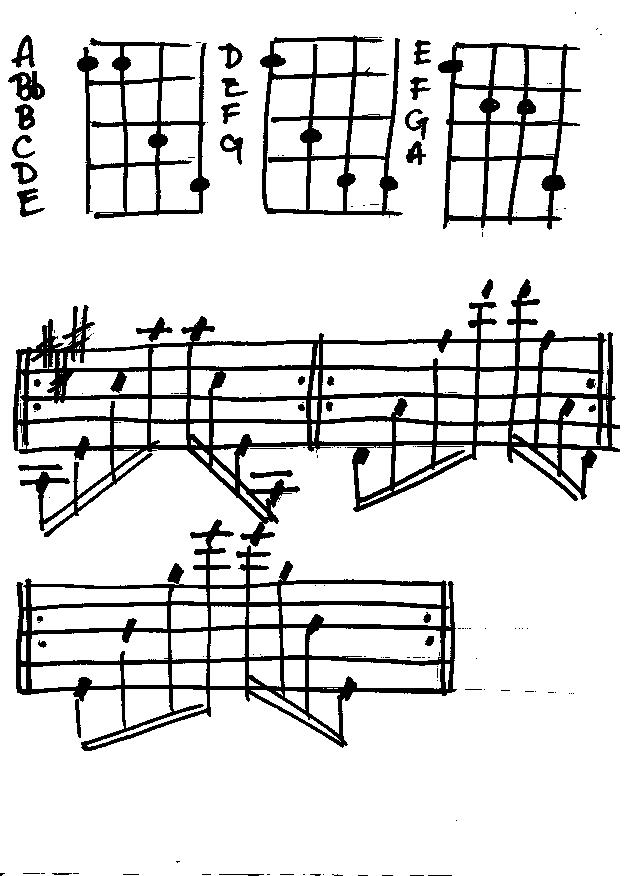
pete_fiddle - Posted - 05/04/2017: 04:56:02
Different granted but not totally alien
D Drone prolly makes F into Dm7?
Edited by - pete_fiddle on 05/04/2017 05:01:48
fujers - Posted - 05/04/2017: 09:11:52
Sorry Henry no I can't its hard enough to play what I played. But I think you may be able to a D drone over a C at the same time in triple stop. Not long lasting or anything but I think It can be done.
Playing a melody it would be a very hard thing to do and I don't think any of us could do such a thing..but watch someone come and show us.
But I think you could sustain a triple long enough to get a fill of what one would sound like. Just let me think. Jerry
Sorry didn't mean to make you laugh...I'll try harder next time..hehehe
fujers - Posted - 05/04/2017: 09:17:15
And Henry you don't know nothing about a flatten bridge because you never tried one...
fujers - Posted - 05/04/2017: 09:50:19
Think I know how you can hit a drone and a C together. Now I haven't tried this yet and don't know if I could do it. Put your second finger on the drone..D on your A and open D right. Next you play a C on your G now play a tripe stop. Honestly, I not sure about playing a medley doing this that way but I guess it could be done but it's going to take a lot of talent to do this in witch I don't have.
It;s because, You don't have a C note readily available anywhere on the neck to hit and you can't hold a triple stop other than your hitting the notes once. Playing a melody I guess might be able to be done but's going to take some know how. So I guess, You may be able to it...yes I think so. Jerry.
DougD - Posted - 05/04/2017: 10:25:49
If you really wanted to do this, you could try this:
G string fourth finger - D
D string third finger - G
A string second finger - C
E string open - E
That's a C chord, second inversion, with a D bass. I don't know how you could play much else while doing this though.
An easier method would be to use "Bonaparte's Retreat" tuning (Ddad) except tune the three upper strings down a full step to Dcgc (or even leave the first string as E for a full triad). Then you could really go to town and no doubt make some of the ugliest music ever heard! "Modern" though.
fujers - Posted - 05/04/2017: 12:30:01
Doug, I think we are talking bout straight tuning with a D drone hitting a C under neith. The only way I can see this done is hitting a tripe stop witch I can do but with the note displacement it would be very hard.
Willing to try but don't expect much. Jerry
Mojohand40 - Posted - 05/04/2017: 13:02:28
quote:
Originally posted by Chops Chomper....
A quad stop. A quad stop is where you play all four strings at one time and man are they a beast to hit..I'd rather change a grown gorillas diaper than to play these things
I usally play this type of thing in strait tuning but here I play it in cross tuned to DADA...don't ask me why. Jerry ....
Check out: youtu.be/Q_YISCe-EDg at around the :58 secs mark. This is the easy way to hit a quad.
as for the rest of this thread...If I am at a jam, and if they call a tune I never heard or knew, and they don't announce the key, ...I simply ask. Seriously...the original post was about participating in a jam and determining the key....the simplest answer..just ask. I've never been in a jam, where myself or someone else couldn't just ask. Usually it's never an issue, and if I was at a jam where it was...I would probably just leave.
lol...
Edited by - Mojohand40 on 05/04/2017 13:04:55
fujers - Posted - 05/04/2017: 13:29:03
Yeah Mojo, That is the easiest way to play a quad. Some time ago I used to play this once in a while but time take a toll on you. Thanks for posting
fujers - Posted - 05/04/2017: 13:51:52
Yep, The D drone over C can be played..But I don't that that was the original topic was it. But they can be played straight playing a triple stop
Edited by - fujers on 05/04/2017 13:53:43
buckhenry - Posted - 05/04/2017: 13:56:47
quote:
Originally posted by Mojohand40
where myself or someone else couldn't just ask. Usually it's never an issue, and if I was at a jam where it was...I would probably just leave.
lol...
LOL.............The whole point of not asking is to challenge your self and open your ears.........LOL
buckhenry - Posted - 05/04/2017: 14:03:13
quote:
Originally posted by pete_fiddle
Different granted but not totally alien
D Drone prolly makes F into Dm7?
Yes the D drone fits here nicely......thats because the the tune is in D......? And, you can easily hear the tonic note......
fujers - Posted - 05/04/2017: 14:12:59
Note really Henry, How would you play a Dmaj drone against the Cmaj note on the bottom. I guess this what this topic is a about..or did I get to far far ahead of my self
Edited by - fujers on 05/04/2017 14:15:48
buckhenry - Posted - 05/04/2017: 14:18:03
Egads........This thread has gone off topic.....????
Jerry.....Play a D DRONE on another instrument, or record a sustained D note and then play a tune in C..
buckhenry - Posted - 05/04/2017: 14:23:01
quote:
Originally posted by Chops Chomper
No you said a D drone and a C together
A drone is a SUSTAINED note....like on the bagpipes.....
fujers - Posted - 05/04/2017: 14:25:39
Henry did you realize we are talking on two threads I would like to keep this on Sound off if you don't mind. How do bagpipes work..do they play two or one note at a times
pete_fiddle - Posted - 05/04/2017: 23:27:10
Think i get you now Henry, (just trying to work out our differences), are you calling all the notes between say D1 & D2 (D chromatic) Key of D ?,.......... i just call D Ionian (D major), the Key of D, and D Dorian, ( Which i think is outlined by the C triad, the F triad, and the D drone on that recording), i would say had the Key Note of D or the Tone centre or Tonic Note of D, and was the 2nd mode in the Key of C Major ,which is where i am building the triads from, and where i would take my basic modes from to improvise etc with....
From my yet unwritten book "Music Theory According To Pete" 
ps:
a similar scenario happens when folk write modal music down, i think some write everything with the key sig of C or Amin and add accidentals, and others would write with the key signature of the Key note and indicate which notes are "naturalled" in the key signature, and others would indicate the mode by naming it (as in the Fiddlers fake book) yet others just plain get it wrong for modern players/readers as in the old Oneill's book which i think had to be reinterpreted by Matt Cranitch for folk to understand better
buckhenry - Posted - 05/05/2017: 00:09:10
The way I see it D dorian and C ionian are different keys each having their own tonic, but they still both have the same pitches.
And the tonic of the key is what you listen for and then build the rest of the scale from the other notes that are represented in the tune....
pete_fiddle - Posted - 05/05/2017: 23:33:51
i differentiate between Keys and Modes, Keys to me are either major or minor, and have a key signature, Modes to me are scales that start on different degrees of the Key indicated in the Key Signature
Don't know if that's right but thats how i taught myself to think of it
buckhenry - Posted - 05/05/2017: 23:46:20
Every key, scale and mode has a home note, finding that home note is the best way to find which key, scale and mode a tune is in, if you are too shy to ask.....
pete_fiddle - Posted - 06/04/2017: 14:34:17
sooo... the answer to the OP is:
1: find the "Home note"..... (this may be the first note or the fifth note of the scale key or or mode)
2: determine if you have the 5th or the 1st of the key scale or mode (or indeed any other interval)
3: figure out the rest of the notes in the key scale or mode
4: listen for any modulations or changes of mode, repeat steps 1,2 &3,and note where they are in the musical form
5: jam along
alternatively... ask another player who may, or may not be able to tell you, and try to figure the tune out from there.
or .....learn the dots by heart, along with composition/ improvisation skills, music analysis, and transposing on the fly.
or..... learn ear training, music theory, genre specifics etc, and figure it out.
or .....just play along best you can and learn from experience and a smattering of all the above ....(that's what i try to do with varying degrees of success) :o)
buckhenry - Posted - 06/04/2017: 23:26:57
quote:
Originally posted by pete_fiddle
or .....just play along best you can and learn from experience and a smattering of all the above ....(that's what i try to do with varying degrees of success) :o)
This is what you do to find out where your weaknesses are, thus you prioritize and do some detailed work on those skills...
Page: 1 2
Terms of Use | Privacy Policy | Privacy Consent (EU/GDPR Only)
Copyright 2026 Fiddle Hangout. All Rights Reserved.


