
DVD-quality lessons (including tabs/sheet music) available for immediate viewing on any device.
Take your playing to the next level with the help of a local or online fiddle teacher.
Monthly newsletter includes free lessons, favorite member content, fiddle news and more.
Premier Sponsors


|
Please note this is an archived topic, so it is locked and unable to be replied to. You may, however, start a new topic and refer to this topic with a link: http://www.fiddlehangout.com/archive/35399
JanetB - Posted - 11/02/2013: 10:54:03
As I researched last week's TOTW, Rebels Raid, for Banjo Hangout it was suggested I contact Jeff Titon to clarify something in his book, Old-Time Kentucky Fiddle Tunes. In doing so he gave me a link to a keynote address he delivered which includes the following beautiful paintings of William Sydney Mount (1807 - 1868). I was only familiar with the famous one called "The Banjo Player." Here's the link for his entire essay http://folkloreforum.net/2012/06/28/music-mediation-sustainability-a-case-study-on-the-banjo/#more-1147 .
Below are the paintings by William Sydney Mount with Jeff Titon's commentary. The subject of his long essay is the banjo as a mediator within and between cultures. Being a cultural anthropology major I appreciate his thinking (though I'd rather be picking than reading these days). Titon is writing here about the interchange between the black and white culture documented by Mount's paintings.
I looked up a bit about the painter and found out he also composed tunes, played on fiddle if you go to the song links included in this link about Mount's life: http://www.3villagecsd.k12.ny.us/Elementary/minnesauke/3villagehist/WlliamSidneyMount.htm I'd like to learn more about this incredible painter, so feel free to add to this thread and help me out.

Figure 1. Photograph of William Sidney Mount. 1867. Photographer unknown.
"One of the least known aspects of that earliest interchange is that which took place in the northern United States. We are fortunate that a skilled American genre painter, William Sidney Mount (1807-1868), documented it in his native area, eastern Long Island, not far from New York City. I became aware of Mount’s paintings when writing my dissertation on blues in 1970.3 Mount also was an accomplished amateur fiddler. His brother Robert Nelson Mount was an itinerant dancing master who played the fiddle to provide music for the dances he taught. Nelson, as his brother addressed him, spent much of his time traveling in the South. In Just in Tune(1849)

Figure 2. William Sidney Mount, Just in Tune. 1849. Oil on canvas, 30” x 25”.
a man resembling Nelson4 is pictured turning a peg to put the fiddle in tune, while the fiddle itself is rendered with unusual accuracy, even to the flame on the maple sides.5 William Sidney Mount’s letters to his brother in the South included fiddle tunes in musical notation, some of which he had learned from local fiddlers in and around his residence in Setauket, Long Island. Altogether William Sidney Mount notated a few hundred of them, chiefly for his own use, and appears to have spent almost as much time each day fiddling as painting.6
Besides representing tunes, Mount represented the Black-white musical interchange in nineteenth century genre paintings without peer or parallel. He portrayed the Black-white musical interchange taking place in Long Island, New York and, we can say with some certainty, one that was occurring in many other places. Although Mount meant to include humor and sentiment in his genre paintings, for the music historian Mount documented the music and dance of his time as no other painter did. He did not succumb to the minstrel stereotype in drawing and painting African Americans; and what is more, partly because he himself was a musician, he took care to illustrate the instruments, the playing positions, and the dancing accurately. Figure 3 shows William Sidney Mount’s 1855 painting of a left-handed, African American fiddler, his facial features an emblem of the Black-white musical interchange. The title is a play on words: “left and right” is a dance call, while the fiddler is left-handed. (Contemporary lithographic reproductions of this painting showed it, incorrectly, as a mirror image.)

Figure 3. William Sidney Mount, Right and Left. 1850. Oil on canvas, 30” x 25”.
Both Just in Tune and Right and Left were part of a series of paintings commissioned for lithographs by the Paris firm, Goupil, Vibert and Co. Minstrel shows enjoyed great popularity in Europe as well as North America in the 1840s and 1850s, and in Mount Goupil had a willing and knowledgeable artist to depict musicians. The correspondence between Mount and William Schaus, Goupil’s American representative, reveals they thought of Black and white fiddlers both as interchangeable and, notably, that two paintings, one of each, would be “companions.” Mount wrote to Schaus, “Do you wish a negro man, or a white man as a companion to the picture ‘Just in Tune?’”7 Schaus replied “I think a Negro would be a good companion to ‘Just in Tune’ . . . . You have probably already an Idea what you intend to make the Companion and I hope you will finish it soon.”8 Another in this series for Goupil was The Bone Player (1856, fig. 4), while the best known of these today is The Banjo Player(1856; fig. 13), which I will discuss shortly. Interestingly, Mount never painted a minstrel show; his paintings show music in barn dances, taverns, homes, and in moments of apprenticeship or practice as well as in informal, community performance for dancers and listeners.

Figure 4. William Sidney Mount, The Bone Player. 1856. Oil on canvas, 36” x 29”.
Mount understood a good deal about music and dancing. Figure 5 shows an early painting of a solo dancer, dancing to the rhythm of hand-clapping and, possibly, a tune sung by the clapper. The crowd around the dancer is white, but a Black man looks on at the far right, taking it all in. Old-time Kentucky fiddler Manon Campbell learned tunes from his mother’s sister, who did not play the fiddle but who whistled the tunes to her son.9

Figure 5. William Sidney Mount, The Breakdown. 1835. Oil on canvas, 22’ x 27”.
In the days before recordings this was not uncommon. In Mount’s 1866 painting, Catching the Tune, a fiddler is shown learning the tune from a man whistling it.

Figure 6. William Sidney Mount, Catching the Tune. 1866. Oil on canvas, 22” x 27”.
A close look at the violin reveals that it has no corners. Fourteen years earlier, Mount had invented and patented a hollow-backed, cornerless violin, which he called “The Cradle of Harmony.”

Figure 7. “The Cradle of Harmony,” the cornerless violin that Mount invented and patented in 1852. Two of Mount’s hand-written transcriptions of fiddle tunes are at the right of the violin.
In his diary Mount names the tune “caught” in his painting (fig. 6) as “Possum Up a Gum Tree,” a title known today and attached to more than one distinct tune in the South and Midwest. All three men as well as the women onlookers are white. A study sketch that Mount did for this painting is notable. The musicians’ faces show a subtle increase in African features as the eye moves from the one on the right to the one on the left.

Figure 8. William Sidney Mount, study for Catching the Tune. Pencil sketch, 1865.
This progression tropes the Black-white musical interchange: the source of the tune is shown on a continuum of racial features that deconstructs the categories black and white.
One of Mount’s justly celebrated paintings, from 1847, is entitled The Power of Music10and shows an African American worker with his axe and molasses jug outside a barn, likely having stopped by after work, listening to a white fiddler playing for two appreciative older men. The barn, which Mount depicted in a number of paintings, belonged to his friend and neighbor Shepard S. Jones, a skilled local fiddler for whom Mount composed a hornpipe.

Figure 9. William Sidney Mount, The Power of Music. 1847. Oil on canvas, 17” x 21”.
The models for this painting were identified in a biographical sketch of the artist: the fiddler is the teenager John Henry Mount, son of William’s older brother Henry Mount; the seated man is Caleb Mills; the standing man (who may be dancing) is Dick Ruland; the Black man is Robin Mills.11 The shared surname opens the possibility that prior to manumission Robin was owned by Caleb’s family.
The Black man’s appearance in The Power of Music is arresting. Handsome and sympathetically drawn, his character is related to but also transcends then-contemporary images of contented, older Black men on southern plantations. Hidden from those inside the barn, he is listening, “catching the tune.” His left hand is cupped very like the fiddler’s left hand, showing that they share the music; coupled with his attentive and approving attitude, it even suggests the possibility that he has mentored the young fiddler.12
In an 1845 painting entitled Dance of the Haymakers, the African American youngster outside the same barn keeps time with percussion sticks while the white fiddler plays and the two men dance.

Figure 10. William Sidney Mount, Dance of the Haymakers. 1845. Oil on canvas, 25” x 30”.
The model for the fiddler was Shepard S. Jones, while others have been provisionally identified as follows: the Black youth playing the sticks is Mathias, Jones’s apprentice; the dancer on the right is Wesley Ruland; the dancer on the left is Tom Briggs; and the man behind the fiddler is Horace Newton, a wheelwright from Stony Brook (Cassedy and Schrott 1983:66). Among the onlookers is a girl in the hayloft, likely the “nurse” of the white child also looking on from the hayloft. About 1845 Mount made a fascinating study sketch for both this painting and the later The Power of Music. The sketch for Power (top) depicts not Caleb Mills but a white listener outside the barn; the sketch for Dance (below) depicts a Black man dancing outside the barn, not the Black youngster playing percussion. Musicologist Christopher J. Smith, who is at work on a study of Mount’s paintings, has pointed out that the substitution of Mills in Power for the sketch of the white man is evidence of the Black-white musical interchange.13 That Mount could so easily interchange the two outside the same barn is telling.

Figure 11. William Sidney Mount, Sketch for The Power of Music and Dance of the Haymakers, c. 1845.
Mount painted Black fiddlers playing for white dancers, a customary practice in the late 18th and early 19th centuries. Other Black figures in his paintings were onlookers, although in The Power of Music the onlooker is the center of attention, and in Dance of the Haymakersthe youngster, although separated from the others, is participating in the music; his sounds must be audible along with the rest. However, Mount did sketch a Black fiddler and dancer together. Here is an undated drawing that shows a fiddler and dancer inside an unpretentious kitchen. Like most of Mount’s sketches, it is a rough rendering of an idea; it is meant to capture gesture.

Figure 12. William Sidney Mount, sketch of Black fiddler and dancer in a kitchen. Pencil sketch, undated. 6 ¼” x 4 ¾”. In possession of the author.
Yet there is enough detail to make the figures recognizably Black, not simply poor as the clothing and room interior also indicate. It is a more intimate and private scene than Mount usually painted, and it probably is a documentary sketch (Mount made many) rather than a preliminary for a painting. If Mount did paint this scene, the painting does not survive.
In 1855 and 1856 Mount painted banjo players. His 1856 portrait of a Black banjo player, for the Goupil lithograph series, has become iconic. The banjo itself is so accurately rendered that its maker, William Esperance Boucher, Jr., can be identified.

Figure 13. William Sidney Mount, The Banjo Player. 1856. Oil on canvas, 36” x 29”.
The banjo player himself has been identified provisionally as George Freeman, who was bound out (from his family) as a servant to Robert Nelson Mount’s father-in-law (Cassedy and Schrott 1983:73). The playing technique is also recognizable in that the thumb rests on the drone string while the first finger plucks upward or downward on the melody strings and the hand itself has the characteristic “clawhammer” shape of the old-time nineteenth century stroke-style playing. The right or noting hand would be forming a D chord if the banjo were in G tuning (gDGBD). Mount may not have played the banjo himself, but he was a close observer of banjo technique.
Mount’s paintings commissioned for lithographic reproduction were called “fancy pictures,” “portrayals from the artist’s imagination rather than actual portraits” (Cassedy and Schrott 1983:20). Yet Mount’s fiddler in Just in Tune looks very like his brother Nelson, while George Freeman was said to have sat as a model for Mount twice a day for eight days (Ibid.:73). Although the musicians may have been understood as types arising from the artist’s fancy or imagination, Mount employed musicians as models and just as his fiddler was based on Nelson, it is possible, even likely, that George Freeman was a banjo player. The principal difference in Mount’s “fancy pictures” was not in the modeling or intended documentation, but in that these were not “actual portraits” commissioned by and for the individuals painted.

Figure 14. William Sidney Mount, The Banjo Player in the Barn. C. 1855. Oil on canvas, 25” x 30”
Ironically, George Freeman’s image is familiar today as an historical illustration of the banjo. The painter, the model, and the original context all have been subjected to erasure. Mount had also painted a white banjo player a year earlier, in the same barn he used for Dance of the Haymakers, Dancing on the Barn Floor, and The Power of Music. The painting was found among his possessions at his death in 1868, leading critics to believe that it was unfinished and that he intended to populate the painted barn more fully but never got around to it. Two additional figures were found chalked in, inside the barn, which Mount presumably would have painted in over the background. We do not know just why Mount set it aside but kept it as found. Possibly he did not have a buyer for it; probably he meant to finish it.14
The chalked-in figures were erased after his death, leaving the painting as we see it now. The young man playing the banjo looks cheerful and confident. He is well dressed in rural finery, not farming clothes. In Mount’s other paintings of music-making in this barn (Dancing on the Barn Floor, Dance of the Haymakers, and The Power of Music) all the hay is in storage; here, there is some still on the barn floor. The only prop in the painting, aside from the banjo and the barrel the man sits on, is the pitchfork, ready for use in throwing the rest of the hay, though where it would go is uncertain.
Taking the painting as it is, not as it might have been, and comparing it with the iconic image of the Black banjo player, it is striking that the man the barn is small and very much alone. He is playing for his own amusement, or practicing. The young Black banjo player is extroverted and, possibly, performing for an audience. His is one of the most finely-made and best-sounding banjos of the period."
amwildman - Posted - 11/02/2013: 12:17:12
Very nice. I sure hope the author approves of it being reposted here. Between this and the Fiddler's Bridge from another thread, I've got my fiddle history fix for quite awhile.
JanetB - Posted - 11/02/2013: 14:24:28
quote:
Originally posted by amwildman
Very nice. I sure hope the author approves of it being reposted here. Between this and the Fiddler's Bridge from another thread, I've got my fiddle history fix for quite awhile.
Thanks for the reminder about permission to share. I emailed Jeff, also asking him about Creolization of America, which one of the fiddlers suggested I look up on Facebook, but had trouble finding it. Jeff wrote back right:
withnall - Posted - 11/02/2013: 14:39:49
Wow, I'm not getting anything productive done for the rest of today then am I!
eric marten - Posted - 11/02/2013: 15:36:07
William Sidney Mount's music comes to life 10 months a year, at Old Bethpage Village Restoration near where Mount lived on Long Island, a 200 acre living history village including 3 farms, an Inn, blacksmith, schoolhouse, etc.- all original buildings from the 19th century. We have four period violins, all set up mid-19th century with gut strings. All of the tunes played at the village are from the William Sidney Mount Music Collection (over 500 tunes) including many of the standards, and some very local tunes (i.e.. Stony Brook Hornpipe). I have four young apprentices performing with me on these instruments, One interesting note: the tuning preferred by many Old Time fiddlers for the key of D, (EADA) was mentioned by William's brother, Robert Nelson Mount, staying in Georgia at the time. He said William should raise the bass string up one tone (to A) to get that "Negro touch".
ironworker - Posted - 11/02/2013: 15:43:28
that was me, Janet, and i'm glad that you were able to find Christopher's book. A work of art and love, for sure.
I didn't know that Mount was included in the Old Bethpage site- another reason to visit. thanks, eric-
michael ford
Bill Shull - Posted - 11/02/2013: 21:35:08
There was a large Mount celebration at Stony Brook several years ago, with a slick cover commemorative publication put out. I think Folkways (or somebody) did an LP of a violinist playing tunes from the Mount Manuscript (Gilbert somebody) that was widely panned for its "non-folk" approach to the music. Mount's manuscript (original at the Museums at Stony Brook), converted to an alternative medium at the personal expense of Alan Buechner, a Professor Emeritus of Music at Queen's College (now deceased), is a collection of over 500 tunes Mount wrote down, taking some from his Long Island surroundings, and others from his brother Robert. Robert had been a traveling dancing/fiddle master traveling down the East coast at least as far as Georgia, playing, dancing, and collecting tunes. Which are which I haven't figured out!
Alfred Frankenstein did the definitive study on Mount, William Sidney Mount (New York: Harry N. Abrams, Inc., 1975.)
Alan and I, with the Missouri State Old Time Fiddlers Association, published a 30 tune sampling of Mount's tunes (re-scored from the sometimes barely legible manuscript) in 1995.
Have fun exploring Mount!
JanetB - Posted - 11/02/2013: 22:20:11
Ah, thank you, Bill. So Mount has been comprehensively studied and his work documented. How does one view the converted manuscript with the 500 tunes? Does the Missouri State Old Time Fiddlers Association have a CD with the 30 tunes? I see that amazon has a CD download by Gilbert Ross called William Sydney Mount, Cradle of Harmony with some of his fiddle tunes. Have you heard of this one?
Edited by - JanetB on 11/02/2013 22:25:52
DougD - Posted - 11/02/2013: 22:32:30
That is the Folkways recording Bill is referring to: folkways.si.edu/gilbert-ross/t...ithsonian Gilbert Ross definitely had a classical approach, but I'd say that its difficult to know what Mount sounded like anyway. At least you can hear some of the tunes from his collection.
Edited by - DougD on 11/02/2013 22:33:21
eric marten - Posted - 11/03/2013: 08:31:32
I had the privilege of working with Alan Buechner, and was part of that celebration of the Mount Music Collection. The program was called "Catching The Tune". I do have and still use that published collection of tunes, signed by Alan, which uses EAEA tuning for one of the tunes "Drunken Scotchman" I believe, so, with this and the Robert Nelson Mount reference to "Negro" tuning, (EADA), we have mid 19th century documentations to the two major cross-tunings still used today by the "Old Timey" fiddlers. I've used the original manuscripts at the Museum., as well as copies, and was able to learn by heart about a hundred or so of the tunes, and still play them regularly at Old Bethpage Village Restoration with my student/apprentices. The Folkways recording, by the way, used modern synthetic strings, not the historically appropriate gut strings - quite a different sound than what would have been heard during the 19th century.
DeamhanFola - Posted - 11/03/2013: 08:53:01
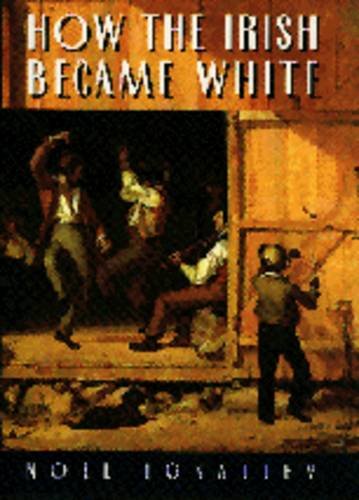
As some of you undoubtedly know, Dance of the Haymakers was used as cover art for Noel Ignatiev's interesting book How the Irish Became White. An excellent read if you are interested in the sorts of cross-cultural issues about which the OP writes, including tensions between Irish nationalists and Irish-Americans (born or naturalized), especially over the issue of slavery. In the 19th century (on both sides of the Atlantic) the Irish were depicted in similarly racialist ways as were African Americans in both print and visual images in some of the leading venues of the day.
Edited by - DeamhanFola on 11/03/2013 09:02:01
JanetB - Posted - 11/03/2013: 13:39:25
Thanks for the link to the Smithsonian Folkways site and the book about the Irish. I've just learned a tune called Boyne River which also has lyrics portraying a historical event where political/religious groups were in conflict. It seems that William Mount didn't focus on conflicts and it's been noted that he didn't portray minstrelsy in his paintings, perhaps avoiding the racial aspect. Did he also perform much?
I still haven't heard if the 500 tunes written and/or collected by Mount are available. The tune Musings of an Old Bachelor--which isn't included in the 30-tune collection "Cradle of Harmony"--would be a fun project for me to learn. Blending my own music with history is the easiest way for me to learn the two.
Bill Shull - Posted - 11/03/2013: 16:15:01
Janet, the "Cradle of Harmony" LP is a separate thing from the tune book Professor Buechner and I put out, which was called "Thirty Fiddle Tunes from the Manuscript Collection of William Sydney Mount." I have the album buried somewhere at home, so I can't check the tune correspondence between the two works right now.
A curator at the Museums at Stony Brook should be able to tell you about the availability of the manuscript. My copy is huge, but if you're really taken up by this subject, I could mail it to you to inspect.
I have a attached a few pages from the tune book which include Professor Buechner's introduction and tune notes.
Eric Marten sounds like he has a terrific handle on the material. I'd like to see if he has found any correspondences between the tunes in the manuscript and modern tune melodies/titles. For example, I feel sure that "Good Morrow to Your Nightcap" is a diminished setting of some Irish tune I've heard.
 Mount Book |
JanetB - Posted - 11/03/2013: 17:08:54
Thanks, Bill. For now I'll be happy with your PDF notes of the tunes and have also ordered the CD with Gilbert Ross' violin, though I think the tunes are different. I'd like to learn one tune Mount composed and can use the link above. This thread has been very informative.
Terms of Use | Privacy Policy | Privacy Consent (EU/GDPR Only)
Copyright 2026 Fiddle Hangout. All Rights Reserved.


