
DVD-quality lessons (including tabs/sheet music) available for immediate viewing on any device.
Take your playing to the next level with the help of a local or online fiddle teacher.
Monthly newsletter includes free lessons, favorite member content, fiddle news and more.
Premier Sponsors


|
Please note this is an archived topic, so it is locked and unable to be replied to. You may, however, start a new topic and refer to this topic with a link: http://www.fiddlehangout.com/archive/34774
alaskafiddler - Posted - 09/06/2013: 15:03:38
Don't know why, but I couldn't get this to post in the other forum asking about tricks.
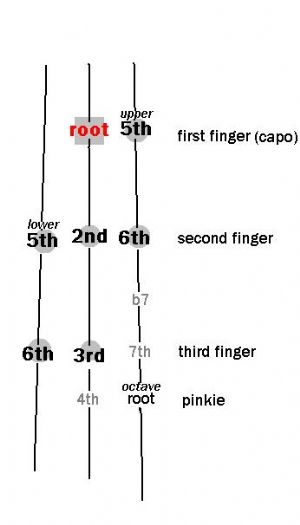
Here is a little chart for when folks mention finger capo, playing pentatonic, and thinking in fingering shape; that can be useful way to learn to play in basic B, Bb, E, F... I only show 3 strings, it will either based on the root finger being on the D string or the A string. Same pattern just moved over a string. I highlighted the main notes (pentatonic) - with these you can play the melody or a basic break in a lot of songs (and will give a foundation which to expand).
alaskafiddler - Posted - 09/06/2013: 15:05:07
(Don't know why but I had to split this into two parts)
The first finger placement is the critical anchor - the root. And the root/fifth combo; the finger capo - unlike the barre on guitar chords (finger laying down flat) - more of placing the finger over both much in the same way a single string; many folks find aiming between the 2 strings easier. It requires a little higher placement as it's not the tip of the finger.
Initially, just focus on the first, second and third fingers - from lower 5th to upper 6th represented by the bolder highlighted spots - you can get by on lots of songs without using the pinkie; Eventually you will want pinkie to give you the fourth and octave - so basic pinkie dexterity is important to playing in these keys. But initially just range of lower 5th to upper 6th.
Might be easier to start with B and/or E (rather than Bb or F) - as the first and second fingers should be familiar placements from other keys (like from D and A) - and all you need to add is a higher third finger placement. Making the lower c, g and d notes (on the G, D and A strings respectively) raised a half step to c#, g# and d#. But as it doesn't rely on any open strings, and the same shape, can start on any root first finger position.
There are some very easy basic doublestops that fall right under these finger placements.
Start with the solid first finger (capo) of root and upper 5th.
3rd and upper 5th (I chord); Lower 6th and root (IV or vi chords) both using the third and first (anchor) fingers
Lower 5th and root (I chord); 2nd and upper 5th (V chord). Both using second and first (anchor) fingers.
Root and upper 6th (IV) First (anchor) and second fingers.
Note all are using the first finger (root or upper 5th) as one of the notes; but will give you a basic I, IV, V and even vi ability. But because of that root/5th can be like the OT playing of one or the other being used as adjacent drone; and that might also help in keeping fingers in tune.
Another trick, if you feel like loosing your tonal root anchor, comes from slightly sliding into the main pitches; which can actually work well to give it a bluesier feel; listen to it against a drone or chord.
There are thousands of OT and BG standards that the melody just need these notes; especially in adding the octave root. While OT tunes (like Angelina Baker) can be good to practice on; for building BG skills you might want to avoid a lot of tunes, or taking a fiddle tune approach; and stick with very simple BG songs. This pentatonic shape lends itself to improvising on those tunes (none of the notes are going to clash horribly, and can easily be played and then shifted to the next pentatonic note. And a big part of playing BG is to not play the straight melody, go off it and improvise.
Here are some songs that have simple melodies, lot's of room to practice the key and improvising.
Will the Circle Be Unbroken; Worried Man; Down in the Willow Garden (Rose Conley); Dreadful Snake; Footprints in the Snow; I Got a Bulldog; Rosalie McFall; Amazing Grace; Nine Pound Hammer; I'll Fly Away; Angel Band; Lonesome Road Blues (going down long lonesome road); Bury Me Beneath the Willow; In the Pines; Little Birdie; Long Black Veil... many many more. Gotta start somewhere, the simple standards, IMO will give a good foundation.
On the chart I also included the 4th and b7 and 7th - those notes are pretty easy to get in; and will expand what you can play by a lot, without really much different fingering complexity.
IMO this closed fingering pentatonic based, (as well as 2 others) can also play a part in the stylistic sound. That is to lower the tuning and play with regular C fingering won't likely give the same overall sound of flow. You would instead play the closed with the first finger C note root on the A string. That is, to really sound like BG, people do care, it does matter, it's not just play the notes of a key, it's how you play the notes. Of course it's okay to play and sing these tunes any way you want, in just common keys.
blgrssr - Posted - 09/06/2013: 16:54:27
that was very interesting and useful. Just what i was looking for. Tx
wooliver - Posted - 09/09/2013: 06:27:42
Don't tet the "jazz" label deter you:
jazzmando.com/ffcp_studies.shtml
I think i posted this before.
One has to adapt this by way of inferred frets, and also one can't but play only two strings at a time on a fiddle.
But as to how the fingerboard is expressed or explained, i found helpful.
Edited by - wooliver on 09/09/2013 06:30:22
blgrssr - Posted - 09/10/2013: 19:13:55
really useful stuff there. I really liked the 4 finger closed position chart.
fiddlebutcher - Posted - 09/10/2013: 21:09:29
quote:
Originally posted by blgrssr
I really liked the 4 finger closed position chart.
Also interesting is that there are only four of these '4 finger' finger patterns, with which all major scales and their modes can be played all over the entire finger board. Eg....1-2-34.....1-23-4....12-3-4, see how the semi-tone is placed between different pairs of fingers until you get the pattern without a semi-tone....1-2-3-4... So, combinations of these patterns apply across all four strings, or five if you have them, and up into the higher positions.
groundhogpeggy - Posted - 09/17/2013: 09:06:14
I need to sit and study this kinda stuff. The more hangin around with BG people I do, the more I need to get outta D, G, and A!
blgrssr - Posted - 09/17/2013: 19:00:39
i am a firm bluegrasser but far prefer "the usual keys". You arent the only one.
martynspeck - Posted - 09/25/2013: 10:48:51
This is great. I posted it to the learning jam technique group.
fiddlehangout.com/group/learningtechnique
Terms of Use | Privacy Policy | Privacy Consent (EU/GDPR Only)
Copyright 2026 Fiddle Hangout. All Rights Reserved.


